Karen Hao Frames AI as Threat to Democracy
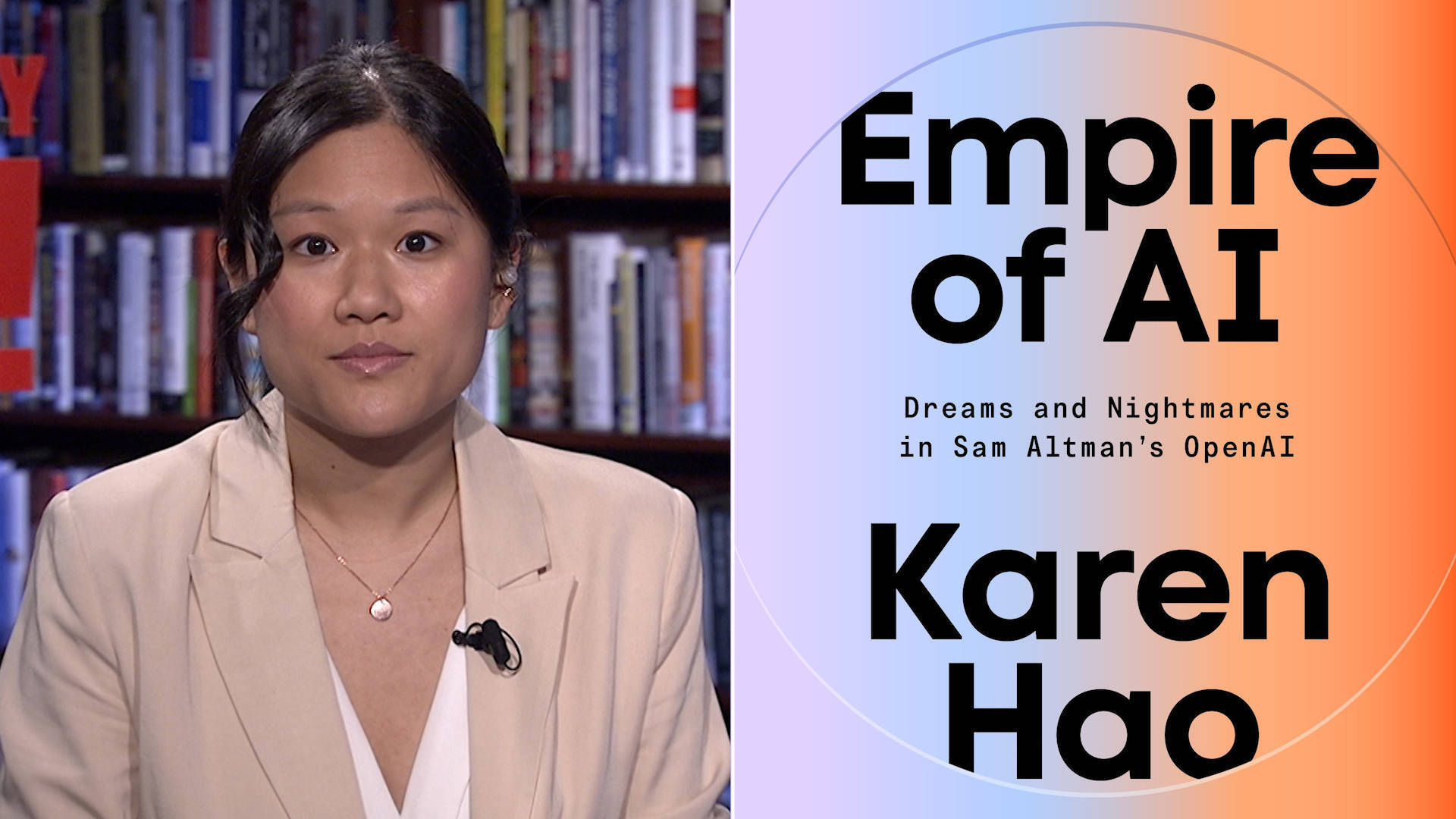
Journalist Karen Hao, in a Democracy Now! interview segment rebroadcast July 3, 2026 as part of a July Fourth special revisiting her 2025 book tour for *Empire of AI*, argued AI's scale-at-all-costs development model amounts to a new colonialism that extracts data, labor, land, energy and water from vulnerable communities worldwide. She cites a McKinsey estimate that AI data centers could add energy demand equal to two to six times California's annual electricity use within five years, a Bloomberg finding that two-thirds of new data centers sit in water-scarce regions, Kenyan content-moderation workers paid a few dollars an hour, and a Chilean community that blocked a Google data center proposed to draw 1,000 times its annual freshwater use. She also raised a 2025 federal bill provision that would have barred U.S. states from regulating AI for a decade - a measure the Senate stripped in a 99-1 vote before the bill became law.
The most concrete, checkable claims in this segment aren't the "colonialism" framing itself but the specific resource and policy facts Hao marshals to support it - a McKinsey energy estimate, a Bloomberg water-siting finding, and a federal provision that would have preempted state AI regulation - each independently relevant to anyone deploying AI infrastructure or tracking AI governance.
What happened
In a Democracy Now! interview segment - part of the network's July 3, 2026 July Fourth special revisiting a 2025 conversation - journalist Karen Hao, author of Empire of AI: Dreams and Nightmares in Sam Altman's OpenAI, told hosts Amy Goodman and Juan Gonzalez that Silicon Valley's AI buildout mirrors historical colonial extraction: "The empires of AI ... seize and extract precious resources to feed their vision of artificial intelligence: the work of artists and writers; the data of countless individuals ... the land, energy, and water required to house and run massive data centers and supercomputers," she writes in the book. Hao, a former Wall Street Journal and MIT Technology Review reporter who leads the Pulitzer Center's AI Spotlight Series for journalists covering AI, pointed to her reporting from Kenya, Chile and Uruguay as evidence.
Industry context
On energy, Hao cites a McKinsey report projecting that AI data center expansion could add as much demand to the global grid within five years as two to six times California's annual electricity consumption, mostly met by fossil fuels, coal-plant life extensions and unlicensed methane turbines. On water, she cites a Bloomberg analysis finding two-thirds of new data centers are sited in water-scarce regions. Her most detailed example: a Chilean community near Santiago that still holds a rare public freshwater right pushed back after Google proposed a data center there that would have drawn roughly 1,000 times the community's annual water use; sustained local activism escalated to Google Chile, Google's Mountain View headquarters and eventually the Chilean government, blocking the project for four to five years and winning a seat at a new roundtable process. On labor, Hao's reporting describes Kenyan contract workers hired by data-annotation firms to label OpenAI's most graphic AI-generated content for a content-moderation filter, paid a few dollars an hour, which she contrasts with the compensation of Silicon Valley-based AI researchers.
Policy context
Hao also flagged a provision in the House-passed version of the 2025 U.S. budget reconciliation bill that would have barred state governments from regulating AI for ten years, opposed even by some Republican supporters of the broader bill, including Rep. Marjorie Taylor Greene, who said she had not known the provision was included when she voted for it. The Senate ultimately stripped the AI moratorium from the bill in a near-unanimous 99-1 vote on July 1, 2025, so it did not become law - though Hao's broader argument, that major AI developers are actively working to insulate themselves from state-level oversight, remains a live debate, since similar federal preemption proposals have continued to surface since.
For practitioners
Teams building or procuring AI infrastructure should treat community water and energy impact as a live commercial and reputational risk, not a hypothetical one: the Chilean dispute shows a single contested data center site can be delayed for years. The Kenya example is a reminder that content-moderation and data-labeling supply chains carry labor and psychological-harm exposure that traces back to the model owner even when the work is subcontracted. Organizations tracking U.S. AI policy should note that federal preemption of state AI law was defeated in 2025 but remains a recurring legislative proposal, not a settled question.
What to watch
Whether federal AI-preemption language resurfaces in future legislation, following the pattern of the 2025 attempt; further reporting on data center siting in water-stressed regions; and whether AI labs disclose more about content-moderation labor conditions and compensation.
Editorial analysis
Hao's "empire" and "colonialism" framing is her own interpretive argument built from the specific reporting above, not a claim about any individual executive's private intent; the underlying facts - the McKinsey and Bloomberg figures, the Chile dispute, the Kenya labor arrangement, and the state-preemption bill's fate - are independently attributable and, where checked, confirmed.
Key Points
- 1Karen Hao's reporting ties OpenAI and Google's AI buildout to Kenyan labor conditions and a contested Chilean data center's freshwater use.
- 2A 2025 federal bill provision that would have barred U.S. states from regulating AI for a decade was later stripped by a 99-1 Senate vote.
- 3Practitioners procuring AI infrastructure should treat community water, energy and labor impacts as commercial risks, not hypothetical concerns.
Scoring Rationale
A substantive, well-sourced critique with checkable claims (McKinsey energy estimate, Bloomberg water-siting data, a specific Chilean data center dispute, Kenyan labor conditions, and a federal AI-preemption bill provision) carrying real relevance for AI infrastructure and policy practitioners; scored above a typical rebroadcast interview because it required a live-content correction (the state AI moratorium was defeated in 2025, which the segment as re-aired does not reflect) that adds independent verification value.
Sources
Public references used for this report.
Practice interview problems based on real data
1,625 SQL & Python problems across 15 industry datasets — the exact type of data you work with.
Try 250 free problems