Japan Targets Sovereign AI Model and 10 Million Robots
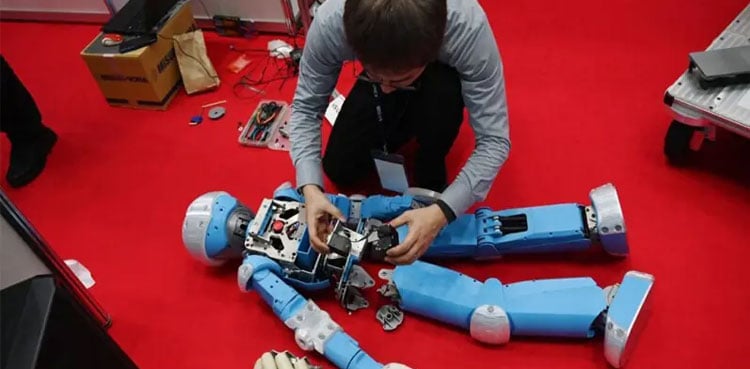
Japan's METI has formally committed up to 1 trillion yen ($6.2 billion) over five years to back Noetra -- a physical AI consortium anchored by SoftBank, Sony, NEC, and Honda, with approximately 44 companies expected to participate. An initial tranche of 387.3 billion yen flows in FY2026. Noetra and the national research institute AIST plan to release a first foundation model this fiscal year, with annually improved versions thereafter built on manufacturer data. The government is targeting 10 million AI-equipped robots deployed across 18 sectors, including restaurant, food manufacturing, and medical, by 2040. For practitioners, the combination of sovereign model funding and a concrete long-horizon deployment target creates sustained demand for edge inference solutions, domain-specific datasets, and validated integration stacks. Japan's industrial manufacturers currently hold roughly 70% of the global industrial robotics market per METI data, giving the initiative a credible production base to build on.
Japan's METI commitment of up to 1 trillion yen to Noetra's physical AI program is the rare sovereign AI initiative backed by both a credible industrial base and a concrete deployment target. For practitioners in robotics, edge inference, and industrial data, this is the more consequential detail: the government is not just funding a model -- it is attaching it to a binding timeline of 10 million deployed robots across 18 sectors by 2040, which creates a real engineering demand curve, not just a research roadmap.
What happened
Japan's Ministry of Economy, Trade and Industry (METI) has formally designated a five-year domestic AI development project led by Noetra, a consortium including SoftBank, Sony, NEC, and Honda. According to Ary News and The Japan Times (June 30, 2026), METI is providing up to 1 trillion yen ($6.2 billion) over the project's life, with an initial 387.3 billion yen allocated for FY2026. Noetra and the National Institute of Advanced Industrial Science and Technology (AIST) plan to release a foundation model as early as this fiscal year, then issue annually improved versions using data from participating manufacturers and operators. Nikkei Asia reporting, cited by Ary News, notes the investor list could grow to 44 companies spanning automotive, electronics, finance, and logistics.
Consortium and deployment targets
Industry Minister Ryosei Akazawa stated (per Ary News): "This strategy sets a target of approximately 10 million robots to be deployed by 2040 and, with the addition of the restaurant, food manufacturing and medical sectors, will vigorously promote social implementation across a total of 18 fields," and "We will build and grow data infrastructure for physical AI and robots that capitalise on Japan's strengths." METI's March 2026 policy announcement also set a target of capturing 30% of the global physical AI market by 2040. Japan's industrial manufacturers currently hold approximately 70% of the global industrial robotics market (METI data via TechWire Asia), providing an existing base for the program.
Practitioner context
Physical AI deployment at this scale imposes requirements that differ materially from cloud model releases: on-device perception and control-loop latency under real-time constraints, safety validation for regulated sectors (medical, food), simulation-to-reality transfer, and long-tail domain data collection for edge adaptation. Engineers working on inference optimization, federated or hybrid data pipelines, and certification workflows should track Noetra's pilot program specifications, since procurement rules typically encode the technical requirements. The annual model release cadence with manufacturer-contributed data also signals an iterative feedback loop between deployed robots and model improvements -- a data flywheel model specific to physical AI.
What to watch
- •Initial model benchmarks and sector-specific variant details when Noetra's first release lands in FY2026.
- •Technical specifications in METI procurement notices, particularly data residency and model audit requirements.
- •Growth of the 44-company investor list and which sectors gain dedicated model variants first.
- •Noetra's approach to simulation-to-reality transfer and safety certification, which are the hard bottlenecks for the 2040 robotics targets.
Key Points
- 1METI commits up to 1 trillion yen over five years to Noetra's physical AI foundation model, with 387.3 billion yen allocated for FY2026 and a first model release planned this fiscal year.
- 2The government targets 10 million AI-equipped robots across 18 sectors by 2040, creating a sustained engineering demand curve for edge inference, domain-specific datasets, and certified integration stacks.
- 3Japan's manufacturers hold roughly 70% of global industrial robotics market, giving the sovereign AI push a credible industrial base -- and a real data source -- that rivals cannot quickly replicate.
Scoring Rationale
METI's formal commitment of 387.3 billion yen (initial FY2026 tranche) and up to 1 trillion yen total to Noetra's physical AI program, paired with binding 10-million-robot deployment targets across 18 sectors by 2040, represents a major state-level infrastructure bet with concrete supply chain implications for practitioners in edge inference, robotics data, and industrial certification. Score reflects notable national-level significance; the more foundational April consortium launch was a separate event.
Sources
Public references used for this report.
Practice with real Banking data
90 SQL & Python problems · 15 industry datasets
250 free problems · No credit card
See all Banking problems