Israel's Space Tech Embraces Space-Based AI Infrastructure
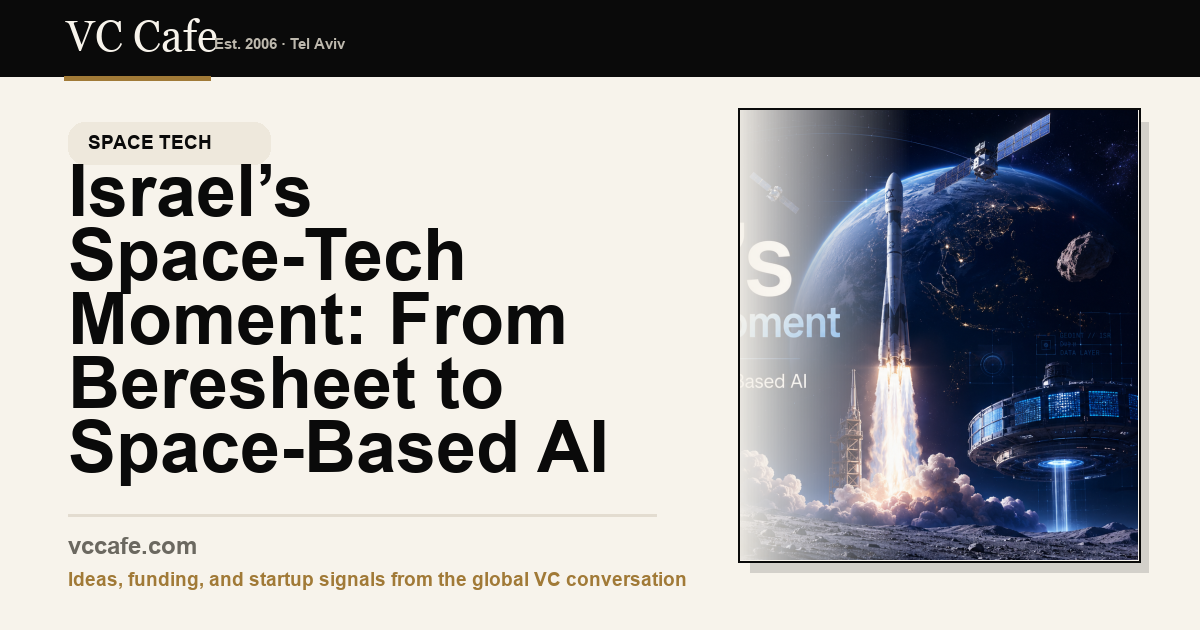
VCCafe, an Israeli venture blog by Eze Vidra, published an analysis framing space as emerging infrastructure for AI compute, connectivity, climate intelligence, and communications, and positioning Israel's space-tech sector within that shift. The piece points to industry signals that make orbital compute a live conversation. CNBC reports SpaceX launched an IPO roadshow in early June 2026 targeting roughly a $75 billion raise at about a $1.77 trillion valuation, with materials that reference space-based opportunities. Separately, Google's Project Suncatcher (announced November 2025) is exploring solar-powered satellite constellations equipped with TPUs and free-space optical links, with a Planet Labs pilot of two satellites targeted for early 2027. VCCafe and academic work cited in the piece highlight solar power and radiative cooling as advantages of orbital compute, alongside open engineering challenges around radiation, launch cost, and latency.
What happened
VCCafe, an Israeli venture blog written by Eze Vidra, published an analysis framing space as a new layer of infrastructure for AI compute, connectivity, climate intelligence, communications, and science, and positioning Israel's space-tech ecosystem within that broader shift. The piece draws on current industry signals to argue that orbital compute is becoming a serious infrastructure conversation rather than a thought experiment.
Industry signals
CNBC reports that SpaceX launched an IPO roadshow in early June 2026, targeting roughly a $75 billion raise at a valuation near $1.77 trillion, with offering materials that reference space-based opportunities. Separately, Google's Project Suncatcher, announced in November 2025, is exploring solar-powered satellite constellations equipped with Tensor Processing Units and free-space optical links; Google and trade coverage describe a Planet Labs pilot of two satellites targeted for early 2027 and radiation testing of its Trillium TPU for low-Earth-orbit conditions.
Technical trade-offs
Orbital compute platforms trade terrestrial constraints for new ones. Abundant solar energy and radiative cooling are attractive in orbit, while radiation hardening, launch payload limits, micrometeoroid shielding, on-orbit maintenance, and communications latency remain material engineering challenges. Academic work cited in the analysis focuses on thermal management, shielding, and optical links as enablers rather than near-term turnkey solutions.
What to watch
- •Launch-cost and regulatory trends that shape the unit economics of orbital racks
- •Progress on radiation-hardened accelerators and on-orbit maintenance demonstrations
- •Bandwidth and latency measurements for distributed AI workloads across satellite links
Key Points
- 1Space-based AI compute is moving from speculative to investable, with orbital data centers and satellite infrastructure cited in industry analysis and corporate disclosures.
- 2Concrete signals include SpaceX's record IPO scale (about $1.77 trillion valuation per CNBC) and Google's Project Suncatcher TPU-in-orbit pilot planned for early 2027.
- 3For practitioners, feasibility hinges on radiation-hardened accelerators, radiative cooling, and free-space optics, not just launch economics or solar availability.
Scoring Rationale
The piece is an industry analysis rather than original breaking news, but it sits on a genuinely active infrastructure theme backed by real developments, including SpaceX's record IPO and Google's Project Suncatcher. It is useful context for practitioners weighing future compute options, though orbital AI remains early-stage engineering. Scored as a solid, on-topic infrastructure analysis.
Sources
Public references used for this report.
Practice interview problems based on real data
1,625 SQL & Python problems across 15 industry datasets — the exact type of data you work with.
Try 250 free problems