Insurers' Risk Leaders Cite AI Staffing Concerns
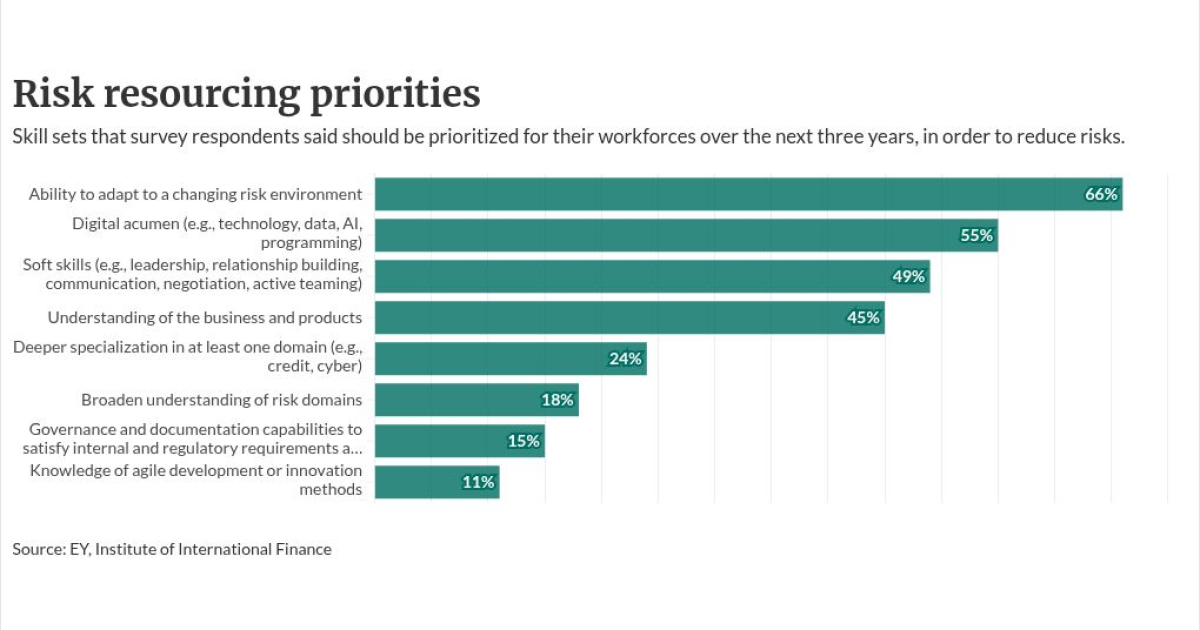
EY's third annual "New shape of risk" survey found corporate risk leaders reporting the impact of AI on staffing and specializations, Dig-in reports. The survey compiled responses from chief risk officers and senior risk executives at 106 insurance companies and Institute of International Finance member firms worldwide, Dig-in reports. Dig-in reports the survey registered a 19 percentage point increase in respondents expressing concern about their staffs' ability to adapt. Respondents named improving productivity while keeping staff levels steady and evaluating AI's impact over the next three years as top concerns, Dig-in reports. "You need talent to support that," said Stu Doyle, principal in the consulting practice at EY, in remarks reported by Dig-in. Insurers increasingly frame AI as a workforce and capability challenge rather than a purely technical investment.
What happened
EY's third annual "New shape of risk" survey found corporate risk leaders reporting the impact of AI on staffing and specializations, Dig-in reports. The survey compiled responses from chief risk officers and senior risk executives at 106 insurance companies and Institute of International Finance member firms worldwide, dig-in reports. Dig-in reports the survey showed a 19 percentage point increase in respondents expressing concern about their staffs' ability to adapt, and respondents listed improving productivity while holding staff levels steady and evaluating AI's impact over the next three years as top concerns, Dig-in reports. "You need talent to support that," said Stu Doyle, principal in the consulting practice at EY, in comments carried by Dig-in.
Context and significance
Editorial analysis
The Dig-in coverage places the EY survey in a broader trend where risk functions move from compliance-check roles toward active partners in product and underwriting oversight as AI instruments proliferate. That shift is relevant to practitioners because it changes the profile of required technical skills, the emphasis on model risk management frameworks, and the kinds of vendor relationships insurers pursue.
Technical implications for practitioners
Editorial analysis - technical context
Industry-pattern observations: Across financial services, reported AI adoption frequently shifts lower-skill, routine work toward automation while increasing demand for data-science and model-risk capabilities. Companies that have publicized AI pilots often report short-term productivity gains alongside longer timelines for integrating domain knowledge into models. For insurance risk teams, that pattern typically surfaces as increased hiring or retraining needs for data-science, model validation, and governance skills.
Risk teams evaluating AI impact should expect to engage more with: model validation pipelines, explainability tooling, data lineage and feature governance, and reproducible evaluation workflows. Observers following implementations often find that creating reliable evaluation datasets and integrating model monitoring into production are practical bottlenecks rather than raw model performance alone.
What to watch
Industry context
Track these indicators to follow how insurers respond to the concerns documented in the EY survey: changes in hiring mixes for risk and analytics roles; published model governance or validation policies; procurement of external model-audit services; and adoption of monitoring and explainability tooling. Also watch survey follow ups that quantify timelines for reskilling and external hires.
Quoted material and attribution
All reported survey figures and quotes are from Dig-in's May 5, 2026 report summarizing EY's "New shape of risk" survey and comments from Stu Doyle, principal in the consulting practice at EY, as presented in the Dig-in article.
Key Points
- 1Insurers report AI as a workforce issue: balancing productivity gains with steady staffing drives demand for new skills.
- 2Survey respondents prioritize evaluating AI impact and boosting data-science capabilities over immediate headcount reductions.
- 3Practitioners should expect model validation, monitoring, and domain integration to become recurring operational priorities.
Scoring Rationale
The EY survey highlights operational and staffing effects of AI that matter to risk and analytics teams across insurance. The story is practitioner-relevant but not a frontier-model or major industry-shaking event, so impact is moderate.
Practice with real Ad Tech data
90 SQL & Python problems · 15 industry datasets
250 free problems · No credit card
See all Ad Tech problems