Harness Adds Autonomous AI Agents for DevOps Automation
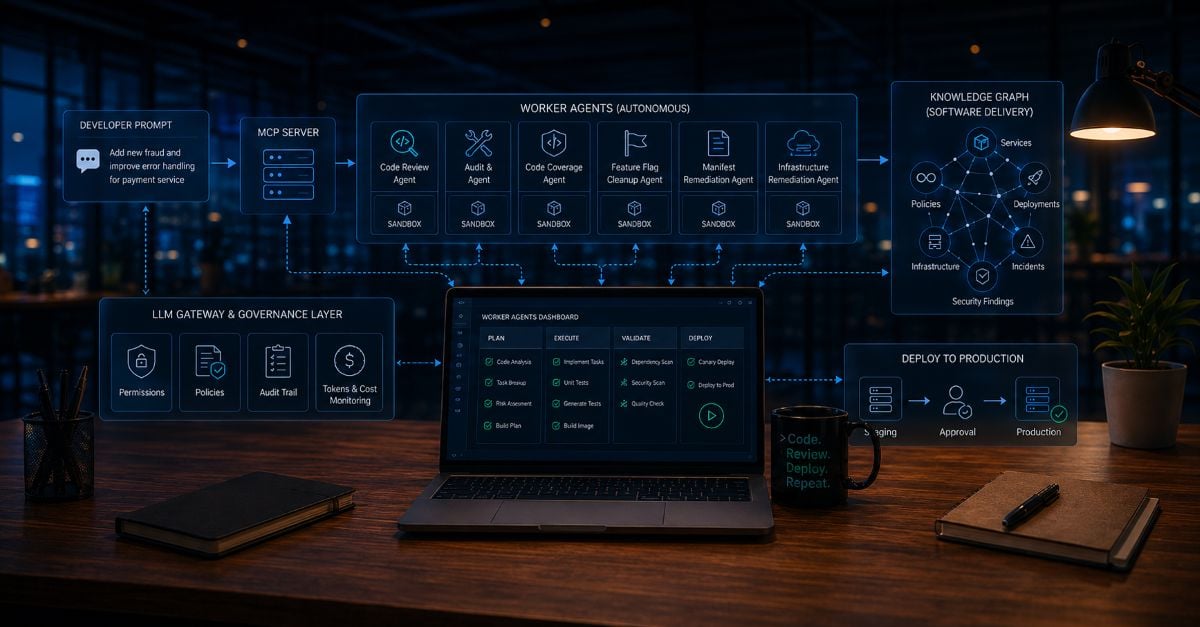
Harness said on June 30, 2026 that its Autonomous Worker Agents and Harness Agent Marketplace are now generally available to all customers, letting AI agents run as governed steps directly inside CI, CD, security, and infrastructure pipelines rather than as bolt-on scripts. According to the company, six prebuilt agents, including Autofix, Code Review, and IaCM Remediation, ship today, drawing on Harness's Software Delivery Knowledge Graph and running under sandboxing, scoped credentials, and audit-trail controls. Agents can use Anthropic, OpenAI, or Gemini models per pipeline. Engineers at Verint Systems and United Airlines said they built production agents in about four days. Harness's own agents product page separately lists the Marketplace as an H2 2026 roadmap item, a detail worth flagging alongside the general-availability announcement.
Harness's launch is less about bolting another chatbot onto the toolchain and more about where AI automation lives in the delivery lifecycle: as a governed, auditable pipeline step rather than a script stitched on afterward. That distinction matters for engineering organizations weighing how to adopt agentic AI without losing the change-control and audit guarantees that regulated software delivery depends on.
What happened
Harness, the DevOps platform maker, announced on June 30, 2026 that Autonomous Worker Agents and the accompanying Harness Agent Marketplace are now generally available to all customers. Each Worker Agent pairs a prompt, a model connector, and optional MCP-connected data sources into a single pipeline step usable across CI, CD, infrastructure-as-code, and security workflows. Harness says agents reason over its Software Delivery Knowledge Graph, a connected map of services, pipelines, deployments, and security findings, so a remediation agent can see which services depend on the one it is touching. Trevor Stuart, SVP and GM at Harness, told DevOps.com the goal is to let teams retire fixed scripts in favor of agents that carry their own identity and permissions.
Technical context
The launch bundles several previously separate pieces: the Harness MCP Server (which also lets Cursor, Claude Code, and other MCP-compatible IDEs trigger Worker Agents), an agent-file format for committing agents to a repository, and guardrails Harness describes as sandboxed execution, scoped credentials, policy enforcement, audit trails, and per-agent cost tracking. Agents are model-agnostic: Harness says customers can run them via Anthropic (directly or through AWS Bedrock), OpenAI, or Gemini, and switch providers per agent, environment, or pipeline without rewriting it. Six Harness-built agents are listed as available now: Autofix, Code Review, Code Coverage, Feature Flag Cleanup, Manifest Remediator, and IaCM Remediation.
For practitioners
The Agent Marketplace organizes agents into three tiers, Harness Managed, Harness Certified, and Community, all forkable, so teams can adopt an existing agent or clone one as a starting point instead of building from scratch. Verint Systems' John Jones said a Kubernetes-troubleshooting agent his team built reached production in about four days and will serve roughly 200 operations staff and 1,000 developers; United Airlines' Ratna Devarapalli described a similar four-day build for a security-remediation agent called RiskSentinel. Those timelines point to a genuinely low barrier for a first agent, but they also mean governance decisions, who can approve a Community-tier agent for production, and how per-agent cost and audit data feeds existing SRE and FinOps tooling, need to happen before adoption scales past a single team.
What to watch
Harness's own product page for its agents lists "Agent Marketplace" as an H2 2026 roadmap item and marks the broader agents offering's stage as Limited Preview, which sits awkwardly next to the launch's general-availability claim; public materials do not make clear whether that page simply had not been updated at publication or refers to a further, wider marketplace milestone. Also worth watching: how Harness vets Community-tier agents at scale, and whether competing CI/CD vendors respond with similarly governed, marketplace-style approaches to agentic automation.
Key Points
- 1Harness's Autonomous Worker Agents and Agent Marketplace are now generally available, embedding AI agents as governed, auditable steps inside CI/CD, IaCM, and security pipelines rather than as bolt-on tools.
- 2Agents are model-agnostic (Anthropic, OpenAI, Gemini), ship with sandboxing, scoped credentials, policy enforcement, and per-agent cost tracking, and Harness cites roughly four-day production builds at Verint Systems and United Airlines.
- 3Harness's own agents product page separately lists the Marketplace as an H2 2026 roadmap item and marks the offering's stage as Limited Preview, a discrepancy with the general-availability announcement worth watching.
Scoring Rationale
Substantive, well-corroborated enterprise DevOps product launch (independent DevOps.com coverage plus named customer validation from Verint Systems and United Airlines) that changes how AI automation is governed inside CI/CD pipelines. Not a frontier research result, and the GA claim conflicts in part with Harness's own roadmap page, which tempers the score slightly from a pure vendor-GA framing.
Sources
Public references used for this report.
Practice interview problems based on real data
1,625 SQL & Python problems across 15 industry datasets — the exact type of data you work with.
Try 250 free problems