
Guide Recommends AI Tools To Improve Student Study
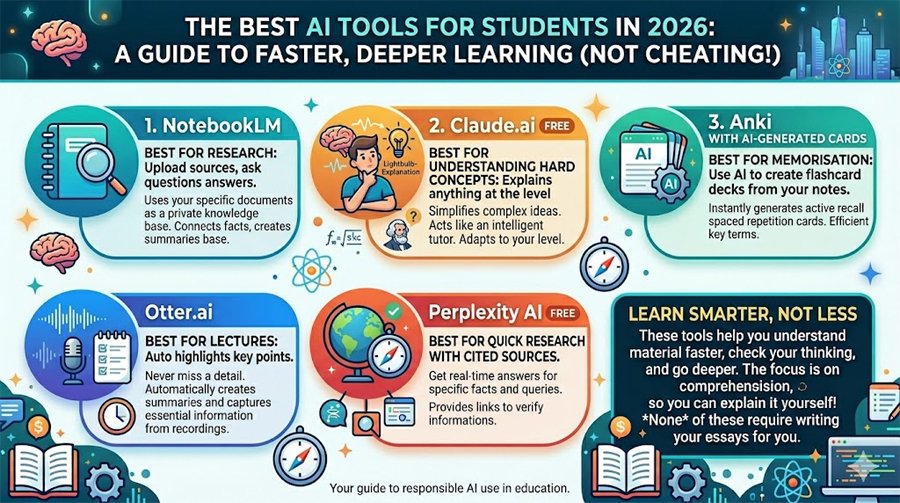
SmashingApps published a guide titled "Best AI Tools for Students in 2026" that highlights AI products intended to help students learn and research more efficiently. The guide recommends NotebookLM, Claude.ai (free), Anki with AI-generated cards, Otter.ai, and Perplexity AI (free), and emphasizes using these tools to learn and understand material rather than to produce work the student cannot explain, according to the article. The piece frames AI as a study aid that accelerates comprehension, flags academic integrity concerns, and advises ethical use in line with university rules.
What happened
SmashingApps published a guide called "Best AI Tools for Students in 2026" that lists recommended consumer tools for study and research. The article highlights NotebookLM as best for research with source uploads and cited answers, Claude.ai (free) for explaining hard concepts, Anki with AI-generated cards for memorization, Otter.ai for lecture transcription and highlights, and Perplexity AI (free) for quick research with cited sources. The guide explicitly states these tools are intended to help students understand material, and it warns against submitting AI-generated work a student cannot explain.
Editorial analysis - technical context
The tools named illustrate two technical themes common in education-focused AI: retrieval-augmented study environments and automation of low-value study tasks. Retrieval-augmented tools like NotebookLM and Perplexity AI combine source ingestion with citation-capable answers, while transcription and summarization services such as Otter.ai reduce note-taking overhead. Flashcard generation workflows, as with AI-assisted Anki decks, automate spaced-repetition content creation. These are generic industry patterns, not claims about any vendor roadmap.
Industry context
Observers of education technology note that combining comprehension aids and workflow automation shifts where student effort is spent, from mechanical tasks to higher-order reasoning. Widespread adoption of such tools tends to increase demand for assessment methods that verify conceptual mastery rather than surface-level output. Academic-integrity debates remain central, and platform-level citation and provenance features are increasingly marketed as mitigation tools.
What to watch
- •Uptake of citation and provenance features in student-facing tools, which alter how instructors verify sources.
- •Integration of transcription and summarization into learning management systems, which changes note-sharing norms.
- •Institutional policy updates on permissible AI use in coursework, which will affect instructional design and assessment.
Key Points
- 1Curated consumer tools reduce time spent on low-value study tasks, letting students focus on comprehension and practice.
- 2Retrieval-augmented products with citation support can change research workflows, increasing emphasis on source attribution and verification.
- 3Education adoption of AI tools intensifies pressure on assessment design, pushing educators toward methods that test conceptual mastery.
Scoring Rationale
This is a practical, consumer-focused roundup with limited direct relevance to ML practitioners. It is useful for education-technology observers but does not introduce new models, architectures, or industry-changing developments.
Practice interview problems based on real data
1,625 SQL & Python problems across 15 industry datasets — the exact type of data you work with.
Try 250 free problems
