Google debuts DiffusionGemma for faster text generation
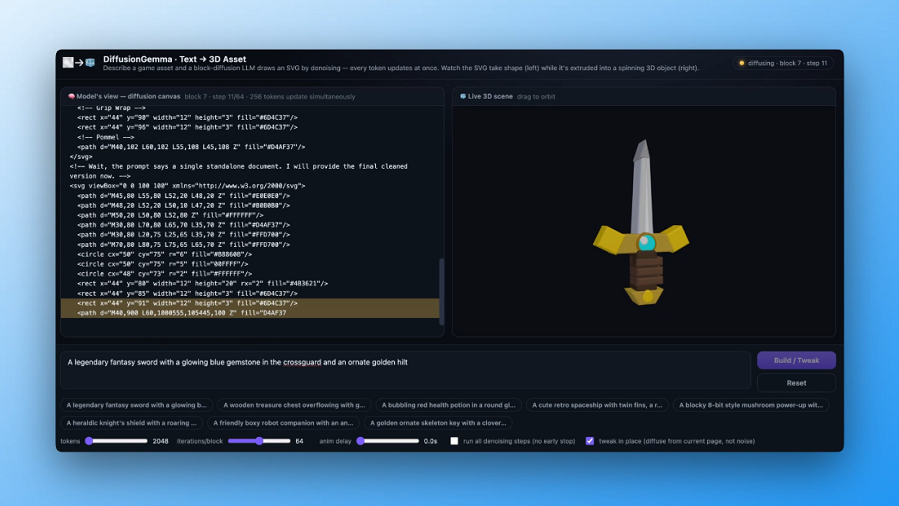
DiffusionGemma is worth practitioners' attention less as a product than as a working demonstration that parallel diffusion decoding can trade a slice of benchmark quality for a large latency win in an open model you can run locally. Google released the experimental, Apache 2.0 model as a 26B Mixture of Experts that activates only 3.8B parameters at inference and fits in 18GB VRAM when quantized, per Google's blog. Instead of token-by-token autoregressive decoding, it uses a diffusion-based head with bi-directional attention to generate blocks of up to 256 tokens in parallel, which Google reports delivers up to 4x faster inference, over 1000 tokens/sec on an H100 and over 700 tokens/sec on an RTX 5090. The load-bearing caveat: it trails Gemma 4 on standard benchmarks, so the design targets latency-critical work like in-line editing and code infilling, not maximum quality.
What builders should take from it
The interesting thing is architectural, not the model card. DiffusionGemma is a shippable demonstration that non-autoregressive, diffusion-style decoding can cut wall-clock latency several fold while running locally and under a permissive license, which makes it a practical testbed for teams weighing latency against quality. The honest tradeoff, stated by Google itself, is that the model trails Gemma 4 on standard benchmarks, so it belongs in latency-bound interactive workflows rather than as a general-quality default.
How it works
Google introduced DiffusionGemma as an experimental open model under Apache 2.0. It is a 26B Mixture of Experts that activates only 3.8B parameters during inference and is built to run within 18GB VRAM when quantized. Rather than decode token by token, it uses a diffusion-based head with bi-directional attention to generate blocks of up to 256 tokens in parallel per forward pass, so every token can attend to all others. Google frames this as shifting the decode bottleneck from memory bandwidth to compute, and reports up to 4x faster generation, over 1000 tokens/sec on an NVIDIA H100 and over 700 tokens/sec on an RTX 5090.
The tradeoff to validate yourself
Parallel diffusion decoding and sparse MoE activation both aim at interactive latency, and both tend to cost some benchmarked quality relative to strong autoregressive baselines. The open questions are token-level coherence and self-correction under the diffusion head, and whether the throughput claims hold on your hardware and quantization setup. For in-line editing, rapid iteration, or memory-constrained local inference, the tradeoff may be worth it; for long-form or high-stakes generation, test coherence before committing.
What to watch
Look for independent evaluations across code, dialogue, and long-form generation, community implementations documenting real latency-versus-accuracy results, and developer guides that quantify the tradeoff on commodity GPUs.
Key Points
- 1Google open-sourced DiffusionGemma, a 26B MoE that decodes text in parallel via a diffusion head instead of autoregressively.
- 2It reports up to 4x faster inference (1000+ tok/s on H100) but trails Gemma 4 on standard benchmarks.
- 3So-what: a concrete, local, Apache-2.0 testbed for latency-versus-quality tradeoffs in in-line editing and code infilling.
Scoring Rationale
DiffusionGemma introduces a notable architecture-level approach to cut latency for interactive workflows, which matters to practitioners evaluating on-device and low-latency deployments. The release is experimental and quality tradeoffs relative to Gemma 4 limit immediate production impact, hence a mid-high significance score.
Sources
Public references used for this report.
Practice with real Ad Tech data
90 SQL & Python problems · 15 industry datasets
250 free problems · No credit card
See all Ad Tech problems