GitLab Updates DevOps Platform for Agentic AI
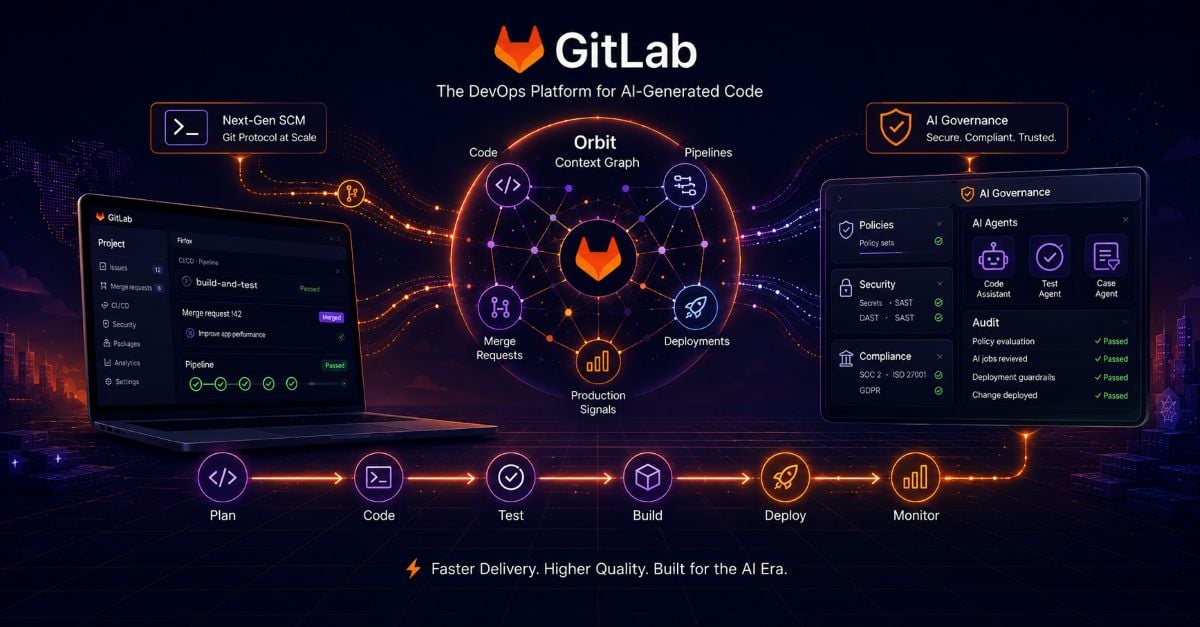
GitLab used its Transcend 2026 event to preview a set of platform updates aimed at supporting AI-generated code and agentic workflows. GitLab's Business Wire announcement details keynotes from CEO Bill Staples and CPO Manav Khurana and demonstrations of agent orchestration across the software lifecycle (Business Wire). DevOps.com reports the release includes a Next Generation Source Code Management implementation claimed to enable agents to complete tasks up to 50 times faster, a context graph called GitLab Orbit said to deliver 11x faster responses while using 4.5x fewer tokens, and an AI Governance framework in private beta that assigns identity, policy paths, and audit records to agent actions (devops.com). DevOps.com also describes a new licensing option, GitLab Flex, combining seats and AI credits. News previews and event listings appeared in Business Wire, Las Vegas Sun, and DevOps Digest.
What happened
GitLab held its virtual event, GitLab Transcend, on June 10-11, 2026 to showcase platform updates for agentic engineering, including keynotes from CEO Bill Staples and Chief Product and Marketing Officer Manav Khurana, and customer and partner sessions with firms such as Southwest Airlines and Oracle Cloud Infrastructure (Business Wire; Las Vegas Sun; DevOps Digest). Business Wire describes demonstrations of AI agents operating across the software lifecycle and a new assessment program for modernization paths (Business Wire).
Technical details
DevOps.com reports three headline platform changes. First, a reworked Next Generation Source Code Management that GitLab, per DevOps.com, says is built on a distributed architecture intended to scale DevOps workflows and allow agentic tasks to run up to 50 times faster (devops.com). Second, a lifecycle context graph called GitLab Orbit that maps code, work items, pipelines, deployments, and production signals; DevOps.com reports GitLab claims Orbit can give 11x faster responses and use 4.5x fewer tokens for agent queries (devops.com). Third, an AI Governance framework is being offered in private beta that, according to DevOps.com, assigns identity, policy paths, and audit records to each agent action and surfaces agent inputs, reasoning, tool calls, and anomalous patterns for DevSecOps teams (devops.com). DevOps.com also reports a new licensing option, GitLab Flex, which bundles seats and AI credits under a single annual commitment (devops.com).
Industry context
Significance for practitioners
What to watch
For practitioners
monitor the public betas and available benchmarks for Next Generation SCM and GitLab Orbit to validate the reported 50x and 11x performance figures. Track the scope and controls exposed by the AI Governance private beta, specifically whether agent audit trails include deterministic tool-call logs and verifiable provenance for generated code. Watch licensing details and telemetry in GitLab Flex to understand how AI credits are measured and how consumption maps to engineering teams' budgets.
Additional context
Editorial analysis
Companies in the DevOps and platform space are integrating lifecycle context and governance features to make agentic workflows auditable and cost-containable. Observers have framed these moves as responses to three recurring enterprise pain points: token and compute cost from agent-driven workloads, lack of unified context for agent actions, and the need for traceability for compliance and security.
If GitLab's performance and token-efficiency claims materialize at scale, teams relying on agentic automation could see materially lower inference costs and faster iteration on routine tasks. The reported governance features also address auditability gaps that have become a priority for regulated or large engineering organizations. However, the claims reported in press coverage come from vendor briefings and public previews; independent verification will be required to assess real-world impact and integration complexity.
The event also includes research and partner showcases, such as work from Stanford's Software Engineering Productivity Research group and partner spotlights with cloud and AI vendors (Las Vegas Sun; DevOps Digest). For engineering leaders, the combination of lifecycle context, agent orchestration, and governance is becoming a standard product narrative across vendor roadmaps; actual lock-in and migration costs, plus compatibility with existing CI/CD pipelines and internal security tooling, will determine adoption speed.
Bottom line
GitLab has presented a set of features aimed at operationalizing agentic AI within DevOps workflows. The announcements reported by Business Wire, DevOps.com, Las Vegas Sun, and DevOps Digest frame the work around performance, context, and governance; practitioners should validate vendor claims in private beta and pay attention to the governance primitives and billing mechanics when evaluating pilot projects.
Key Points
- 1GitLab previewed a distributed Next Generation SCM, a context graph (GitLab Orbit), and an AI Governance private beta, per DevOps.com and Business Wire.
- 2Vendor-reported performance claims include up to 50x faster agent tasks and 11x faster Orbit responses while using 4.5x fewer tokens; independent validation is needed.
- 3Editorial analysis: Firms are standardizing lifecycle context and governance to make agentic automation auditable, cost-manageable, and enterprise-ready.
Scoring Rationale
Notable platform updates from a major DevOps vendor introduce lifecyle context and governance for agentic workflows; the story matters for teams piloting agent automation but relies on vendor claims that require independent benchmarking.
Sources
Public references used for this report.
Practice interview problems based on real data
1,625 SQL & Python problems across 15 industry datasets — the exact type of data you work with.
Try 250 free problems