Ghost Font Uses Motion to Confound AI Vision
In July 2026, Mixfont released Ghost Font, an animated dot pattern whose hidden text is readable through motion but disappears in a paused frame. Creator Eric Lu and Mixfont report that models labeled Claude Fable and GPT Sol 5.6 Ultra failed to decode the intended message without being told the technique. The experiment is a visual robustness demonstration, not an independently benchmarked evaluation of AI vision systems.
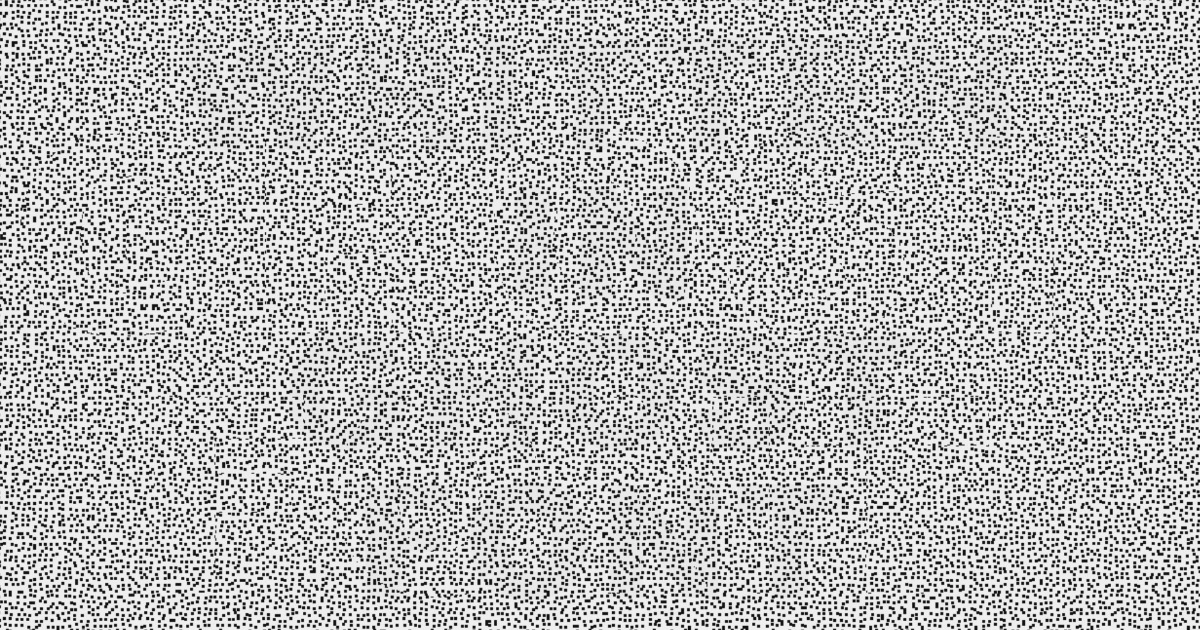
Mixfont has released Ghost Font, an experimental web-based typography tool that encodes text in animated motion rather than static letterforms. The project creates videos filled with dots, where dots representing letters move differently from surrounding dots; when the video is paused, the message is intended to become visually indistinguishable from noise.
According to Mixfont, users can enter a short message in a browser-based prototype, preview the animation locally, and download a video clip. The project page states that entered data is not sent to a server. Mixfont describes the mechanism as a combination of motion, video, noise, and decoy patterns.
Developer and designer Eric Lu wrote on X that he tested Ghost Font with models labeled "Fable" and "GPT 5.6 Sol Ultra," and that neither decoded the text correctly. Mixfont similarly reports that its test models initially read embedded decoy text rather than the intended moving message, and could decode it only after being prompted with the specific technique. Those results are self-reported by the project's creator and are not an independently validated benchmark of named models or general-purpose video-understanding systems.
Text appears through collective motion
Ghost Font does not provide a conventional installable font file. Instead, it produces an animation in which the dots belonging to a character move in one direction while background dots move in another. NDTV describes the result as an optical illusion: people can group dots by their shared movement and perceive the hidden word, while a single frame appears as random visual noise.
The project also includes decoy text, according to Mixfont and Yahoo Tech coverage. That detail matters because an incorrect model output is not necessarily a failure to detect that an animation contains structured motion; it can also reflect a failure to distinguish the intended signal from deliberately planted alternatives.
A narrow but useful robustness case
The reported test is best understood as a targeted challenge for visual-language systems, OCR pipelines, and agent workflows that rely on screenshots or sparse video sampling. Mixfont notes that taking a screenshot does not reveal the message, because the character information is distributed across motion rather than visible in an individual frame.
In comparable machine-vision evaluations, temporal sampling, optical-flow estimation, object tracking, and multi-frame feature aggregation can materially change results. A system tested only on isolated frames faces a different task from one designed to reason over a complete video sequence. The available reporting does not provide prompt logs, model versions, video settings, success rates, or a comparison against specialized video models, so it cannot establish a broad claim that AI systems cannot read Ghost Font.
Still, the experiment illustrates an adversarial-design pattern relevant to practitioners: visual information can be encoded in relationships across frames rather than in static pixels. Teams building document ingestion, content moderation, accessibility, or surveillance tooling can use examples like this to test whether their systems preserve temporal information before applying OCR or multimodal inference.
Ghost Font follows earlier attempts to make text difficult for OCR. Mixfont cites designer Sang Mun's 2013 anti-OCR typeface project, which used visual noise and false marks. The newer experiment shifts the challenge from static typography to video perception, where motion is the primary carrier of the message.
Key Points
- 1Ghost Font encodes characters in relative dot motion, making a still image insufficient for conventional screenshot-based OCR workflows.
- 2Mixfont's reported model failures are illustrative self-tests, not reproducible evidence about the general capabilities of video-capable AI systems.
- 3Comparable robustness testing should vary temporal sampling, optical flow, and decoy content rather than treating video as independent image frames.
Scoring Rationale
Ghost Font offers a concrete adversarial example for multimodal and OCR pipeline evaluation, particularly where systems extract information from video or screenshots. Its claims currently rest on creator-reported demonstrations rather than a controlled benchmark, limiting the result's broader technical weight.
Sources
Primary source and supporting public references used for this report.
Practice with real Ad Tech data
90 SQL & Python problems · 15 industry datasets
250 free problems · No credit card
See all Ad Tech problems