Generalist Releases GEN-1 Robotic Intelligence Foundation Model
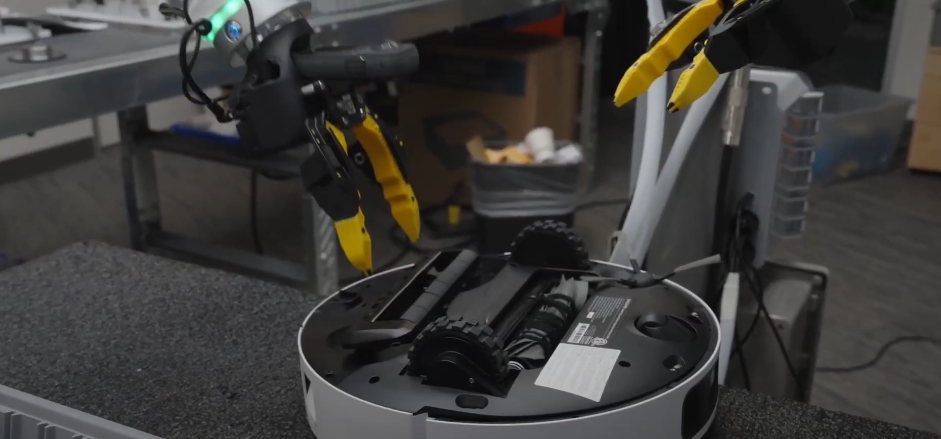
Generalist released GEN-1, a new embodied-robotics foundation model that claims mastery-level performance on simple physical tasks. GEN-1 emphasizes three engineering goals — reliability, speed and improvisation — and the company reports task success rates exceeding 99%, motion execution up to ~3× faster than prior art, and improved recovery from interruptions. Example benchmarks cited include assembling a box in 12.1 seconds versus 34 seconds for prior models. Generalist positions GEN-1 as a step toward scaling ‘mastery’ across diverse physical work by training on raw movement data and optimizing inference kernels and attention mechanisms for real-time control.
What happened
Generalist published GEN-1 (blog April 2, 2026) and formally announced the model in press coverage the week of April 6, 2026. GEN-1 is presented as a large, multimodal embodied foundation model for real-time action generation that advances three dimensions: reliability, speed and improvisation.
Technical context
Robotics has trended toward foundation models trained on large, diverse embodied datasets rather than task-by-task controllers. Generalist’s prior work emphasized training directly on raw movement data; GEN-1 continues that direction and focuses engineering effort on inference latency, training stability and model architectures that support longer, multi-step task reasoning and real-world recovery behaviors.
Key details from sources
- •Performance claims: Generalist reports success rates above 99% on multiple tasks and motion execution roughly 2.8–3× faster than the closest state-of-the-art comparators. In a boxed benchmark, GEN-1 assembled a box in ~12.1 seconds compared with ~34 seconds for GEN-0 and pi-0.
- •Engineering improvements: Public reporting credits improvements to training-stability work, custom compute kernels and novel attention mechanisms (paged attention) to make long-horizon embodied reasoning tractable and low-latency in control loops.
- •Behavioral capabilities: GEN-1 targets longer, stepwise tasks (assembly, multi-piece folding) rather than single-action repetition, and it emphasizes recovery and improvisation — reacting to interruptions, learning from changed environments and correcting mistakes in-flight.
Why practitioners should care
GEN-1 is significant for teams building real-world automation because it claims simultaneous gains in execution speed, robustness, and longer-horizon planning — the three practical friction points that limit deployment of manipulators in logistics, light assembly and service robotics today. If the performance claims hold under independent evaluation, GEN-1 could reduce integration complexity (less bespoke task scripting), raise throughput (faster motions), and lower failure rates (better recovery). The technical hints (custom kernels, paged attention) indicate attention to both model architecture and systems-level optimization required for closed-loop control.
What to watch
Validate claims: independent benchmarks across varied hardware and environments. Disclosure: detailed training data composition, compute costs, and model size/latency numbers. Safety and robustness: how GEN-1 handles edge cases, adversarial objects, and multi-robot coordination. Commercialization: availability (models, SDKs, or cloud inference) and hardware compatibility.
Key Points
- 1GEN-1 combines reliability, speed and improvisation to target longer, multi-step physical tasks beyond repetitive motions.
- 2Engineering focus on training stability and custom kernels enables ~2.8–3× execution speedups, lowering closed-loop control latency.
- 3High success rates (>99%) and faster recovery improve deployability, but independent validation and disclosure remain critical next steps.
Scoring Rationale
GEN-1 is a foundational robotics model claiming major practical improvements (speed, reliability, recovery) that directly affect production automation and research. It merits high importance for practitioners, though independent benchmarks and technical disclosures will determine true impact.
Sources
Public references used for this report.
View 5 more sources
- 'GEN-1,' an AI model that enables robots to perform tasks ...gigazine.net
- Generalist GEN-1 Model Gives Robots a New Kind of Skilltecheblog.com
- Generalist AI's GEN-1 is here—robots are really getting tobinance.com
- Generalist AI unveils robot model it says masters simple ...perplexity.ai
- Generalist AI, Inc.theresanaiforthat.com
Practice interview problems based on real data
1,625 SQL & Python problems across 15 industry datasets — the exact type of data you work with.
Try 250 free problems