Foundation Future Industries Secures $24M Pentagon Contract
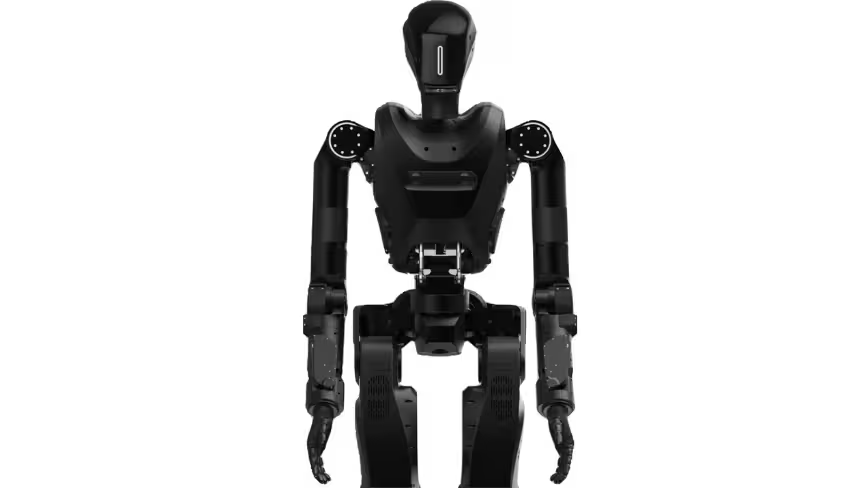
Foundation Future Industries, a San Francisco robotics startup, secured $24 million in Pentagon research contracts to test its Phantom humanoid robots, according to reporting by The Next Web and Fox Business. The company's chief strategy adviser is Eric Trump, and he discussed the deal on Fox Business, saying, "We are America First. We have to win this race," per Fox Business and Mediaite. The Next Web reports that two Phantom MK-1 units were sent to Ukraine in February for logistics and reconnaissance testing. The Next Web also reports the company, founded in April 2024, is seeking roughly $500 million at a valuation above $3 billion and previously set aggressive production targets; The Next Web additionally reports the CEO formerly ran a fintech that later failed with consumer deposits unaccounted for. Several Democratic lawmakers criticized the award, with Senator Elizabeth Warren calling it "corruption in plain sight," as reported by Yahoo and AOL.
What happened
Foundation Future Industries secured $24 million in Pentagon research contracts to test humanoid robots, according to reporting by The Next Web and Fox Business. The Next Web reports the awards involve multiple service branches, naming the US Army, Navy, and Air Force. Fox Business and Mediaite covered a TV appearance by the company's CEO, Sankaet Pathak, alongside Eric Trump, who is identified in multiple outlets as the company's chief strategy adviser and an investor.
The Next Web reports that two Phantom MK-1 units were sent to Ukraine in February for logistics and reconnaissance testing. The Next Web also reports technical and commercial claims about the MK-1: a 176-pound machine that walks at 1.7 meters per second, carries a 44-pound payload, uses eight cameras (no LiDAR disclosed), has 19 upper-body degrees of freedom, proprietary cycloidal actuators, and an autonomy stack that translates high-level instructions into motion while keeping human operators in the loop for lethal decisions. The Next Web reports a unit cost around $150,000 and a lease model at about $100,000 per year. The Next Web additionally reports the startup was founded in April 2024 and is seeking roughly $500 million at a valuation exceeding $3 billion, with production targets previously reported by The Next Web for 2025-2027.
Several outlets report political backlash. Yahoo and AOL quote Senator Elizabeth Warren calling the award "corruption in plain sight," and multiple news sites flagged concerns about a potential conflict of interest given Eric Trump's public role and the family relationship to the sitting president.
Technical details
Editorial analysis - technical context
The technical claims reported by The Next Web about the Phantom MK-1 align with contemporary industry tradeoffs in humanoid robotics: prioritizing multi-camera vision and compact actuators to reduce weight and cost, and combining higher-level autonomy with supervised teleoperation to limit autonomous use of lethal force. The reported specifications (speed, payload, degrees of freedom) place the MK-1 in the category of heavy-duty research humanoids rather than lightweight social robots. Reported price points (approximately $150,000 per unit) are low compared with large industrial robot fleets but would still require major scale-up in manufacturing and supply chains to meet the production targets The Next Web reports.
Context and significance
Government awards to early-stage robotics firms accelerate field testing and create pathways for rapid iteration, but they also elevate scrutiny on procurement, disclosure, and governance. Public coverage of Eric Trump's adviser role and the vocal reactions from Democratic lawmakers emphasize political risk and transparency issues that commonly accompany defense contracting where investors have political ties. Separately, claims of frontline testing in Ukraine, if independently verified, matter for practitioners because operational feedback from contested environments can materially change development priorities and validation criteria for robot hardware and autonomy.
What to watch
Editorial analysis
Observers should look for:
- •procurement documents or contract announcements from the Department of Defense clarifying the contracting branches and scope
- •independent verification or technical reports documenting the Ukraine deployments and outcomes
- •any SEC, DOD, or other disclosures about investors and adviser roles that bear on conflict-of-interest or procurement rules. Industry watchers will also monitor whether the company publishes technical validation data, safety assessment documents, or test logs that substantiate the performance metrics reported by The Next Web
Throughout this summary, reporting is attributed to named outlets when a claim is not public-record: key contract and deployment details are reported by The Next Web, the CEO and adviser appearances and quotes are covered by Fox Business and Mediaite, and political reactions are reported by Yahoo and AOL.
Key Points
- 1Pentagon-funded testing of humanoid robots is underway, accelerating real-world validation cycles for heavy-duty robotics hardware.
- 2Public, high-dollar contracts involving politically connected investors raise governance and transparency questions that can slow procurement and adoption.
- 3Frontline testing reports from Ukraine, if verified, could provide actionable operational data for autonomy and durability engineering teams.
Scoring Rationale
The story is notable because it documents a multimillion-dollar Pentagon award and reported frontline testing, which matter for practitioners tracking defense procurement and field validation of humanoid robots. Political controversy raises governance and adoption risk. The item is important but not a paradigm-shifting technical breakthrough.
Sources
Public references used for this report.
View 8 more sources
- Eric Trump Faces Fierce Backlash Over $24M Pentagon Contractaol.com
- Eric Trump-linked firm’s $24M Pentagon deal ignites corruption claimsmsn.com
- Pentagon taps humanoid robot startupssemafor.com
- Seth Meyers calls out Eric Trump's $24m Pentagon deal for his robot startupmashable.com
- Pentagon Awards $24M Contract for AI-Enabled Humanoid Military ...oecd.ai
- Foundation Phantom's $4 Billion Inflection: Leasing Model ... - AInvestainvest.com
- Pentagon Backs $24M Humanoid Robot Push for Modern Warfarewibc.com
- Eric Trump brags about his company winning $24M Pentagon deal ...themirror.com
Practice interview problems based on real data
1,625 SQL & Python problems across 15 industry datasets — the exact type of data you work with.
Try 250 free problems