
FloatForm robots assemble reconfigurable floating structures
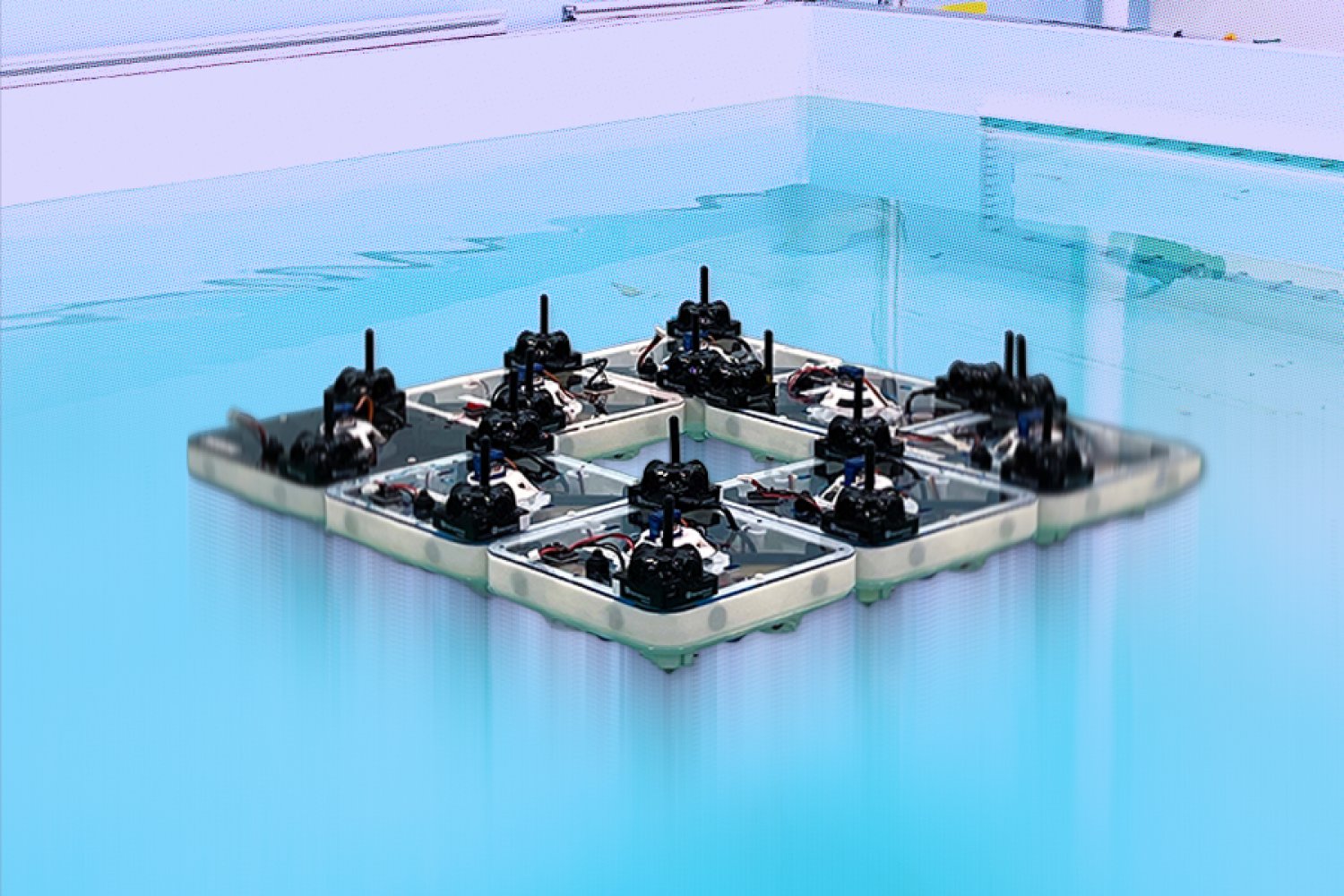
MIT CSAIL researchers described FloatForm, a set of modular robotic boats about 21 centimeters square, in a July 9, 2026 Nature Communications paper and MIT article. The boats use onboard sensing, thrusters, and magnetic latches to self-assemble, reconfigure, and move as larger floating structures. For robotics practitioners, the result matters because it shifts waterborne assembly from fixed infrastructure toward distributed agents that must solve docking, localization, control, and fault tolerance under hydrodynamic disturbance. The published work is still a research platform, not a deployment roadmap, but it gives teams a concrete testbed for multiagent coordination, modular-robot hardware design, and simulation-to-hardware validation in aquatic environments.
The practitioner value in FloatForm is not the waterfront vision; it is the engineering pattern. The project turns floating infrastructure into a multiagent robotics problem, where docking, localization, latch reliability, and disturbance rejection decide whether modular hardware can become useful outside calm demonstrations.
What happened
MIT CSAIL described FloatForm as a swarm of small square robotic boats that can self-assemble into connected structures, break apart, and reconfigure on water. Nature Communications published the peer-reviewed paper on July 9, 2026. The paper says each unit uses onboard sensing, motion control, and physical connection with neighboring robots, coordinated through a hybrid framework that combines distributed controllers with a minimalist central planner.
Technical context
The hard problem is aquatic self-reconfiguration. The Nature paper notes that water-based modular robots face nonlinear hydrodynamics, disturbances from nearby robots, external forces, and unreliable localization. FloatForm addresses that with repeatable hardware units and coordination logic, but the approach still has to prove durability and reliability in less controlled conditions.
For practitioners
Robotics teams should read this as a testbed for multiagent docking and formation control. The platform's simple square modules and magnetic latches simplify the mechanical interface, while shifting complexity into perception, control, energy management, and failure recovery. Those are the systems questions that matter if the idea moves toward search-and-rescue, environmental monitoring, temporary platforms, or adaptive marine infrastructure.
What to watch
Follow experiments in rougher water, longer deployments, and larger module counts. The most useful follow-up artifacts would be controller code, simulation environments, latch fatigue data, battery-life measurements, and benchmark tasks that let other teams compare self-reconfiguration reliability under realistic disturbance.
Key Points
- 1FloatForm shifts floating-structure assembly from fixed infrastructure toward coordinated modular boats with sensing, thrusters, and magnetic latches.
- 2The research gives multiagent-control teams a hardware testbed for docking, reconfiguration, localization, and fault tolerance under water disturbance.
- 3Scaling beyond lab demonstrations will depend on latch durability, battery life, communications, and robust control in waves and currents.
Scoring Rationale
This is a notable robotics research demonstration for practitioners working on multiagent control, docking mechanics, and adaptive infrastructure. It is not a production deployment, but the Nature Communications paper provides experimental detail useful for replication and follow-on engineering.
Sources
Public references used for this report.
Practice interview problems based on real data
1,625 SQL & Python problems across 15 industry datasets — the exact type of data you work with.
Try 250 free problems


