Federal Reserve Survey Flags Geopolitical and AI Risks
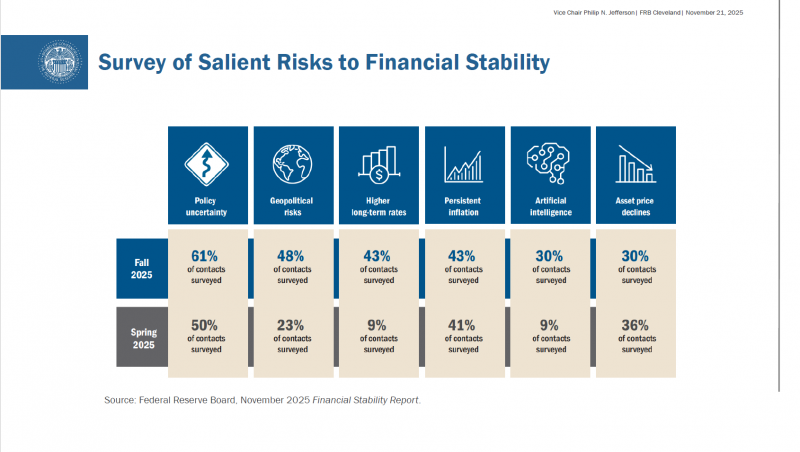
The Federal Reserve's Spring 2026 Financial Stability Report, as reported by CryptoBriefing and a Binance summary, places geopolitical risks as the most cited threat to U.S. financial stability, up from second in Fall 2025. CryptoBriefing links the ranking shift to a US-Israel operation on February 28, 2026, that it reports resulted in the killing of Iran's Supreme Leader and sparked ongoing Middle East hostilities that threaten energy infrastructure. Binance, citing Jin10, reports artificial intelligence climbed from fifth to third in perceived risk, while private credit moved from ninth to fourth and inflation/monetary tightening fell from third to fifth. CryptoBriefing also notes commentary from the CFA Institute, BlackRock, Nobel laureate Simon Johnson, and former FDIC Chair Sheila Bair raising cyber, labor, and capital-allocation concerns related to AI.
What happened
The Federal Reserve's Spring 2026 Financial Stability Report, as reported by CryptoBriefing, shows geopolitical risks are now the most cited threat to U.S. financial stability, rising from second in the Fall 2025 survey. CryptoBriefing connects that elevation to a US-Israel operation on February 28, 2026, which it reports resulted in the killing of Iran's Supreme Leader and triggered broader Middle East hostilities that threaten energy infrastructure and supply chains. Binance, referencing Jin10, reports artificial intelligence climbed from fifth to third in respondents' risk rankings; Binance also reports private credit moved from ninth to fourth, while inflation and monetary tightening fell from third to fifth.
Technical details
CryptoBriefing reports the Fed and external commentators highlighted particular AI-related vulnerabilities: increased cyber risk and labor-market dislocations. CryptoBriefing cites the CFA Institute classifying AI-driven threats as persistent vulnerabilities and notes commentary attributed to BlackRock on elevated AI-related cybersecurity and inequality risks. The article references Nobel laureate Simon Johnson and former FDIC Chair Sheila Bair discussing labor and capital-allocation implications in public commentary noted by CryptoBriefing.
Context and significance
Editorial analysis
Companies and regulators confronting rapid AI adoption routinely flag two categories of systemic exposure: first, amplified cyberattack surface as automation, orchestration, and model APIs proliferate; second, concentration risks where automation shifts economic returns toward capital rather than labor. Observers following financial stability work also note that nonbank credit growth, such as private credit, has surfaced repeatedly in recent supervisory dialogues as a source of funding-structure fragility.
That a central bank survey places geopolitical risk and AI high on the same list is notable for practitioners building models that ingest macro signals. Geopolitical shocks can produce large, discrete jumps in commodity and counterparty risk, while AI-related operational or cyber events can create correlated failures across firms that rely on the same tooling or vendors. Private credit growth ranking higher underscores an ongoing supervisory concern about risks outside traditional bank balance sheets.
What to watch
Industry context
Observers should track:
- •any public release or data appendix from the Federal Reserve that details survey methodology and respondent mix
- •Fed or supervisory commentary tying AI-specific scenarios to stress-testing frameworks
- •market indicators for private-credit liquidity and concentration, including redemption notices and manager-level leverage reporting. Also watch for follow-up statements from bodies cited in coverage, including the CFA Institute and major asset managers, for concrete policy recommendations or risk frameworks
Key Points
- 1Geopolitical risk rose to the top in the Fed's Spring 2026 survey, linked by reporting to a February 28, 2026 Middle East escalation.
- 2Reporting shows artificial intelligence climbed from fifth to third in perceived financial-stability risk, highlighting cyber and labor concerns.
- 3Private credit moved from ninth to fourth in the survey, flagging nonbank funding as a quieter but rising vulnerability for stability.
Scoring Rationale
The Fed survey elevates AI as a material stability concern alongside geopolitical shocks, which is noteworthy for risk modelling, cyber preparedness, and scenario design. The story is relevant to practitioners but not a paradigm shift in model capability.
Sources
Public references used for this report.
Practice interview problems based on real data
1,625 SQL & Python problems across 15 industry datasets — the exact type of data you work with.
Try 250 free problems