Fake videos falsely show Meloni snubbing Netanyahu
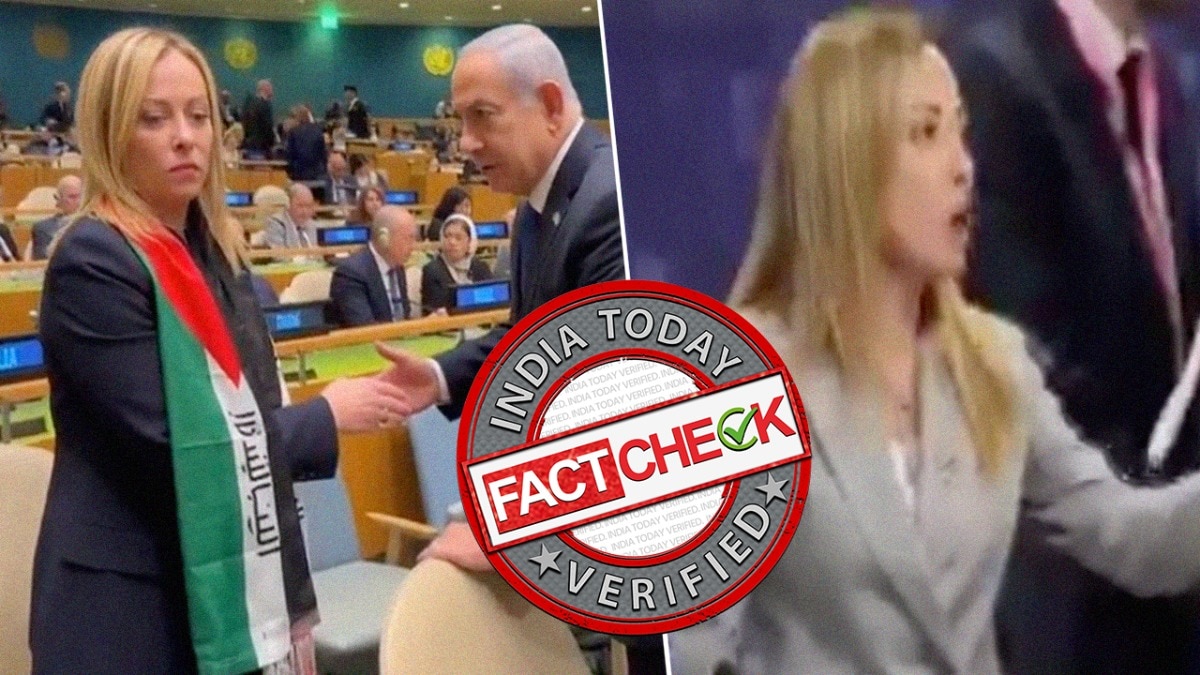
India Today fact-check reports two viral clips claiming Italian Prime Minister Giorgia Meloni snubbed Israeli Prime Minister Benjamin Netanyahu are synthetic. India Today says the first clip, which purportedly shows Meloni ignoring a handshake while wearing a scarf in Palestinian colors, was flagged as AI-generated by a deepfake detection tool developed at the University at Buffalo, with four detectors identifying manipulation. The second clip, showing Meloni angrily throwing papers, was labelled AI-generated by three detectors of the Deepfake-o-meter, per India Today. The fact-check found no evidence in news archives of a real incident and noted there are no reports of Italy ending all contracts with Israel beyond a defence cooperation agreement, according to India Today.
What happened
India Today fact-check reports two viral videos falsely portraying Italian Prime Minister Giorgia Meloni snubbing Israeli Prime Minister Benjamin Netanyahu. Per India Today, the first clip shows Meloni allegedly ignoring a handshake while wearing a scarf with Palestinian colors; the outlet ran the clip through a deepfake detector developed at the University at Buffalo, which identified the video as AI-generated on four detectors. The second clip, showing Meloni throwing papers at a conference, was evaluated by Deepfake-o-meter, whose three detectors labelled that clip AI-generated, India Today reports. India Today also reports there are no independent news accounts confirming such incidents and notes no reports of Italy ending all contracts with Israel apart from the defence cooperation agreement.
Editorial analysis - technical context
Industry-pattern observations: synthetic media that aims to mimic public figures commonly exhibits telltale artifacts such as stiff or robotic motion, inconsistent facial expressions, and reuse or slight alteration of archival footage. Detection pipelines often use ensembles of specialized detectors; India Today's report cites outputs from two such systems, illustrating how multi-detector signals are used in verification workflows. For practitioners, corroborating detector outputs with metadata, provenance checks, and archived video comparison remains standard practice.
Industry context
India Today places the viral clips in a broader moment of Italy-Israel tension, reporting earlier incidents between the countries, including an April 8 episode in which Israeli forces fired warning shots at an Italian peacekeeping convoy in Lebanon, per India Today. Editorial analysis: misinformation and synthetic clips are frequently amplified during geopolitical strain, increasing the risk of rapid narrative spread on social platforms and complicating automated moderation.
What to watch
Verification indicators to monitor include additional forensic-tool consensus, platform takedown or labeling actions, and any archival source matches for attire or staging. Observers tracking this case should check official government communications and mainstream reporting for corroboration before amplification.
Key Points
- 1India Today finds both viral clips of Giorgia Meloni snubbing Netanyahu are AI-generated, citing University at Buffalo and Deepfake-o-meter detections.
- 2Deepfakes often show robotic motion, inconsistent expressions, and reuse of archived footage, which multi-detector pipelines can help flag.
- 3Misinformation spikes during geopolitical tension, so verification and cross-checking with archival sources and official channels is essential.
Scoring Rationale
This is a notable misinformation event with geopolitical context that matters to verification specialists and platform moderators. It is not a frontier-model or infrastructure story, but it illustrates real-world harms from synthetic media and the utility of multi-detector forensic checks.
Sources
Public references used for this report.
Practice interview problems based on real data
1,625 SQL & Python problems across 15 industry datasets — the exact type of data you work with.
Try 250 free problems