EarlyDetect Forecasts Solar Active Region Emergence Earlier
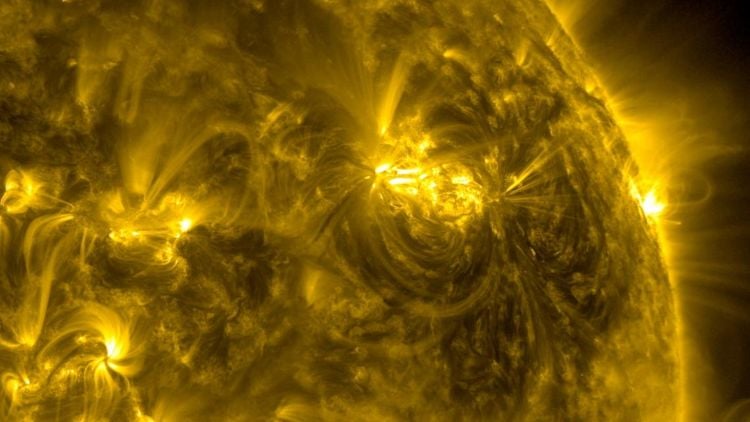
NJIT-led researchers published EarlyDetect on August 14, 2026, a transformer-based model that forecast solar active-region emergence 9.24 hours in advance on average in its evaluation. The model uses acoustic-power maps and magnetic-flux measurements from NASA's Solar Dynamics Observatory to detect weak precursors before active regions become visible, but it does not predict whether an emerging region will produce a flare or coronal mass ejection.
Researchers led by the New Jersey Institute of Technology have developed EarlyDetect, a machine-learning system that forecast the emergence of solar active regions 9.24 hours in advance on average in its published evaluation. The study was published August 14, 2026, in the *Journal of Geophysical Research: Machine Learning and Computation*, according to Tech Explorist and The Watchers.
Solar active regions are concentrated magnetic structures that rise through the Sun's visible surface and can develop sunspots. They are associated with the solar flares and eruptions that drive space-weather risks for satellite communications, power systems, and other infrastructure. The reported result concerns detection of an active region's emergence, not prediction of whether that region will later generate a solar flare or coronal mass ejection.
Inputs and model design
EarlyDetect uses observations from NASA's Solar Dynamics Observatory and its Helioseismic and Magnetic Imager. According to The Watchers, its inputs are hourly acoustic-power maps and magnetic-flux measurements, while its target is the evolution of continuum intensity associated with active-region emergence. The underlying observations used to create the acoustic products have a 45-second cadence.
The system applies a sliding-window transformer to forecast continuum-intensity evolution up to 12 hours ahead. The paper's architecture adds attention biases and a timing-aware loss function intended to increase sensitivity to the onset of emergence, The Watchers reports. Researchers also compared it with a standard transformer and versions using a Conv1D front end.
The training data came from the Solar Active Region Emergence Dataset, or SolARED. The Watchers reports that the dataset initially included 50 large active regions, of which four were excluded because of data gaps or quality issues. The remaining 46 regions were split into 41 training and validation cases and five held-out test cases.
Faint solar signals
The approach relies on helioseismology, which analyzes sound-like acoustic oscillations in the Sun. As magnetic structures rise below the photosphere, they can alter acoustic waves before a visible active region appears. Tech Explorist reports that EarlyDetect was trained to recognize these weak acoustic signatures alongside magnetic-field data.
Jonas Tirona, an NJIT undergraduate researcher and the study's lead author, told Tech Explorist: "The most valuable thing this work shows is that we can use machine learning to predict when solar active regions will emerge in advance." He added that such warning could give satellite-communications and power-grid operators time to prepare and potentially mitigate solar-storm damage.
Alexander Kosovichev, an NJIT distinguished professor and co-author, told Tech Explorist that filtering intended to isolate short-timescale patterns instead removed faint fluctuations that provided the earliest warning. The reported experiments found improved performance when those filters were removed.
The work is a focused example of transformers operating on multivariate scientific time-series and spatial measurement products rather than language. More broadly, comparable early-warning systems face a persistent evaluation challenge: a useful lead-time metric does not by itself establish operational value unless false alarms, missed events, robustness across solar cycles, and downstream event prediction are also measured.
Key Points
- 1EarlyDetect forecast active-region emergence 9.24 hours early on average, extending warning time before visible solar signatures appear.
- 2The model combines helioseismic acoustic-power maps with magnetic-flux measurements, showing transformers can process multimodal solar-observation time series.
- 3Early emergence detection does not establish flare prediction; operational warning systems require evaluation of false alarms, misses, and downstream hazards.
Scoring Rationale
This is a notable scientific ML application with a quantified early-warning result and a technically relevant transformer design. Its practitioner impact is narrower than a general-purpose model release, and the published evaluation does not establish prediction of flares or coronal mass ejections.
Sources
Public references used for this report.
Practice with real Ride-Hailing data
90 SQL & Python problems · 15 industry datasets
250 free problems · No credit card
See all Ride-Hailing problems