Dyson launches Find+Follow Purifier Cool with camera
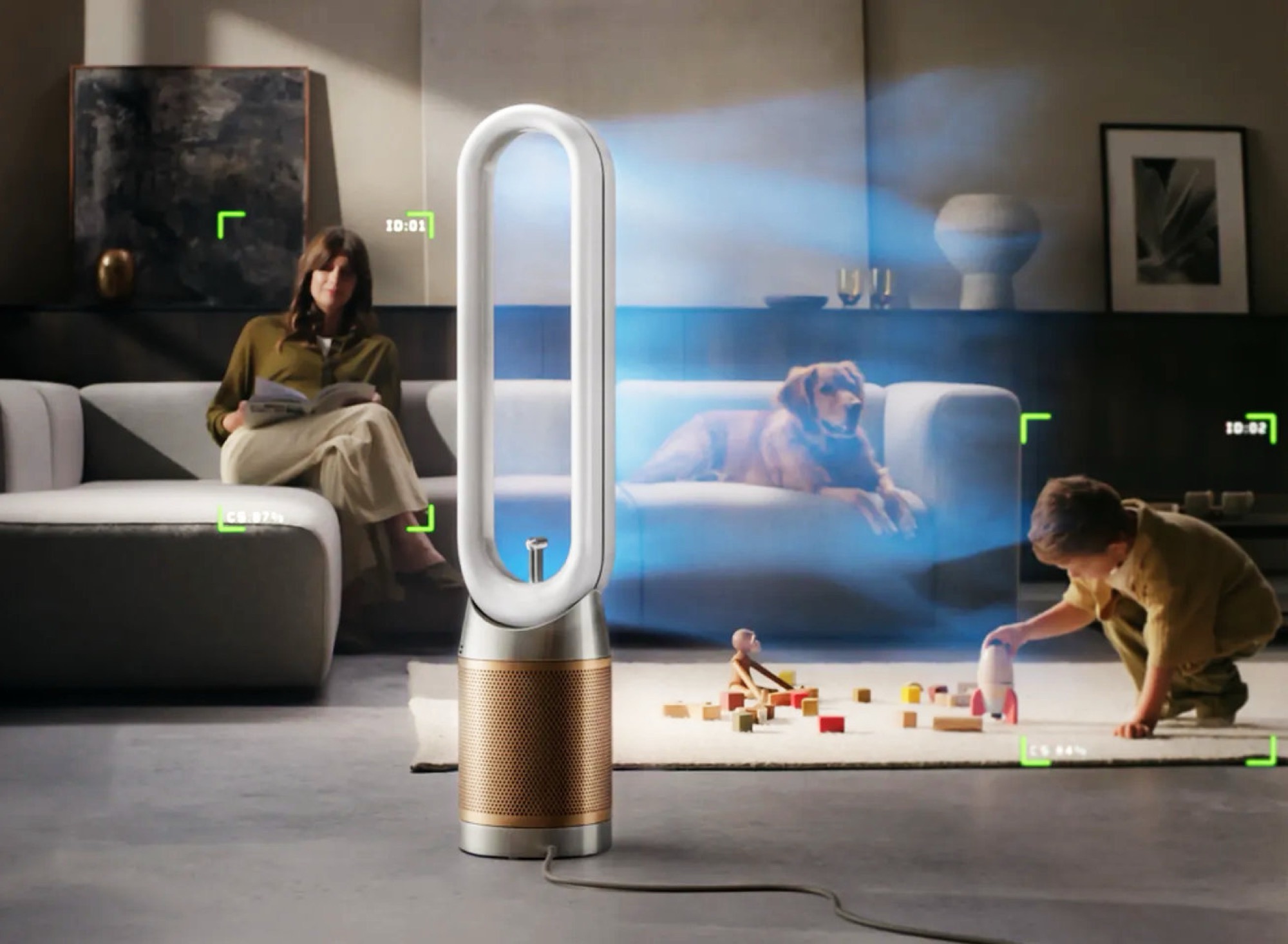
Dyson announced the Find+Follow Purifier Cool in a May 13 press release, a purifying fan that uses an onboard camera and on-device AI to detect people and direct airflow. In its press release, Dyson describes a 17-key point user detection system and states, "Images are analyzed in real time and instantly deleted, never stored or uploaded." Reporting in The Verge, Forbes, Tom's Guide and T3 notes the unit combines HEPA and K-Carbon filtration and is rated to capture 99.97% of particles as small as 0.3 microns. Reported pricing varies across outlets, with The Verge listing $894.99, Tom's Guide reporting $849 (US) and £549 (UK).
What happened
Dyson unveiled the Find+Follow Purifier Cool in a May 13, 2026 press release, describing a bladeless purifying fan that uses an onboard camera and on-device AI vision to locate people in a room and direct airflow to them. The press release describes a "17-key point user detection" approach and states, "Images are analyzed in real time and instantly deleted, never stored or uploaded." Reporting by The Verge, Forbes, Tom's Guide and T3 supplements Dyson's launch details, noting the device combines HEPA and K-Carbon filtration and is claimed to capture 99.97% of particles as small as 0.3 microns.
Technical details
Per Dyson's press release, the Find+Follow system uses an AI vision sensor to drive smart oscillation and targeted air projection; the company says the product can detect multiple people and automatically adjust its airflow distribution. Forbes and Tom's Guide report the mechanism supports wide oscillation, with Forbes citing oscillation coverage up to 350 degrees. The product includes Wi-Fi connectivity and mobile-app controls, according to The Verge and Forbes. Dyson's press release supplies the engineering rationale and includes a quote from Omer Ali, Senior Dyson Engineer: "We designed the Dyson Find+Follow Purifier Cool to respond to real human behaviour. You shouldn't need to manually adjust your fan for comfort."
Industry context
Practical implications for builders and buyers
Context and significance
What to watch
Editorial analysis
Consumer-device makers are increasingly embedding on-device vision and lightweight ML to enable spatially aware features that older sensors cannot provide. Camera-based presence detection offers higher spatial resolution than simple PIR or ultrasonic sensors, which can improve targeted functions such as directional airflow or zoned climate control, but it also increases firmware complexity and creates new privacy and security trade-offs that manufacturers must address through engineering and disclosure.
For ML engineers and embedded systems teams, deploying an on-device vision pipeline implies constraints on model size, latency, and power consumption, plus a need for robust real-time deletion guarantees and secure local inference. For product security teams, adding a camera increases the attack surface compared with passive sensors, so secure boot, encrypted storage, and documented telemetry practices become more relevant for consumer IoT audits.
The Find+Follow launch illustrates a broader pattern where mainstream home appliances adopt perception-driven features previously limited to smartphones or robotics. That pattern accelerates demand for small, quantized vision models and verified privacy-preserving pipelines in edge devices. It also underscores why reviewers and regulators focus on both capabilities and handling of sensor data, since claims of local-only processing are central to consumer trust.
Observers should follow independent tests of detection accuracy, claims about immediate image deletion, third-party security assessments, and firmware update behavior reported by outlets such as The Verge and Tom's Guide. Reported retail prices vary across coverage, with The Verge listing $894.99, Tom's Guide reporting $849 (US) and £549 (UK), so traction in different markets and user reception will be informative for how quickly camera-based sensing becomes mainstream in air treatment products.
Key Points
- 1Camera plus on-device AI enables spatially targeted airflow, improving perceived cooling while reducing wasted airflow in empty space.
- 2On-device image processing with immediate deletion is emerging as the consumer privacy posture, but independent verification and clear disclosures remain important.
- 3Adding vision to consumer appliances increases firmware, ML, and cybersecurity surface area, raising engineering and testing demands for device teams.
Scoring Rationale
Notable consumer product launch because it brings camera-based, on-device vision into a mainstream air purifier, raising practical engineering and privacy questions for IoT practitioners. The story is product-focused rather than a frontier AI advance.
Sources
Public references used for this report.
Practice interview problems based on real data
1,625 SQL & Python problems across 15 industry datasets — the exact type of data you work with.
Try 250 free problems