Denmark pauses grid connections amid data centre surge
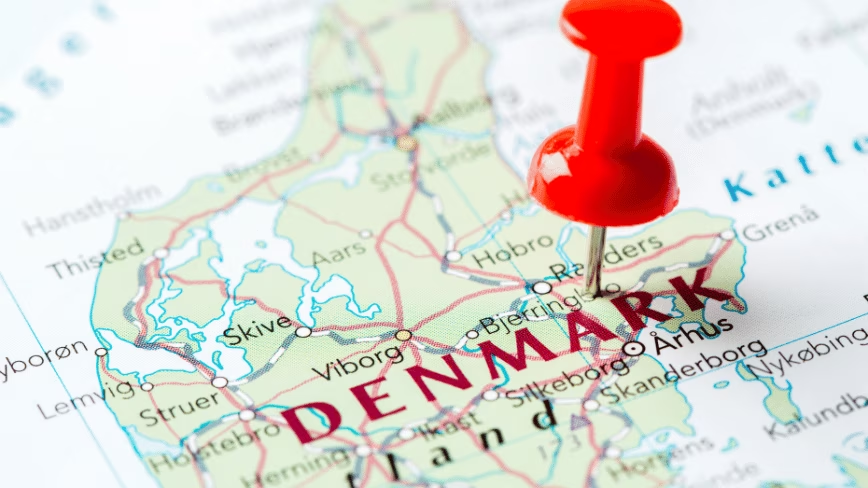
Denmark's transmission operator, Energinet, paused all new large-scale grid connection agreements in March after receiving roughly 60 GW of connection requests, far exceeding the country's peak demand of about 7 GW, according to reporting by CNBC, The Next Web, and EnergyWatch. The backlog includes a large share of data centre projects; estimates cited by The Next Web and The News put existing Danish data centre capacity at 398 MW with 208 MW under construction and projections to reach 1.2 GW by 2030, and hyperscalers accounting for about 60% of current footprint. CNBC and other outlets report the pause was described as a temporary three-month moratorium, though industry sources told CNBC it could be extended. Microsoft, Google, and Apple are among the hyperscalers driving demand, with Microsoft committing $3 billion in Danish infrastructure between 2023 and 2027, per The Next Web and The News.
What happened
Energinet, Denmark's state-owned transmission system operator, introduced a pause on new large-scale grid connection agreements in March, citing an overwhelming volume of applications, according to CNBC and EnergyWatch. Reporters state roughly 60 GW of projects are waiting in the queue, versus a national peak consumption of about 7 GW (CNBC; The Next Web; EnergyWatch). Coverage identifies a substantial portion of the queue as data centre projects and notes that hyperscale operators, including Microsoft, Google, and Apple, have driven recent growth (The Next Web; The News).
Technical details
Per reporting in The Next Web and The News, Denmark had about 398 MW of installed data centre capacity at the start of 2026, with 208 MW under construction and projections to reach 1.2 GW by 2030. The Next Web and The News also report hyperscale facilities make up roughly 60% of the current footprint. CNBC and The News quote industry sources describing the incoming applications as an "explosion" (CNBC) and a "fantasy" queue (DDI CEO Henrik Hansen, via The News). Microsoft has publicly committed $3 billion to Danish data centre construction between 2023 and 2027, according to The Next Web and The News.
Industry context
Context and significance
What to watch
Editorial analysis
The pause exposes a structural mismatch that can emerge when transmission planning, built around domestic consumption patterns and renewable intermittency, meets sudden, concentrated demand from hyperscale data centres. Grid planning timelines, permitting processes, and the geographic distribution of load mean large new loads frequently require multi-year upgrades to transmission and distribution assets.
Operators and regulators across Europe have already begun wrestling with similar tensions as AI-driven compute demand compresses what would otherwise be decades of incremental load growth into a few years. Netherlands and Ireland previously enacted moratoriums or strict conditions on data centre connections, a precedent highlighted in CNBC coverage.
For practitioners, the Danish pause signals tighter constraints on site selection and project timelines for capacity-hungry AI infrastructure. Sourcing locations with low-carbon grids no longer guarantees immediate access to power at scale; developers and cloud customers should factor queue risk, TSO prioritization policy, and grid reinforcement lead times into deployment planning.
The situation also underscores trade-offs that policymakers will face between attracting investment and protecting domestic supply and decarbonisation goals. Reporting notes Energinet has asked politicians whether the operator should be allowed stronger prioritization powers, and the pause comes while Denmark forms a new government, creating additional regulatory uncertainty (EnergyWatch; CNBC; The News).
Track three indicators:
- •whether Denmark's pause is extended or refined after the initial three-month window referenced in CNBC and The News
- •any formal changes to connection-application criteria or stronger project maturity gates proposed by Energinet or legislators (EnergyWatch; The News)
- •how other Nordics and EU regulators adjust permitting and prioritization frameworks in response, given the cross-border nature of hyperscale siting decisions
Practitioners should monitor statements from hyperscalers on project timelines and any shift toward brownfield upgrades, regional load-shedding agreements, or on-site generation/back-up solutions that affect engineering trade-offs for colocations and custom data centres.
Reported open points
Energinet and Danish political bodies have not published a final prioritization policy; reporting indicates political timing around a general election may delay decisions (CNBC; The News).
Key Points
- 1Energinet paused new connections after a roughly 60 GW queue hit a 7 GW peak grid, exposing urgent transmission constraints.
- 2Hyperscaler-driven demand concentrates large power loads quickly, forcing longer grid upgrade timelines and tougher permitting scrutiny.
- 3Regulatory pauses like Denmark's often shift project risk back to developers and cloud customers, affecting site choice and deployment timing.
Scoring Rationale
The story materially affects AI infrastructure planning: a national-grid moratorium driven by hyperscaler demand alters site-selection, timelines, and cost assumptions for large compute deployments across Europe. It is a notable, not historic, infrastructure development with broad practitioner impact.
Sources
Public references used for this report.
Practice interview problems based on real data
1,625 SQL & Python problems across 15 industry datasets — the exact type of data you work with.
Try 250 free problems