Deepak Ahuja Joins Redwood Materials as CFO
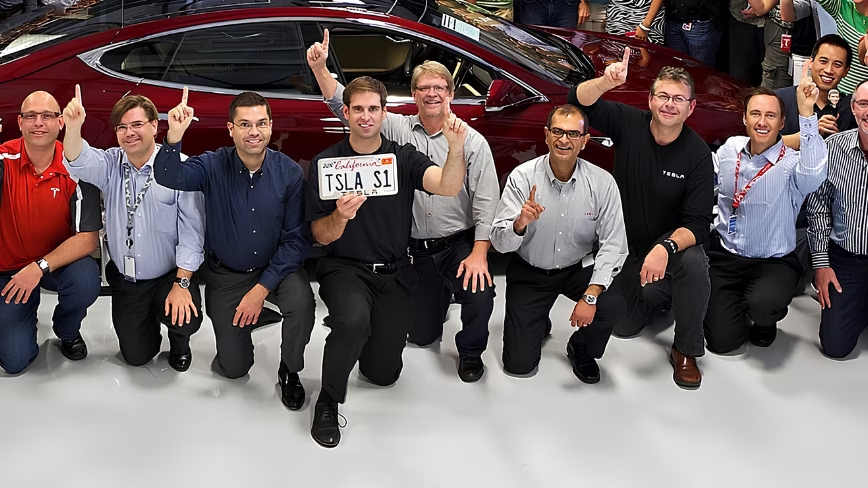
Reuters and CNBC report that Redwood Materials has hired former Tesla finance chief Deepak Ahuja as its new chief financial officer. Ahuja told TechCrunch it is "too early" to discuss an IPO. Public coverage describes Redwood as expanding beyond battery recycling into grid-scale energy storage for data centers through its Redwood Energy division, including a reported deployment with Crusoe that reached 12 megawatts and 63 megawatt-hours of second-life EV battery capacity, according to The Next Web. CNBC reports Redwood has raised more than $2.3 billion; TechCrunch reports a $425 million Series E in January that brought total capital to more than $2 billion and a valuation above $6 billion, while CNBC also reports a $2 billion loan commitment from the U.S. Department of Energy. TechCrunch reports the company recently restructured and cut about 10 percent of its workforce. Senior finance hires with IPO experience commonly precede capital-heavy scaling and invite closer investor scrutiny.
What happened
Reuters and CNBC report that Redwood Materials appointed former Tesla finance chief Deepak Ahuja as its new chief financial officer. TechCrunch quotes Ahuja saying it is "too early" to talk about an IPO. CNBC reports the company has raised over $2.3 billion in venture funding. TechCrunch reports the company in January closed a $425 million Series E that brought total capital raised to more than $2 billion and a valuation above $6 billion. CNBC reports a $2 billion loan commitment from the U.S. Department of Energy. The Next Web reports Redwood processes more than 20 gigawatt-hours of batteries annually and holds roughly 70 percent of the U.S. battery recycling market. The Next Web and company announcements describe a shift toward deploying second-life EV batteries for grid and data center power; The Next Web reports a joint deployment with Crusoe that reached 12 megawatts and 63 megawatt-hours, which it called the largest second-life battery deployment and the largest microgrid in North America.
Technical details
Editorial analysis - technical context
Second-life EV batteries are being repurposed for stationary energy storage because they retain substantial usable capacity after automotive service life. For practitioners, these systems require robust battery management, cell- and pack-level diagnostics, and thermal and lifecycle management to deliver reliable grid or data center power. Integrating reclaimed packs into microgrids introduces interoperability and safety trade-offs compared with new utility-grade batteries, and system-level control and inverter integration become central engineering tasks.
Context and significance
Hiring a CFO with documented IPO and scaling experience is a common move for companies entering capital-intensive infrastructure markets. Public reporting frames Ahuja's hire as strengthening financial leadership while Redwood redirects resources toward energy storage for data centers; TechCrunch reports the company recently restructured and reduced its workforce by about 10 percent. The funding history and the DOE loan commitment reported by CNBC and TechCrunch indicate strong investor and public-sector backing, which matters for projects that combine recycling, domestic critical minerals supply, and large-scale deployments.
For AI infrastructure practitioners, second-life battery microgrids offer a potential pathway to lower-cost, lower-embedded-carbon backup and peak-shaving solutions colocated with compute. Editorial analysis - technical context: However, using reclaimed EV packs at data center scale raises operational questions familiar to facility engineers, including state-of-health monitoring, warranty and liability frameworks, long-term degradation modeling, and integration with existing UPS and site-level energy management systems.
What to watch
- •Announced commercial contracts with hyperscalers or major AI data center operators, which would show demand beyond pilot projects.
- •Technical performance and reliability metrics for second-life deployments, including measured round-trip efficiency, availability, and degradation rates under data center load profiles.
- •Follow-on financing events or a formal IPO timetable, which coverage has flagged as of interest but which Ahuja told TechCrunch is "too early" to discuss.
- •Regulatory or interconnection approvals tied to grid services and microgrid operation, and any standardization efforts around second-life battery certification.
Bottom line
Editorial analysis
The hire is notable because it combines deep cleantech financial experience with a company straddling recycling, critical-minerals supply, and energy storage for high-growth AI compute demand. For data center and energy architects, Redwood's public deployments and capital backing make it a firm to monitor as second-life batteries move from pilots toward operational microgrids.
Key Points
- 1Senior finance hires with IPO experience commonly precede capital-heavy scaling, increasing investor scrutiny and fundraising readiness.
- 2Second-life EV batteries can lower costs for data center energy storage but introduce lifecycle, safety, and integration complexity.
- 3DOE backing and large venture rounds materially reduce capital risk for infrastructure pilots, accelerating commercial deployments if technical metrics hold.
Scoring Rationale
Notable for AI and energy infrastructure practitioners: a high-profile CFO hire combined with large funding, DOE support, and visible second-life battery deployments increases the likelihood that reclaimed batteries will scale into operational data center microgrids.
Sources
Public references used for this report.
View 6 more sources
- ‘Too early’ to talk IPO, Redwood Materials’ incoming CFO saystechcrunch.com
- Redwood Materials hires former Tesla CFO - Axiosaxios.com
- Former long-time Tesla CFO Deepak Ahuja joins JB Straubel’s Redwood Materialselectrek.co
- Redwood Materials hires former Tesla CFO Deepak Ahuja - Quartzqz.com
- 'Too early' to talk IPO, Redwood Materials' incoming CFO saysfinance.yahoo.com
- Redwood Materials names ex-Tesla CFO Deepak Ahuja as finance ...investing.com
Practice with real Telecom & ISP data
90 SQL & Python problems · 15 industry datasets
250 free problems · No credit card
See all Telecom & ISP problems