Customizing large model agents operates smart grids
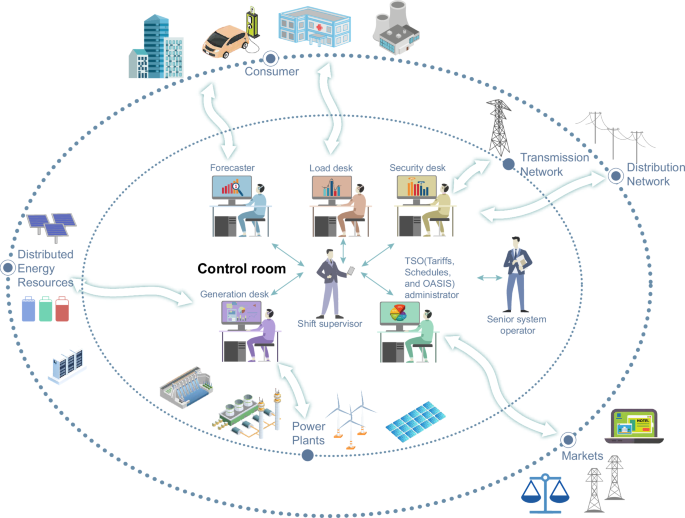
A paper published in Nature Communications Engineering presents a framework for operating smart grids using customized large model agents. As renewable energy integration, electrification, and digitalization increase grid complexity and data volumes, the authors argue that tailoring large model agents to grid-specific operational contexts offers a path for autonomous decision support, real-time control, and handling the scale of modern power system data. The research targets practical challenges grid operators face as traditional rule-based systems struggle to keep pace with dynamic and data-intensive power networks.
Overview
Published June 24, 2026 in Nature Communications Engineering, this paper proposes a framework for applying customized large model agents to smart grid operations. The central argument is that modern power grids have become too complex and data-rich for conventional control approaches to handle effectively.
The Challenge
Grid operators face compounding pressures: renewable energy sources (solar, wind) introduce generation variability; accelerating electrification (electric vehicles, heat pumps) reshapes demand patterns; and pervasive sensor networks generate data volumes that exceed legacy-software capacity to process in real time. Standard optimization algorithms, designed for simpler grids, increasingly struggle with this complexity.
The Approach
The authors propose customizing large model agents - adapting large language model architectures to the specific operational vocabularies, data schemas, and decision-making contexts of power grid management. This domain-specific customization distinguishes their approach from deploying generic AI systems and is intended to improve accuracy and reliability in grid tasks such as load forecasting, fault detection, and demand response coordination.
Context
The paper joins a growing body of research applying LLM-based agents to energy infrastructure. Related work has shown LLM agents can interpret natural-language interconnection requests, orchestrate power system simulations, and support peer-to-peer energy trading. Publication in a peer-reviewed Nature journal lends credibility to the framework, though specific benchmarks are behind institutional access and could not be independently verified.
Key Points
- 1What: Nature Communications Engineering paper proposes tailoring large model agents to smart grid operations for autonomous control and decision support.
- 2Why: Renewable integration, electrification, and digitalization are making power grids too complex and data-rich for conventional automation systems.
- 3So what: Domain-specific customization of LLM agents - rather than generic deployment - may become a standard approach for next-generation grid management.
Scoring Rationale
A peer-reviewed Nature paper applying customized LLM agents to smart grid operations is solid, practically relevant research for AI/DS practitioners in the energy sector. Single-paper publication in a niche applied domain without independently verified benchmarks places it firmly in the solid-but-not-major range.
Sources
Public references used for this report.
Practice interview problems based on real data
1,625 SQL & Python problems across 15 industry datasets — the exact type of data you work with.
Try 250 free problems