
Cornell Builds Autonomous Microrobots With CMOS Brains
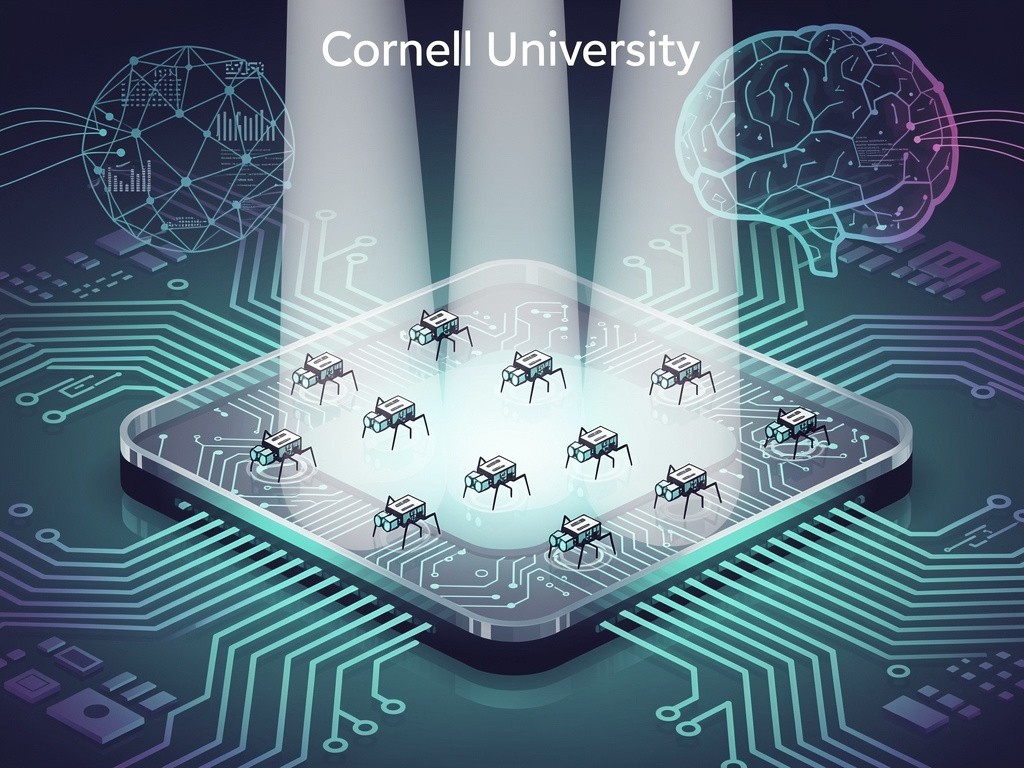
In a Cornell University lab, researchers led by Paul McEuen and Itai Cohen have built autonomous 100-micron robots integrating CMOS control, photovoltaic power, and platinum-legged bubble propulsion, reported in Nature. They trained reinforcement-learning algorithms (announced early 2023) in simulation to discover efficient gaits, achieving speeds above 10 micrometers per second. The scalable wafer-based fabrication suggests potential for in-vivo diagnostics and micro-manufacturing, though power, control, and biocompatibility hurdles remain.
Key Points
- 1Integrates CMOS control, solar cells, and platinum legs into 100-micron autonomous robots
- 2Demonstrates untethered autonomy and onboard decision execution via flashed AI-discovered gaits
- 3Enables scalable wafer-level production for swarms, applicable to diagnostics and micro-manufacturing
Scoring Rationale
Strong experimental advance with peer-reviewed validation; limited near-term clinical applicability due to power, control, and biocompatibility deployment hurdles.
Practice interview problems based on real data
1,625 SQL & Python problems across 15 industry datasets — the exact type of data you work with.
Try 250 free problems


