Cloudsmith Raises $72M To Secure AI Software Supply Chains
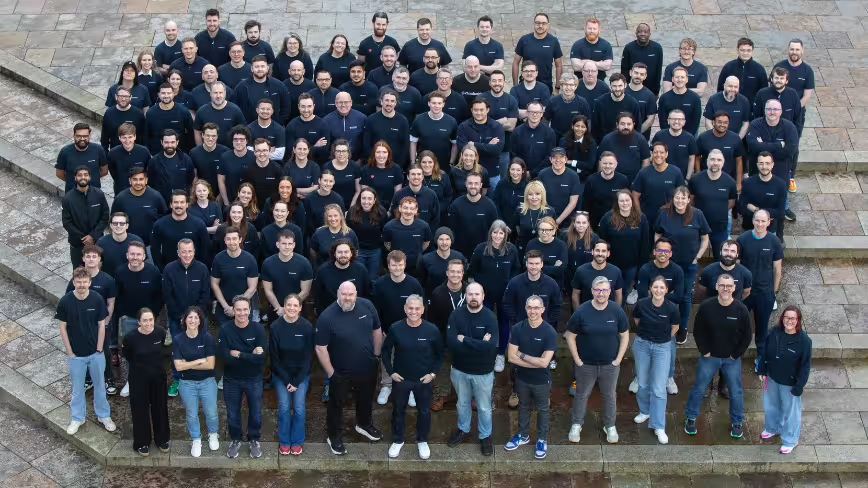
Belfast-founded artifact management provider Cloudsmith raised $72 million in a Series C led by TCV with participation from Insight Partners. The funding, coming less than a year after a $23 million Series B, will accelerate product development and go-to-market expansion for Cloudsmith's cloud-native private registry and artifact governance capabilities. The company positions itself as a critical control layer for the rising volume of AI-generated code and expanding software supply chain attack surfaces, offering package hosting, mirroring of public registries, scanning, policy enforcement, and a newly emphasized model registry. CEO Glenn Weinstein frames the shift as permanent: AI agents create too much code for human review, so enterprises need automated, enterprise-grade artifact controls.
What happened
Cloudsmith raised $72 million in a Series C round led by TCV with participation from Insight Partners and existing investors. The financing follows a $23 million Series B less than thirteen months earlier and will fund product R and D, go-to-market expansion, and scaling of its cloud-native artifact management platform. "Cloudsmith is the only platform built for the way software is being developed today, by AI agents. We're never going back to hand-crafted software," said Glenn Weinstein, CEO.
Technical details
Cloudsmith operates a universal, cloud-native private registry for software artifacts: packages, binaries, containers, dependencies, and internal build outputs. Its product set focuses on visibility, governance, and enforcement across the software supply chain to compensate for the velocity and volume introduced by AI coding agents. Key capabilities include:
- •Private package hosting and distribution across formats
- •Mirroring and caching of public registries such as PyPI, Docker Hub, Maven, and npm inside enterprise boundaries
- •Automated security scanning and vulnerability detection integrated into CI/CD pipelines
- •Policy enforcement and access controls to prevent unsafe artifacts entering production
- •An emerging ML Model Registry capability to manage models as first-class artifacts
Cloudsmith positions these features as distinct from legacy artifact managers like JFrog Artifactory and Sonatype Nexus, arguing the incumbents were built for slower, human-led development cycles and require rethinking for agent-driven code production.
Context and significance
The round is notable for investor behavior as much as product positioning. TCV and Insight Partners both backed Cloudsmith's Series B and doubled down quickly, signaling conviction that artifact management becomes a strategic infrastructure tier as enterprises adopt AI-coding agents. The thesis is straightforward: AI agents multiply the number of artifacts and the speed at which they are produced, expanding the attack surface exposed via open-source dependencies, third-party packages, and generated code patterns that may introduce novel vulnerabilities. Regulatory and board-level scrutiny around software supply chain security and "secure by design" requirements is also elevating demand for platforms that provide auditability and enforceable policies.
For practitioners, Cloudsmith's push matters because securing the software supply chain increasingly requires controls at the artifact layer rather than only at source code or runtime layers. Managing provenance, immutability, signing, and policy enforcement at the registry level reduces the window in which compromised or malicious artifacts can propagate through CI/CD. The ML Model Registry mention signals vendor recognition that models themselves will become managed artifacts with provenance, licensing, and security requirements similar to binaries.
What to watch
Adoption metrics among Fortune 500 and Global 2000 customers, integration breadth with major CI/CD systems and SCA tools, and velocity of the new model registry feature. Competitor responses from incumbents and open-source registry projects will indicate whether this becomes a centralized enterprise practice or a fragmented set of point solutions.
Bottom line
The funding validates artifact management as strategic infrastructure for the AI era. Cloudsmith now has capital to accelerate productization of registry-level controls and model artifact governance, but enterprise traction will hinge on deep CI/CD integrations, developer ergonomics, and demonstrable security outcomes.
Key Points
- 1Cloudsmith raised $72M to expand cloud-native artifact management, positioning itself as a control plane for AI-generated software supply chains.
- 2Investors TCV and Insight Partners reinvested quickly after Series B, signaling conviction in Cloudsmith as enterprise guardrails for AI coding agents.
- 3Product emphasis on private registries, mirroring public registries, scanning, policy enforcement, and a model registry targets new AI-era attack vectors.
Scoring Rationale
This is a notable Series C that underscores rising enterprise demand for registry-level controls as AI-generated code increases artifact volume. It is important for infrastructure and security teams but not a paradigm-shifting event.
Sources
Public references used for this report.
View 6 more sources
- Cloudsmith Raises $72M in Series C Fundingfinsmes.com
- Cloudsmith raises $72M in Series C funding led by TCVza.investing.com
- Cloudsmith raises $72M in Series C funding led by TCVca.investing.com
- Cloudsmith obtiene $72M en ronda Serie C liderada por TCVmx.investing.com
- Cloudsmith raises $72M in Series C funding led by TCVuk.investing.com
- Cloudsmith Raises $72M Series C Led by TCV with Participation from Insight Partners to Control and Secure the AI-Powered Software Supply Chainweeklyvoice.com
Practice interview problems based on real data
1,625 SQL & Python problems across 15 industry datasets — the exact type of data you work with.
Try 250 free problems