What happened
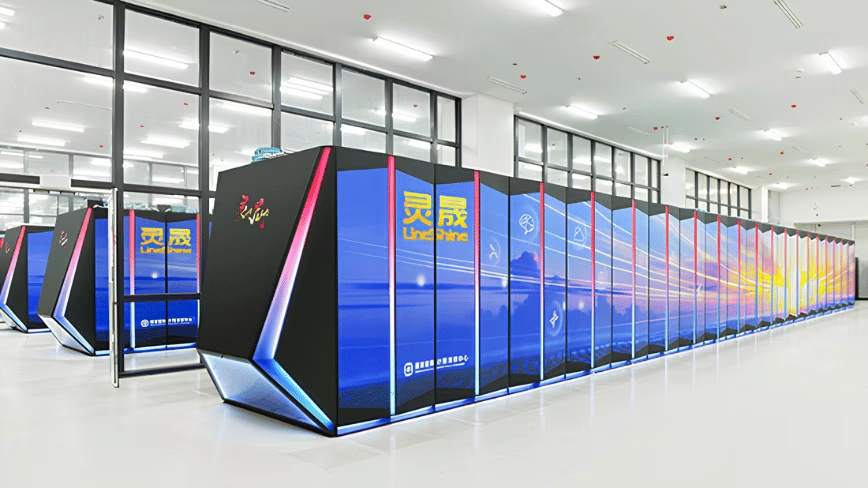
The TOP500 announced on June 23, 2026 that LineShine, installed at the National Supercomputing Centre in Shenzhen, debuts at No.1 with 2.198 Exaflop/s on the HPL benchmark, per the TOP500 press release. TOP500 reports LineShine reached about 80 percent of a 2.736 Exaflop/s theoretical peak and recorded 22.00 HPCG-Petaflop/s on the HPCG benchmark. The entry displaces El Capitan (TOP500 reports 1.809 Exaflop/s) and marks the first Chinese No.1 since 2017, according to TOP500.
Technical details
TOP500 attributes the result to a CPU-focused architecture: the system uses semi-custom LX2 processors with 304 cores each running at 1.55 GHz, supplying 13.79 million total cores across the machine, TOP500 states. TOP500 lists power draw at approximately 42.2 megawatts and an efficiency of 52.07 Gigaflops/Watt. Data Center Dynamics (DCD) reports the LX2 processors are based on the ARMv9 instruction set and were co-developed with Huawei, with 40,960 chips deployed across 92 cabinets using Huawei Kunpeng racks (DCD, June 23, 2026). TOP500 further reports LineShine achieved 7.92 Exaflop/s on HPL-MxP; DCD notes this places LineShine fourth on the mixed-precision ranking, consistent with a CPU-only design without dedicated low-precision accelerators.
Reporting by The Next Web, Tom's Hardware, and Engadget supplements TOP500's technical summary by noting that LineShine runs Kylin OS with a proprietary LingQi interconnect.
Industry context
Editorial analysis: Industry observers note LineShine highlights a different hardware path to leadership-class HPC: achieving sustained double-precision exascale performance with many-core CPUs rather than GPU-accelerated nodes. Reporting across technical outlets emphasizes increased architectural diversity on the TOP500, with leading systems now spanning CPU-only, GPU-accelerated, and mixed approaches.
Editorial analysis: Observers following export-control-driven supply constraints point out that a high-performing CPU-only architecture relying on domestically sourced LX2 and Huawei networking reduces dependence on Nvidia, AMD, or Intel components. The co-design with Huawei adds a notable supply-chain and geopolitical dimension to the result.
Significance for practitioners
For ML and HPC practitioners, the key open question is workload parity: CPU-centric designs show sustained double-precision exascale performance but ranked fourth on HPL-MxP, which measures mixed-precision throughput closer to AI training workloads. Whether CPU-dominant architectures can match GPU-accelerated systems on the mixed-precision and AI training benchmarks that matter most to model developers remains to be demonstrated at scale.
Key Points
- 1Industry observers note LineShine's 2.198 Exaflop/s HPL result proves CPU-only architectures can reach sustained double-precision exascale leadership.
- 2Reporting highlights LineShine's domestically sourced stack, which lowers dependence on Nvidia/AMD/Intel GPUs and adds hardware-path diversity on the TOP500.
- 3For practitioners, the key question is workload parity: CPU-centric designs must demonstrate comparable mixed-precision and AI training efficiency to shift procurement patterns.
Scoring Rationale
This is a notable infrastructure milestone: a CPU-only system reaching sustained double-precision exascale changes hardware diversity and has supply-chain and geopolitical relevance for ML and HPC practitioners.
Practice with real Health & Insurance data
90 SQL & Python problems · 15 industry datasets
250 free problems · No credit card
See all Health & Insurance problems