What happened
Broadcom announced VMware Cloud Foundation 9.1 in a May 5 press release, positioning the release as an AI- and Kubernetes-native private cloud platform aimed at production inference and agentic AI workloads. The company and VMware blog posts describe platform updates that include NVMe memory tiering, vSAN global deduplication and enhanced compression, and mixed compute support across AMD, Intel, and NVIDIA hardware vendors. NetworkWorld and Broadcom materials report integrated virtualized load balancing using VMware Avi Load Balancer and security controls including vDefend to reduce reliance on physical appliances.
Broadcom's announcement and VMware's product blog present quantified vendor claims for infrastructure impact: the press release attributes up to 40% reduction in server costs via memory tiering, up to 39% lower storage TCO through deduplication and compression, and up to 46% reduction in Kubernetes operational costs, along with claims of 4x faster cluster upgrades and 2x increased fleet capacity.
Technical details
Per Broadcom and VMware blog posts, VCF 9.1 extends the platform's software-defined stack to better consolidate AI and traditional workloads. Key technical items reported across vendor and trade coverage include:
- •Enhanced NVMe memory tiering that offloads colder pages from DRAM to NVMe to increase effective memory capacity.
- •vSAN continuous global deduplication and improved compression that operate in encrypted environments.
- •Virtualized networking and appliance consolidation using VMware Avi and vDefend to provide inference endpoint load balancing without dedicated hardware.
- •Multi-tenant infrastructure and controls intended to enforce strict security boundaries for co-located AI projects, as reported by NetworkWorld and StorageReview.
Each of the above technical claims and the percentage TCO numbers are presented by Broadcom in its press materials and by VMware in product blog posts.
Industry context
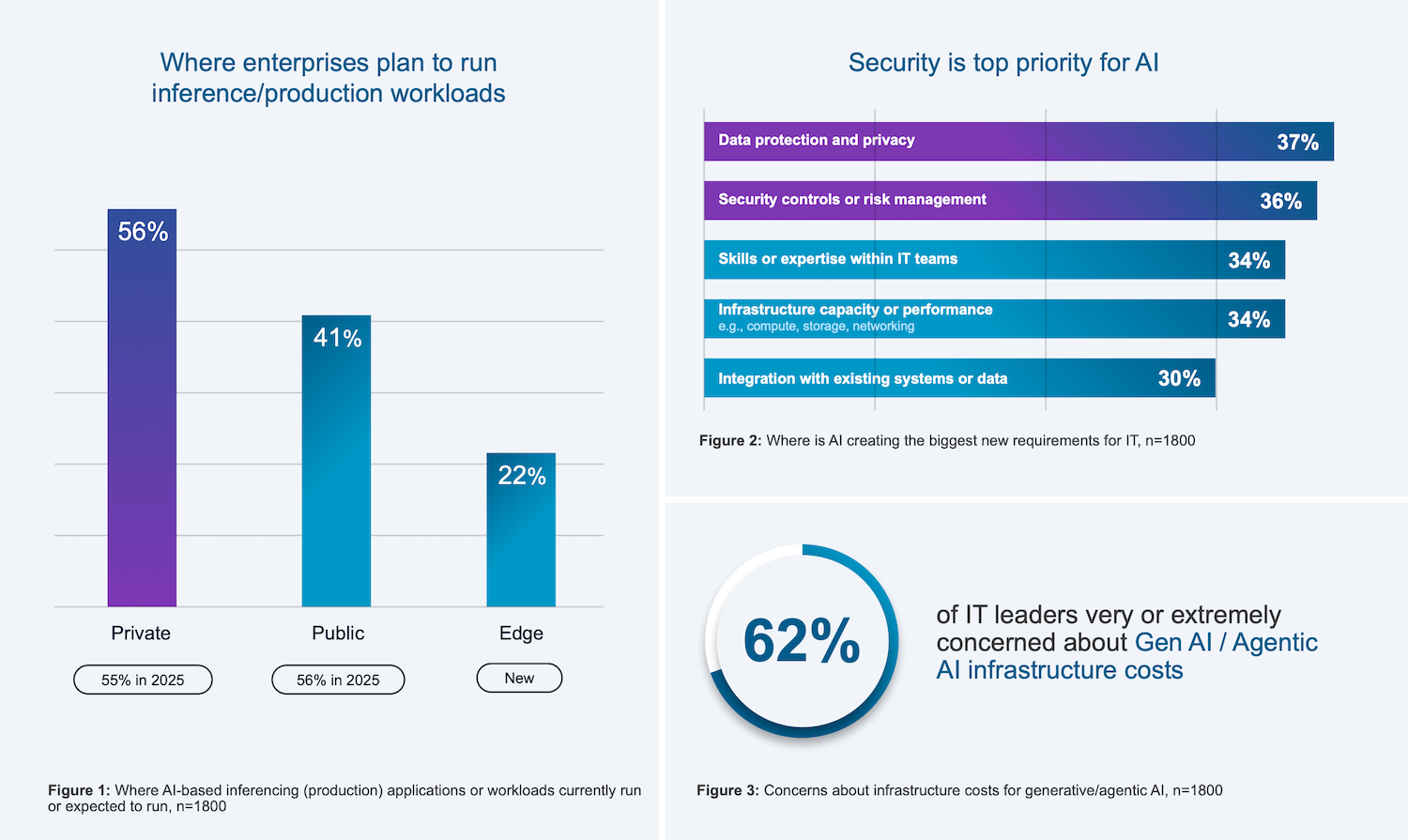
Editorial analysis: Public reporting frames VCF 9.1 as part of a broader industry shift where vendors are packaging private-cloud stacks to address cost, data governance, and supply-chain friction around GPUs and other accelerator hardware. The preview of the Private Cloud Outlook 2026 report (compiled by Radius Tech with Broadcom) is cited by multiple outlets as evidence that enterprises are more often considering private environments for production inference, with 56% reported as running or planning private-cloud inference and 41% in public cloud. That survey result, together with vendor claims about cost reductions, underscores why infrastructure vendors are emphasizing efficiency and multi-vendor hardware support.
For practitioners
Editorial analysis: Practitioners should treat the platform claims as vendor-provided until independent benchmarks and customer case studies appear. The most consequential items to validate are the memory-tiering performance characteristics under mixed AI and VM workloads, real-world TCO gains from vSAN deduplication on AI datasets, and the operational impact of the reported 46% Kubernetes cost reductions. Interoperability with specific GPU generations from NVIDIA and AMD, integration with existing cluster orchestration tooling, and the behavior of multi-tenant security boundaries under agentic workloads are practical questions operations teams will need answered before committing to large-scale migrations.
What to watch
Editorial analysis: Look for third-party performance studies, customer deployment reports that quantify cost and performance vs public cloud, certifications or partner hardware reference architectures from GPU vendors, and independent security assessments of the multi-tenant and zero-trust features. Also monitor whether Broadcom releases detailed technical whitepapers or benchmarks that replicate the vendor TCO figures presented in the press release.
Bottom line
Broadcom and VMware present VCF 9.1 as a private-cloud platform tailored for production AI with a mix of software storage, memory-tiering, networking, and security updates. The headline efficiency and TCO figures come from vendor materials and a vendor-partnered survey; independent validation will determine how those claims translate into operational decisions for enterprise AI deployments.
Key Points
- 1VCF 9.1 bundles memory-tiering, vSAN deduplication, and virtualized load balancing to target production inference cost reduction, per Broadcom.
- 2A Broadcom-partnered Private Cloud Outlook preview reports 56% of orgs running or planning private-cloud inference, highlighting cost and governance drivers.
- 3For practitioners, independent benchmarks, GPU interoperability, and security validation will be decisive when evaluating vendor TCO claims.
Scoring Rationale
The release is a notable vendor play to make private cloud more appealing for production AI, with quantified TCO claims and multi-vendor GPU support. It matters to infrastructure and operations teams but relies on vendor-provided benchmarks, so the story is significant but not immediately transformative.
Practice with real Ad Tech data
90 SQL & Python problems · 15 industry datasets
250 free problems · No credit card
See all Ad Tech problems