AWS and Cisco Secure AI-Agent Deployments at Scale
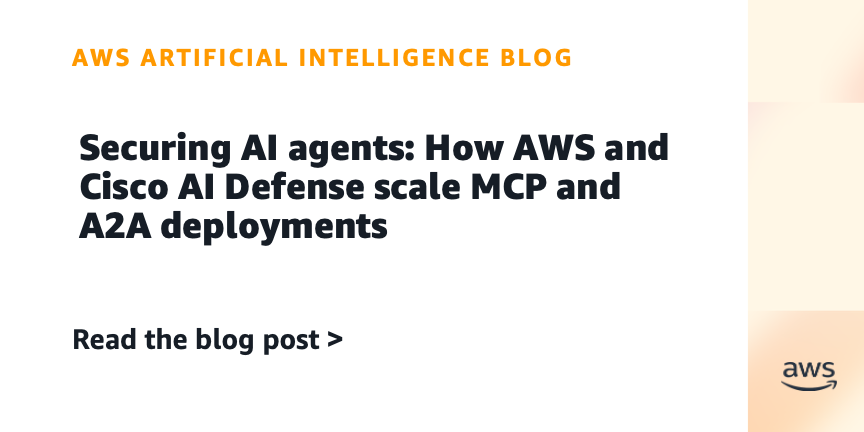
The AWS blog post describes a collaboration between AWS and Cisco AI Defense that addresses three enterprise security gaps for AI agents: visibility, manual security-review bottlenecks, and compliance risk. The post says MCP adoption accelerated after its November 2024 introduction and that A2A communication followed in April 2025, producing "dozens to hundreds" of MCP servers in enterprises, per the blog. The post reports risks from unvetted MCP servers, A2A agents, and Agent Skills including inadvertent access to sensitive systems, potential SOX and GDPR compliance failures, and operational disruption. The blog states manual security reviews can add several weeks to deployment. To address these gaps, the AWS blog post describes integration between Cisco AI Defense and an AWS-backed open-source project to provide automated scanning and unified governance for MCP servers, AI agents, and Agent Skills.
What happened
The AWS blog post documents a collaboration between AWS and Cisco AI Defense focused on enterprise-scale security for AI agents. The post says MCP adoption accelerated after its November 2024 introduction and that A2A capability appeared in April 2025, with organizations now running "dozens to hundreds" of MCP servers, per the post. The blog reports three primary security gaps: lack of visibility into deployed tools and agents, manual security-review bottlenecks that can add several weeks to deployments, and inadequate audit trails for compliance frameworks such as SOX and GDPR. The post describes integration of Cisco AI Defense with an AWS-backed open-source project to enable automated scanning and unified governance across MCP servers, AI agents, and Agent Skills.
Technical details
Editorial analysis - technical context: The blog emphasizes automated scanning and metadata-driven discovery as the core technical levers for addressing tool sprawl and A2A complexity. Industry implementations that adopt automated scanning typically combine inventory discovery, static and dynamic analysis of connectors/skills, and telemetry correlation to detect lateral agent communications and risky permissions. Unified governance layers often map discovered artifacts to policy templates and generate audit trails suitable for compliance teams.
Context and significance
Industry context: Enterprises moving from single-agent prototypes to fleets of agents face operational scale problems that are familiar from microservice and API sprawl. Automated security controls and centralized observability reduce manual review overhead and create machine-readable evidence for compliance reviews. The AWS blog describes the Cisco integration as a way to overcome AI security challenges through automated scanning and unified governance.
What to watch
For practitioners: monitor whether the integration produces searchable inventories and tamper-evident audit logs for Agent Skills and MCP servers, and whether automated scanners surface false positives at scale. Observers should watch for published integration guides, sample policies, and any open-source tooling from the AWS-backed project that can be evaluated in customer environments.
Key Points
- 1Automated scanning plus inventory discovery addresses visibility and reduces the manual-review backlog that often delays agent deployments.
- 2Mapping discovered agents and Skills to policy templates helps create machine-readable audit trails required by frameworks like SOX and GDPR.
- 3Integrations between security platforms and open-source tooling are an industry pattern for scaling governance across many heterogeneous AI agents.
Scoring Rationale
This story matters to practitioners because it addresses operational security and compliance at scale for AI-agent deployments, a practical challenge as organizations run dozens to hundreds of MCP servers. The coverage is notable but not paradigm-shifting.
Practice interview problems based on real data
1,625 SQL & Python problems across 15 industry datasets — the exact type of data you work with.
Try 250 free problems