AnySearch Launches Search Infrastructure for AI Agents
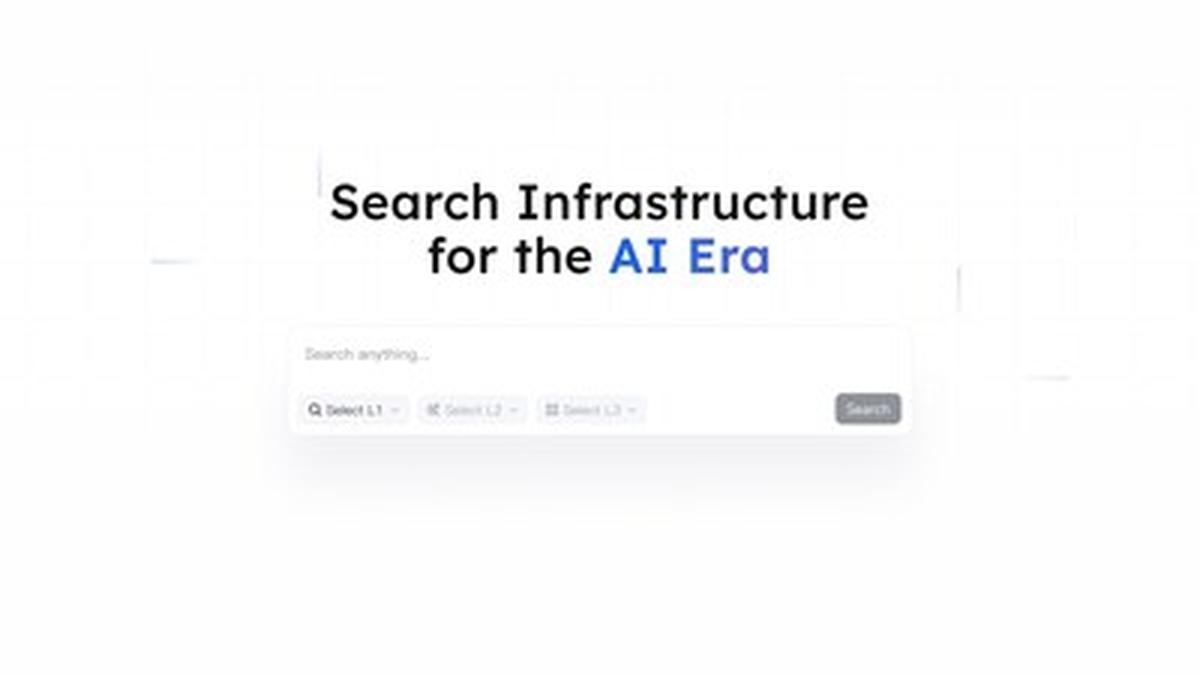
AnySearch has launched a search infrastructure product purpose-built for AI agents and enterprise systems, the company announced in a PR Newswire release and on its website. Per the PR Newswire release, AnySearch exposes a single unified API that aggregates vertical, authenticated sources such as finance, legal, academic repositories, code hosts, and structured APIs, and the product is available across developer ecosystems including GitHub, skills.sh, ClawHub, SkillHub, and Glama with users receiving 1,000 free API calls per day. AnySearch's website publishes internal benchmark results showing 76.4% overall accuracy across three datasets (Frames, FreshQA, WebwalkerQA) using z-ai/glm-5.1 as the LLM, and reports an end-to-end agent latency of 47.8s, which it compares to competitor figures for Parallel and Brave. The AnySearch website also advertises privacy features including "no tracking, no telemetry, and no logging."
What happened
AnySearch launched a search infrastructure product purpose-built for AI agents and enterprise AI systems, according to a PR Newswire distribution reproduced on Yahoo Finance and other outlets. Per the PR Newswire release, AnySearch offers a unified API that aggregates vertical, authenticated sources across domains including finance, legal, academic research, cybersecurity, energy, and corporate intelligence. The PR Newswire release and the AnySearch website state the product is available across developer ecosystems such as GitHub, skills.sh, ClawHub, SkillHub, and Glama, and PR Newswire reports users currently receive 1,000 free API calls per day. The AnySearch website publishes benchmark claims showing 76.4% overall accuracy across three datasets and an end-to-end agent latency of 47.8s, evaluated with the z-ai/glm-5.1 model; the site includes comparisons versus competitors it labels Brave and Parallel. The company website also lists privacy and security features described as "zero retention execution," "zero-knowledge credentials," and "no tracking, no telemetry, no logging."
Editorial analysis - technical context
AnySearch emphasizes structured, agent-friendly outputs and routing tuned for agent workflows. Industry-pattern observations: AI agents often suffer from token inefficiency when consuming free-text search results; providing structured markdown and entity-enriched responses can reduce prompt and context overhead and lower per-query LLM cost. Observers building agent stacks frequently prefer unified connectors that hide authentication, rate limits, and schema differences across vertical sources; this reduces integration overhead for agent skills and toolchains. The AnySearch benchmarks use the same LLM (z-ai/glm-5.1) across baselines, which isolates the search component in end-to-end testing but still leaves open questions about generalization across other model families and real-world agent chains.
Context and significance
Coverage for agent-centric search has grown as agents move from exploratory demos toward production automation. Companies and research projects are increasingly focused on delivering low-latency, high-precision retrieval from authenticated and real-time sources, rather than only crawling the public web. For practitioners, a product that standardizes access to authenticated professional sources can shorten development time for agent skills that require domain-grade data, such as financial analysis or security audits. However, claimed benchmark advantages reported by a vendor should be validated independently, especially when evaluations use proprietary datasets or a single model backbone.
What to watch
Industry context
Watch for third-party reproductions of AnySearch's benchmark numbers across multiple LLMs and agent frameworks, and for independent tests of latency under realistic concurrent load. Also monitor which vertical data partnerships AnySearch secures for regulated domains, since enterprise adoption of unified search hinges on licensed access and SLAs. Observers will also track ecosystem integrations beyond the initial list, pricing beyond the promotional 1,000 free API calls per day, and security audits or attestations that corroborate the "no telemetry" and "zero retention" claims.
Practical takeaway for practitioners
Editorial analysis
For teams building agent-based workflows, the two relevant trade-offs are retrieval fidelity versus integration surface area. Using a unified, authenticated search API can reduce connector engineering, but teams should evaluate result structure, provenance metadata, and latency in their own agent loops. Industry-pattern observations: vendors that provide structured outputs and intent-aware routing can materially change agent prompt design, but independent validation is essential before replacing existing retrieval or knowledge-grounding layers.
Key Points
- 1Vendor claims a unified API to authenticated vertical sources, reducing connector engineering for agent developers.
- 2AnySearch reports 76.4% accuracy and 47.8s end-to-end latency using z-ai/glm-5.1; independent reproduction is needed.
- 3Industry-pattern observation: structured, agent-native results can lower token use and improve runtime for agent workflows.
Scoring Rationale
This is a notable product launch for agent infrastructure with potential practical value for teams integrating authenticated vertical data. The score reflects vendor-stage importance rather than a frontier-model release, and it deducts slightly for the need for independent validation.
Sources
Public references used for this report.
Practice with real FinTech & Trading data
90 SQL & Python problems · 15 industry datasets
250 free problems · No credit card
See all FinTech & Trading problems