AMD reportedly planning another GPU price hike
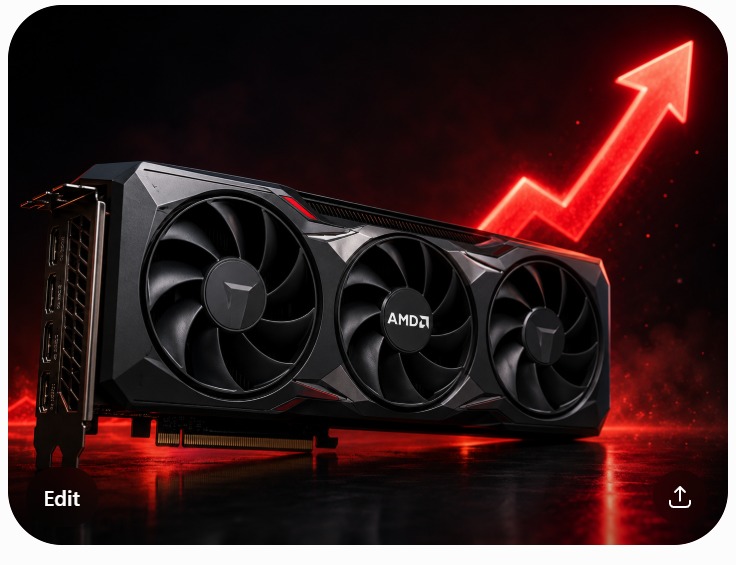
A post on Board Channels - the Chinese supply-chain trade forum that has correctly called prior AMD pricing moves - reports that AMD may direct its add-in board partners to raise Radeon GPU and VRAM bundle prices by 10 to 15 percent as early as July 2026, according to coverage by VideoCardz and Notebookcheck. AMD has not confirmed the move. The underlying cost driver is concrete: GDDR6 memory spot prices have roughly tripled since late 2025, rising from around $2.50 per GB to $7.50 per GB, per Tech4Gamers citing Silicon Motion analyst Wallace Kou. Memory fabs including Samsung and SK Hynix have shifted wafer capacity toward HBM for AI data-center processors, reducing GDDR6 supply even though flagship AI accelerators do not use GDDR6 directly. As of the report's publication, Nvidia has not issued a corresponding price-increase notice to its AIB partners. If the hike materializes, AMD's Radeon RX 9000 series cards - including the RX 9060 XT, 9070, 9070 XT, and the anticipated 9080 - would cost 10 to 15 percent more at retail as early as the back-to-school season.
What happened
A post on Board Channels - the Chinese supply-chain trade forum that has correctly anticipated at least two prior rounds of Radeon price adjustments - reported on June 19-21, 2026 that AMD may direct its add-in board partners to raise Radeon GPU and VRAM bundle prices by 10 to 15 percent as early as July 2026. The report was first covered by the Japanese outlet Gazlog, then amplified by VideoCardz and Notebookcheck. AMD has not confirmed any pricing action, and the figure should be treated as a credible early-warning signal rather than a confirmed price announcement. Board Channels intercepts signals in the AMD-to-AIB communication layer, which is why it carries predictive weight ahead of official retail price changes.
Technical details
The cost driver is a structural squeeze in GDDR6 memory supply. Since late 2025, GDDR6 spot prices have roughly tripled, rising from approximately $2.50 per GB to $7.50 per GB, according to Tech4Gamers citing data attributed to Silicon Motion. The mechanism is one level upstream from consumer GPUs: memory manufacturers including Samsung and SK Hynix have shifted substantial wafer fabrication capacity toward HBM (High Bandwidth Memory) production, which carries higher profit margins in the current AI infrastructure cycle. HBM serves AI data-center accelerators like Nvidia's H100 and AMD's MI300X series; those chips do not use GDDR6. But the capacity reallocation reduces overall DRAM wafer starts, including for GDDR6, creating a supply squeeze on consumer GPU memory that is structural rather than cyclical. Silicon Motion's Wallace Kou is reported by Tech4Gamers to expect VRAM prices to continue rising through H2 2026.
Editorial analysis - market context
This is a second-order effect of AI infrastructure investment: frontier AI hardware absorbs fab capacity through HBM demand, which indirectly pressures consumer GDDR6 pricing. As long as HBM margins remain elevated - and no current public signal suggests that changes soon - GDDR6 wafer starts are unlikely to recover on a short timeline. A meaningful correction would require either a sustained slowdown in AI infrastructure spending or new fabrication capacity coming online, a 12 to 18 month process at minimum.
Competitive dynamics
The most consequential detail in the Board Channels report is what Nvidia has not done. As of publication, Nvidia had issued no corresponding price-increase notice to its AIB partners. This asymmetry would put AMD's Radeon lineup at a competitive disadvantage entering the back-to-school GPU purchasing window. Whether Nvidia is absorbing higher memory costs internally, operating under different supply arrangements, or waiting to see how AMD's move lands in the market is not clear from public information. TechTimes notes that Nvidia did raise RTX 5090 series AIB pricing in May 2026, so a future Nvidia increase is possible.
Affected SKUs
The Board Channels report targets GPU and VRAM bundle pricing, meaning add-in board partner cards rather than AMD reference designs exclusively. Cards likely to be affected include the Radeon RX 9060 XT, 9070, 9070 XT, and the anticipated 9080. On cards in the $400 to $700 range, a 10 to 15 percent increase translates to $40 to $105 per unit. Board partners may apply additional margin, so retail increases could exceed the reported percentage.
What to watch
- •Retail MSRPs and street prices for the Radeon RX 9000 series, particularly the 9070 XT as a bellwether SKU.
- •Spot and contract indices for GDDR6 and HBM; a sustained move back toward $2.50 per GB GDDR6 would remove the cost-pass-through rationale.
- •Partner notices or distributor price lists from AMD AIB partners (ASUS, MSI, Gigabyte, Sapphire, PowerColor).
- •Any corresponding Nvidia AIB pricing notices, which would confirm the squeeze is industry-wide rather than AMD-specific.
- •Memory supplier commentary from Samsung, Micron, and SK Hynix on production allocation and GDDR6 lead times.
Key Points
- 1Board Channels reports AMD may raise Radeon GPU and VRAM bundle prices 10 to 15 percent starting as early as July 2026, per VideoCardz and Notebookcheck.
- 2GDDR6 spot prices have roughly tripled since late 2025 - from $2.50 to $7.50 per GB - as memory fabs shift capacity to higher-margin HBM for AI accelerators.
- 3Nvidia has not issued a matching price-increase notice to its AIB partners, which would give it a competitive advantage if AMD proceeds with the hike.
Scoring Rationale
Multiple credible tech outlets (Notebookcheck, VideoCardz, TechTimes, Tech4Gamers) corroborate a Board Channels signal that AMD may raise Radeon GPU and VRAM bundle prices 10 to 15 percent starting Q3 2026, with a verified structural driver in tripled GDDR6 spot prices. Directly relevant to AI practitioners who budget for consumer GPU procurement and small-scale inference rigs. Well-sourced supply-chain story but not a paradigm shift; scored at the upper end of Solid.
Sources
Public references used for this report.
View 7 more sources
- AMD Radeon May Raise GPU Prices by 10-15% in the Second Half of 2026tech4gamers.com
- AMD confirms GPU price hike with partners - Reportoverclock3d.net
- AMD Reportedly Planning GPU Price Increase as Memory Costs Spiketechpowerup.com
- New Report Suggests Phased Price Hikes for AMD and Nvidia GPUs in 2026vice.com
- NVIDIA and AMD are reportedly preparing sharp price hikes for GPUs in 2026gosugamers.net
- AMD Reportedly Planning GPU Price Increase as Memory Costs Spikehardforum.com
- AI Boom Could Drive GPU Prices Up Soongaming.lenovo.com
Practice interview problems based on real data
1,625 SQL & Python problems across 15 industry datasets — the exact type of data you work with.
Try 250 free problems