Altman Predicts Context-Aware ChatGPT Within Six Months
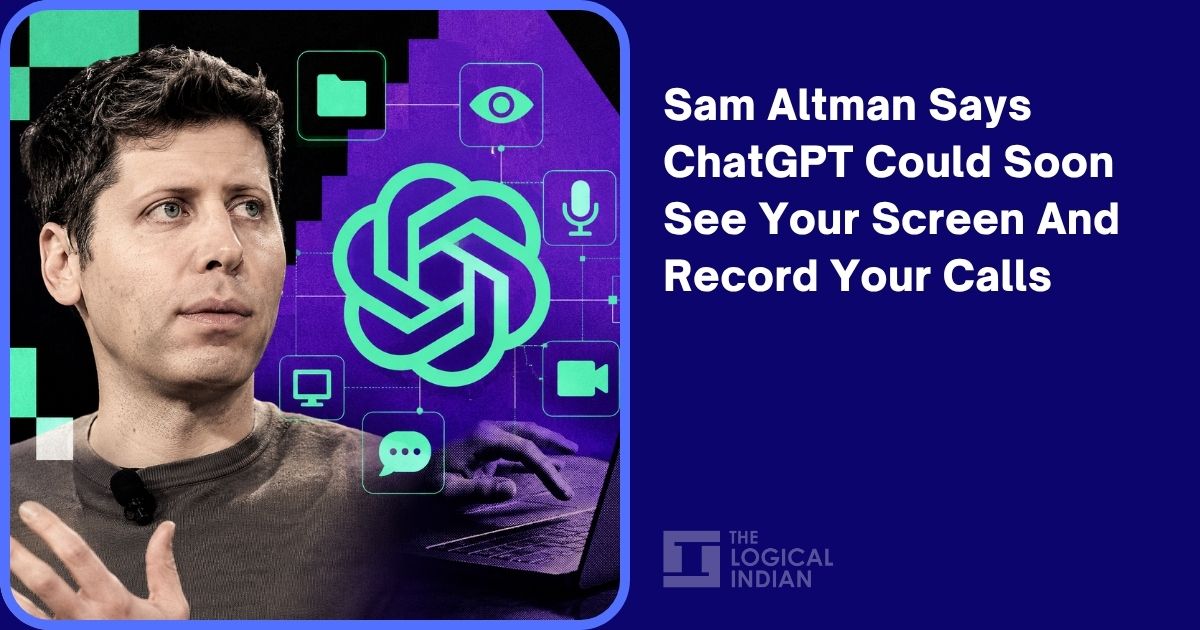
OpenAI CEO Sam Altman said a future descendant of ChatGPT could continuously view a user's screen, meetings and calls within six months. In an interview with Cory Levy, reported by Business Standard, India Today and Times Now, Altman described a user-controlled system that could connect with messages, email, documents and Slack to provide context-sensitive assistance. The remarks describe a forecast, not an announced ChatGPT product release.
OpenAI CEO Sam Altman said a future descendant of ChatGPT could continuously observe a user's computer screen, meetings and calls, building enough context to assist with day-to-day work. In an interview with Z Fellows founder Cory Levy, Altman put the possible usefulness of such a system at "some time within the next six months," according to Business Standard.
The comments describe an anticipated capability rather than a released product or a formal OpenAI launch announcement. Business Standard, India Today and Times Now each reported that Altman framed the concept as an assistant with access to user-authorized sources such as text messages, email, documents and Slack.
"I think we are close to a world where you can have a descendant of ChatGPT watch your computer screen all the time, watch every meeting you're in, record every call," Altman said, according to Business Standard. He added that the system could have "perfect context of your whole life, everything you see."
A persistent-context assistant
Altman described users as choosing which information and services the system could access. According to Business Standard, he said the proposed assistant would work alongside users rather than make decisions for them.
The reported examples center on knowledge-work assistance. While a user writes a sales pitch, the system could draw on customer history, previous conversations and relevant documents; while a user prepares a strategy document, it could suggest another idea, flag a possible mistake or offer to complete a task, Business Standard reported.
Times Now quoted Altman as saying, "I think we're only like one model generation away from this actually being incredibly useful." India Today similarly reported that Altman characterized the assistant as a way to help people manage more information than they can personally track.
Data access and security questions
The proposal combines several technically distinct inputs: screen activity, meeting and call recordings, communications data, and enterprise documents. In comparable assistant designs, the usefulness of retrieval and recommendation systems depends on reliable identity resolution, permissions, provenance and temporal context across those inputs.
Persistent capture also creates a substantially different risk profile from a conventional prompt-response chatbot. Security and privacy reviews for comparable systems commonly examine consent from meeting participants, least-privilege access, retention controls, encryption, audit logs, data residency, and how an assistant distinguishes private material from information it can use in a response.
For enterprise AI teams, a product with the capabilities Altman described would require more than a strong multimodal model. It would require integrations that preserve existing access-control boundaries across email, chat, file repositories and collaboration tools, plus governance controls that make data collection and downstream use inspectable.
The reports do not provide technical specifications, supported platforms, retention policies, pricing, or a public release date. As a result, Altman's six-month reference is best read as an interview forecast about the direction and maturity of future ChatGPT-like systems, rather than a committed deployment timetable.
Key Points
- 1Altman described a user-controlled, persistent-context ChatGPT concept, but the reported six-month timing is a forecast rather than a product announcement.
- 2The proposed assistant would combine screen, call, meeting and enterprise-data context, raising integration and authorization requirements beyond ordinary chat interfaces.
- 3Comparable always-on assistants typically require rigorous consent, retention, access-control and audit mechanisms before organizations can deploy them broadly.
Scoring Rationale
Altman's comments outline a potentially consequential direction for AI assistants: continuous multimodal context connected to personal and enterprise data. The story is not a product release and contains no technical specifications or committed launch details, which limits its immediate implementation impact.
Sources
Public references used for this report.
Practice interview problems based on real data
1,625 SQL & Python problems across 15 industry datasets — the exact type of data you work with.
Try 250 free problems