AlphaFold Fuels Next-Generation Protein Design Platforms
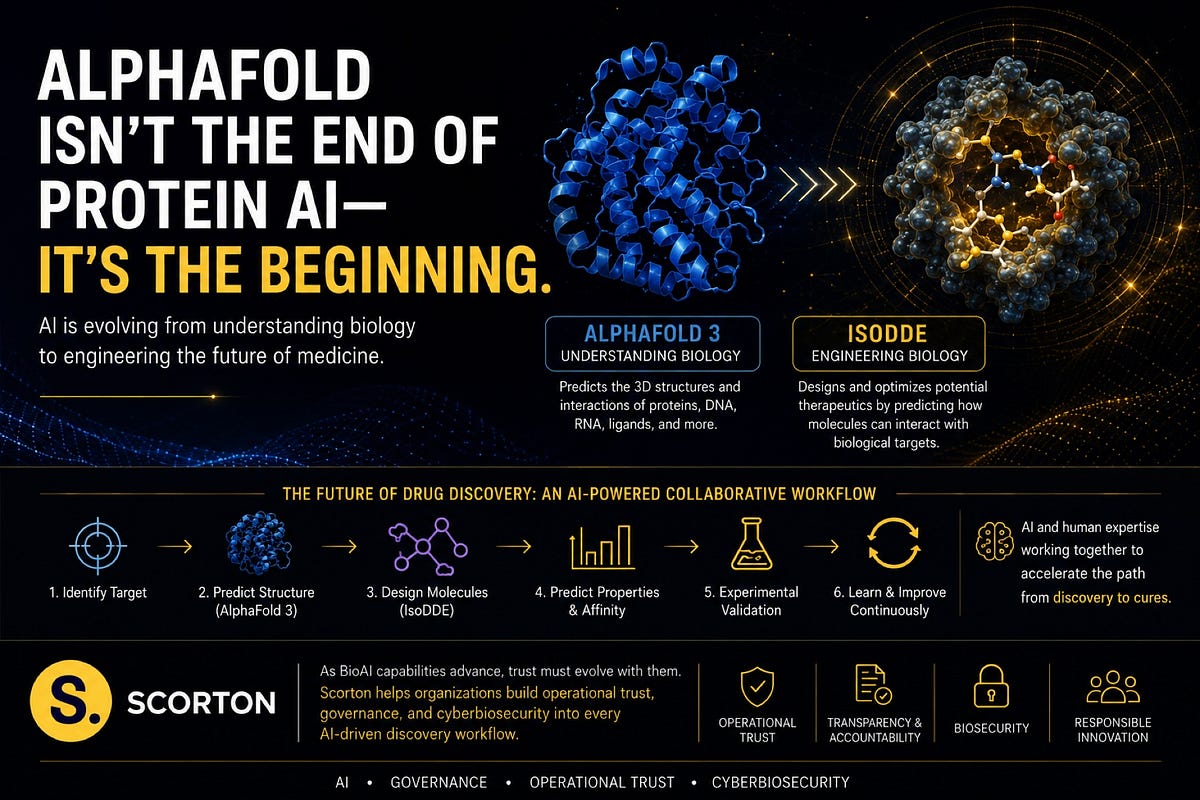
The Scorton analysis published in July 2026 argues that AlphaFold 3 and Isomorphic Labs' IsoDDE show protein AI moving from structure prediction toward drug-design systems. According to Google DeepMind, AlphaFold 3 predicts interactions among proteins, DNA, RNA, ligands, and other biomolecules; Isomorphic says IsoDDE adds design-oriented capabilities such as protein-ligand prediction, binding-affinity estimation, cryptic-pocket identification, and antibody-antigen modeling. For ML practitioners, the useful takeaway is that BioAI evaluation is shifting toward closed-loop discovery metrics, uncertainty, assay data quality, and wet-lab validation rather than structure accuracy alone.
For ML teams working near biology, the important shift is from predicting molecular structure to operating a design loop. Structure models remain foundational, but design platforms have to optimize across affinity, selectivity, manufacturability, uncertainty, assay constraints, and experimental feedback. That turns protein AI into a systems problem, not only a model-accuracy problem.
What happened
A July 2026 Scorton analysis frames AlphaFold as the beginning of a broader protein-AI wave rather than the endpoint. It points to Google DeepMind's AlphaFold 3 work, which Google says predicts interactions among proteins, DNA, RNA, ligands, and other biomolecules, and to Isomorphic Labs' Isomorphic Drug Design Engine, or IsoDDE. Isomorphic describes IsoDDE as combining protein-ligand structure prediction, binding-affinity estimation, cryptic binding-pocket identification, and antibody-antigen interaction modeling.
Technical context
The engineering bar changes when a system moves from explanation to design. A useful drug-design engine needs calibrated scoring functions, reliable negative results, data lineage for assays, and benchmarks that measure whether model outputs improve downstream discovery decisions. Per-structure accuracy still matters, but it is only one part of a larger optimization loop.
For practitioners
BioAI teams should watch the data layer as closely as the model layer. Binding assays, selectivity labels, wet-lab turnaround time, and uncertainty estimates determine whether generated candidates are useful enough to prioritize. The strongest products will likely pair predictive models with experiment-aware workflows that make failures informative instead of merely expensive.
What to watch
The next evidence bar is reproducible validation: public benchmarks, external replications, and disclosed experimental results that show design systems improving real candidate selection. Until then, vendor claims about design engines should be treated as promising but still partly self-reported.
Key Points
- 1Protein AI is moving from structure prediction toward design loops that optimize candidates against experimental and operational constraints.
- 2AlphaFold 3 and IsoDDE point to broader systems combining molecular interaction prediction, affinity scoring, and pocket identification.
- 3For practitioners, assay data quality, uncertainty calibration, and closed-loop validation matter more than structure accuracy alone.
Scoring Rationale
This is a solid BioAI analysis story because it explains how AlphaFold-style structure prediction is becoming part of broader drug-design workflows. The score is below major-release level because the event is a synthesis of already disclosed DeepMind and Isomorphic work rather than a new open model, benchmark, clinical result, or independently validated study.
Sources
Public references used for this report.
Practice with real Health & Insurance data
90 SQL & Python problems · 15 industry datasets
250 free problems · No credit card
See all Health & Insurance problems