AI-driven rotation reshapes stock market leadership
Palo Alto Networks and CrowdStrike hit all-time highs this week as Wall Street's holiday-shortened session showed investor capital rotating out of semiconductors and into AI-security stocks, CNBC reports. The PHLX Semiconductor Index fell 6.3% Wednesday and 5.4% Thursday even as the S&P 500 closed the first half of 2026 up 9.6% and the Russell 2000 posted its best first-half gain since 1991, near 22%. CNBC linked part of the cybersecurity rally to Wall Street Journal reporting that Zhipu AI's open-weight GLM-5.2 model now rivals Anthropic's restricted Mythos model at finding software vulnerabilities, a signal investors read as raising near-term demand for AI-security spending. The Dow closed at a record Thursday after a soft June jobs report reduced near-term Fed rate-hike odds, with markets closed Friday for the holiday.
For AI and data practitioners, this week's market moves are a rare directly observable signal of where enterprise security budgets may be heading: capital rotated out of high-flying semiconductor stocks and into cybersecurity vendors in the same week that evidence mounted that AI models, including a cheap, open-weight Chinese model, are closing the gap on the vulnerability-hunting capability that has helped justify premium pricing for security tooling.
What happened
CNBC reports that Wall Street closed out the first half of 2026 with the S&P 500 up 9.6%, the Nasdaq up 12.8%, and the Dow up 8.9% - the Dow's best first half since 2021. The Russell 2000 gained about 22% in the first half, its best performance since 1991, briefly touching an all-time high of 3,033.75 on Wednesday, July 1, before slipping 0.55% Thursday to 2,996.11, according to IBTimes. The PHLX Semiconductor Index fell 6.3% Wednesday and 5.4% Thursday as investors took profits in chip stocks that had risen more than 80% in the first half. Over the same days, cybersecurity stocks rallied hard: Palo Alto Networks and CrowdStrike both hit fresh highs, with Palo Alto up 9% and CrowdStrike up 7% in a single Monday session, according to 24/7 Wall St., after both stocks posted their best quarter on record between April and June, up roughly 95% and 113% respectively, per CNBC. The Dow closed at a record Thursday after June nonfarm payrolls came in at 57,000 versus 115,000 expected, reducing near-term odds of a Fed rate hike; markets were closed Friday for the July 4 holiday.
Timeline
Palo Alto Networks, CrowdStrike, and Okta shares jumped 9%, 7%, and 5% respectively after a UBS note projected 13% global cybersecurity market growth in 2026.
The Russell 2000 touched an all-time high of 3,033.75 as the PHLX Semiconductor Index sank 6.3% on chip-stock profit-taking.
The Dow closed at a record high and CrowdStrike's 4-for-1 stock split took effect, even as the PHLX Semiconductor Index fell another 5.4%.
Technical context
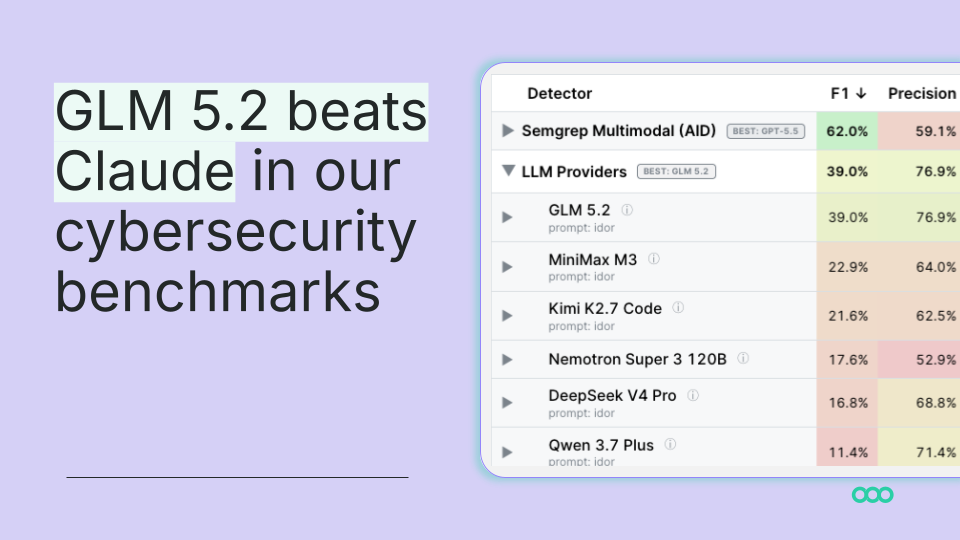
CNBC ties part of the cybersecurity rally to Wall Street Journal reporting that Zhipu AI's open-weight GLM-5.2 model performs on par with Anthropic's tightly access-restricted Mythos model on vulnerability-detection tasks. Independent benchmarking from security-tooling firm Semgrep, published June 22, supports the broader trend without confirming the exact WSJ comparison: on Semgrep's IDOR vulnerability-detection benchmark, GLM-5.2 scored 39% F1 with no custom scaffolding, ahead of Claude Code's 28-37% F1 range across recent Opus versions, at roughly one-sixth the cost per vulnerability found (about $0.17). Semgrep's own multimodal pipeline still led the field at 53-61% F1, and the firm cautions this is one task on one dataset, not proof that open-weight models have closed the gap broadly.
For practitioners
If AI models are getting meaningfully better and cheaper at finding vulnerabilities, that cuts both ways for security teams: it can speed up defensive scanning and triage, but it also lowers the cost for attackers to find the same bugs. Treat this as a signal to re-evaluate build-vs-buy tradeoffs on AI-assisted vulnerability scanning, and note that regulatory scrutiny is already active: in May 2026, US House lawmakers opened a formal inquiry into cybersecurity risks from Chinese AI models in critical infrastructure, naming Zhipu AI alongside DeepSeek, MiniMax, and ByteDance.
What to watch
Vendor earnings commentary from Palo Alto Networks and CrowdStrike will show whether elevated valuations (Palo Alto trades near 75x forward earnings; CrowdStrike remains unprofitable on a trailing basis) are backed by durable demand or a short-term rotation. The Fed's next meeting is July 28-29, and the soft jobs report makes that meeting a bigger catalyst than usual for both chip and security names. Also watch for further congressional action on Chinese AI models in critical infrastructure, and whether other open-weight models beyond GLM-5.2 close the gap on security benchmarks.
Key Points
- 1Cybersecurity stocks hit record highs this week while chip stocks sold off sharply, marking a rotation within AI-linked equities.
- 2A Wall Street Journal report on a Chinese open-weight model rivaling Anthropic's Mythos on vulnerability detection helped fuel the cybersecurity rally.
- 3Vendor earnings and the Fed's July 28-29 meeting will show whether this reallocation reflects lasting demand or short-term profit-taking.
Scoring Rationale
A notable, well-corroborated market-rotation story: capital moved from semiconductors into cybersecurity in the same week a WSJ report on a Chinese open-weight model's vulnerability-detection gains was cited as a catalyst, and the claim is independently supported by Semgrep's own benchmark. Solid for practitioners tracking AI-security demand signals, but it is a market recap rather than a technical or policy breakthrough, so it stays in the notable-not-industry-shaking band.
Sources
Public references used for this report.
Practice with real FinTech & Trading data
90 SQL & Python problems · 15 industry datasets
250 free problems · No credit card
See all FinTech & Trading problems