AI-assisted Engineers Face a New Form of Burnout
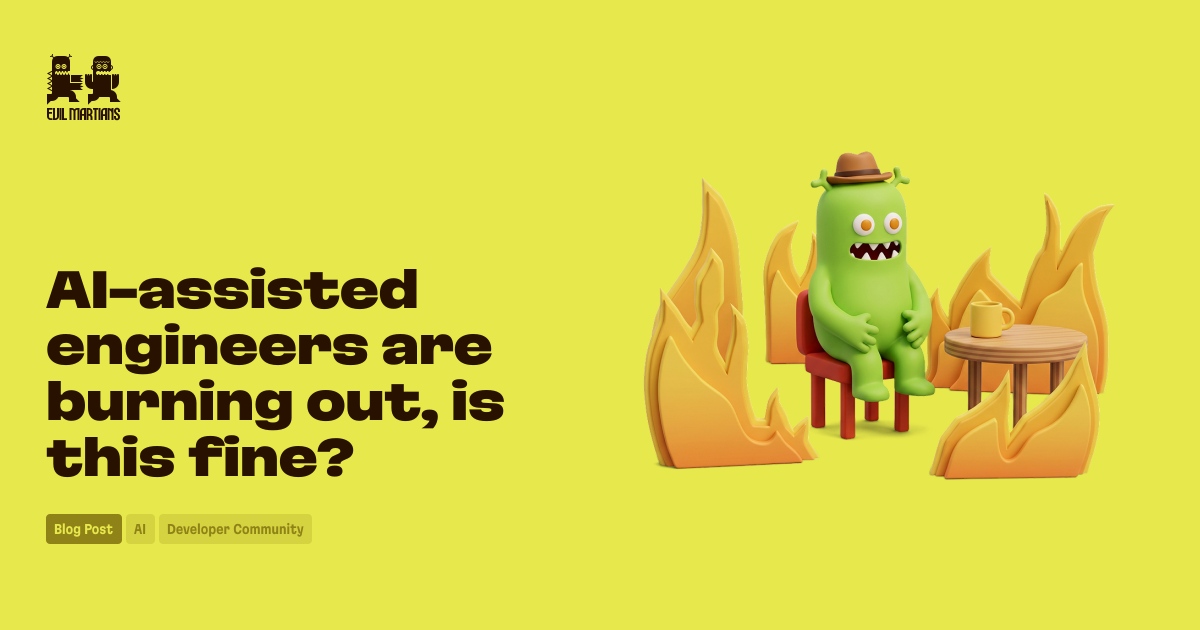
In a May 19, 2026 blog post, Evil Martians reports that AI-assisted code generation increases output but also contributes to a rising phenomenon the authors call "AI burnout." The post describes developers experiencing sustained cognitive overload, shortened windows of high-intensity productivity - quoting "you might get 4-5 extremely intense hours before your brain is fully cooked" - and mixed feelings about AI-enabled workflows. The post's TL;DR recommends restoring enjoyment, rebuilding ownership and pride, and resisting the impulse to maximize productivity at every moment. Industry practitioners should treat these reports as an early warning about developer experience risks when adopting AI-first tooling.
What happened
Evil Martians published a May 19, 2026 blog post arguing that AI-assisted code generation has a productivity upside and a hidden cost, which the authors label AI burnout. The post reports developer experiences of rising fatigue, a constant pressure to keep up with faster output cycles, and a "weirder" cognitive overload distinct from classical burnout; the authors quote a vivid description: "you might get 4-5 extremely intense hours before your brain is fully cooked." The post includes a TL;DR with three concrete prescriptions: restore enjoyment of the work, rebuild feelings of achievement and ownership, and avoid maximizing productivity at every moment.
Editorial analysis - technical context
Developers integrating prompt-driven workflows, copilot-style assistants, and generation tools frequently trade manual friction for faster surface-level output. Industry-pattern observations note that reducing friction often shifts cognitive work from mechanical tasks to continuous supervision, verification, and mental-context switching, which can increase sustained attentional demand even as measurable output rises. For practitioners, this means tool adoption can change the shape of effort without reducing total cognitive load.
Context and significance
Editorial analysis: Reports like Evil Martians' add to a growing set of anecdotal signals about human factors in AI-enabled teams. Comparable accounts across developer forums and company engineering blogs describe similar trade-offs between throughput and satisfaction; those accounts suggest workforce wellbeing and knowledge retention are operational risks distinct from code correctness or velocity metrics. For teams, measuring productivity only by lines shipped or PR throughput risks missing declining developer engagement.
What to watch
Editorial analysis: Observers should track three indicators:
- •shifts in time-to-focus metrics (long blocks of deep work shrinking)
- •qualitative reports in internal surveys about fulfillment and ownership
- •increases in bug rates or rework tied to rapid-generation workflows
Companies releasing post-mortems or internal surveys that quantify these effects will provide empirical grounding. Evil Martians' post provides practitioner-facing coping steps, but broad, instrumented studies are still needed to quantify prevalence and causal mechanisms.
Key Points
- 1AI-assisted coding raises throughput but can increase sustained cognitive load, producing a distinct form of developer fatigue.
- 2Reducing mechanical friction often shifts effort to supervision and context-switching, which industry patterns link to decreased job satisfaction.
- 3Teams should augment velocity metrics with wellbeing and quality indicators to detect declining developer engagement early.
Scoring Rationale
The topic matters to many AI/ML practitioners because AI coding assistants are widely used and can change how engineering work is experienced. This is notable for team operations and tooling choices but is not a frontier-model or regulatory event.
Practice interview problems based on real data
1,625 SQL & Python problems across 15 industry datasets — the exact type of data you work with.
Try 250 free problems