Accessibility Experts Urge Teams to Test AI
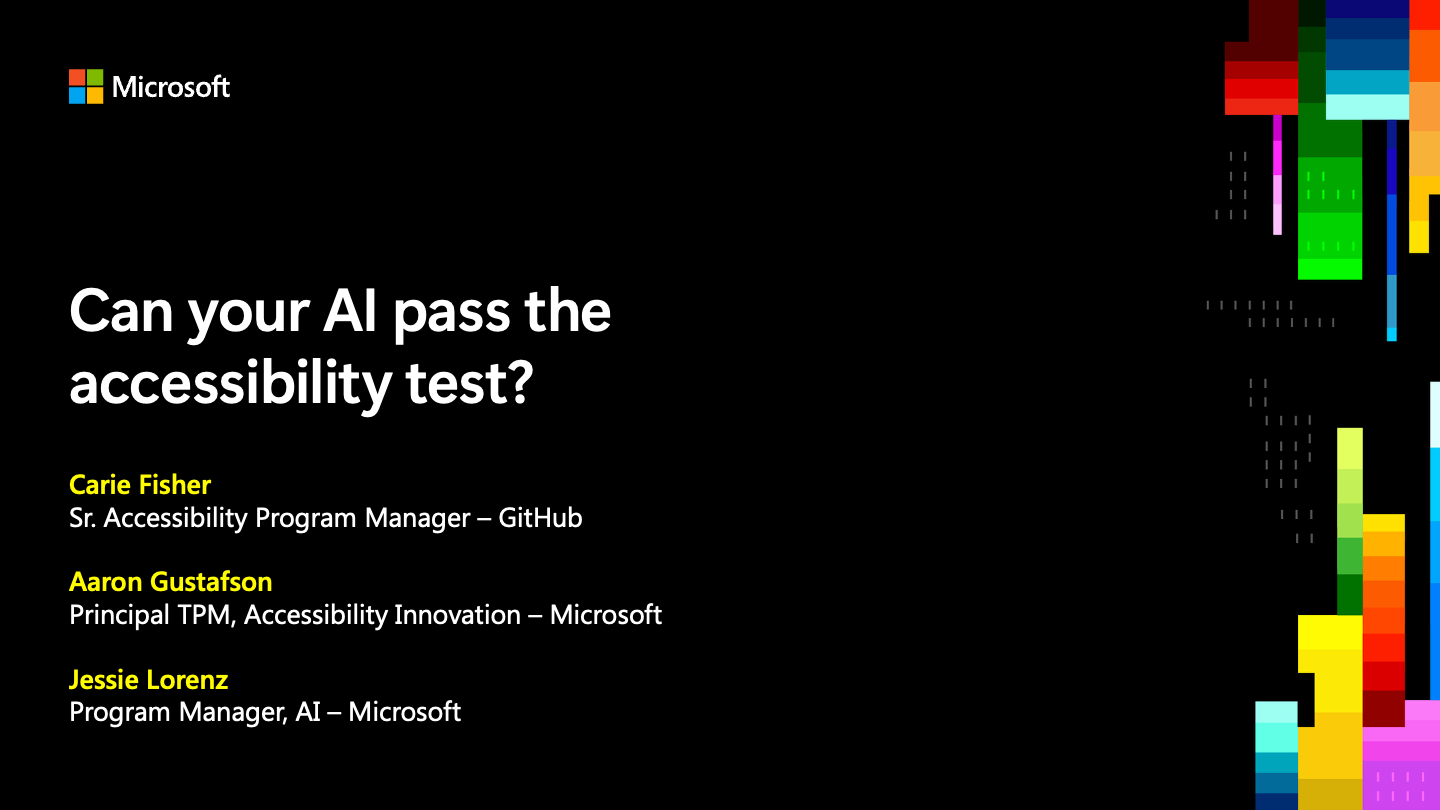
At Microsoft Build, accessibility practitioners Aaron Gustafson, Jessie Lorenz, and Carie Fisher presented "Can Your AI Pass the Accessibility Test?", arguing that AI does not fix a broken process but accelerates whatever process already exists. Per Gustafson's June 10, 2026 companion post, out-of-the-box coding agents pass only about 8-25% of automatable accessibility checks, rising to 37-60% with instruction files and roughly 86% once agents are given accessibility skills and deterministic tests to run against. Jessie Lorenz, a blind product manager at Microsoft, said fixing accessibility issues gets 10x, 100x, and 1000x more expensive as they move later through the planning-to-release pipeline. The speakers noted automated tests still only cover about half of what makes a UI truly accessible.
For practitioners, this talk is a concrete cost-of-delay argument backed by numbers most teams don't have handy: it converts "shift accessibility left" from a values statement into a lifecycle-stage cost multiplier, and quantifies just how far current AI coding agents are from closing the gap on their own.
What happened
At Microsoft Build, accessibility practitioners Aaron Gustafson, Jessie Lorenz (a blind product manager at Microsoft), and Carie Fisher (GitHub) presented "Can Your AI Pass the Accessibility Test?", published as a companion post by Gustafson on June 10, 2026. Their core argument: "AI does not fix a broken process; it accelerates whatever process you already have." Lorenz mapped a six-stage software pipeline (planning, design, development and coding, code review and CI/CD, public release, customer feedback) and said accessibility fixes that are free in planning become roughly 10x more expensive in design, 100x in development, and 1000x more expensive if they ship unfixed.
Technical context
Gustafson reported that out-of-the-box, most coding agents pass only about 8-25% of automatable accessibility checks; adding instruction files that spell out accessibility expectations raises that to 37-60%; giving agents accessibility-specific skills gets closer to 86%; and only pairing agents with deterministic tests they can run and iterate against closes most of the remaining gap. Even then, the speakers said automated checks cover only about half of what is needed for a UI to be considered truly accessible, since usability requires human and assistive-technology testing. Fisher described GitHub's open-source Accessibility Scanner, which uses Deque's aXe ruleset in a "Find, File, Fix" workflow that turns scan results into GitHub issues assignable to Copilot for remediation.
For practitioners
Embed accessibility checks at every pipeline stage rather than as a post-release audit: a lint rule in the editor, a CI/CD gate, and a code-review check, plus design-stage tooling such as the Accessibility Assistant plugin for Figma that lets designers export accessibility annotations as specs for engineering. Because base AI-generated code fails most automatable checks, teams relying on AI-assisted coding or design need these guardrails specifically, not as a generic best practice.
What to watch
Whether AI coding and design tools begin shipping accessibility skills and deterministic test hooks by default, adoption of accessibility scanners in CI/CD pipelines, and whether vendors publish pass-rate figures the way this talk did, since that kind of measurement is currently rare in the industry.
Key Points
- 1Out-of-the-box AI coding agents pass only 8-25% of automatable accessibility checks, rising to about 86% only with skills and deterministic tests.
- 2Accessibility fixes cost roughly 10x, 100x, and 1000x more as they move from planning to design to unfixed release, per Microsoft Build speakers.
- 3Automated checks cover only about half of true accessibility, so AI-assisted teams still need human and assistive-technology testing alongside tooling.
Scoring Rationale
A primary-source, data-backed talk (verified via the speaker's own published transcript) quantifying a practical, high-impact risk for AI-enabled product teams: coding agents fail most automatable accessibility checks out of the box, and fixes compound in cost through the pipeline. Directly actionable for product, design, and engineering teams; not a frontier-model or regulatory development, so it stays in the notable range.
Sources
Public references used for this report.
Practice interview problems based on real data
1,625 SQL & Python problems across 15 industry datasets — the exact type of data you work with.
Try 250 free problems