Zoox Debuts Cortex Internal LLM Platform
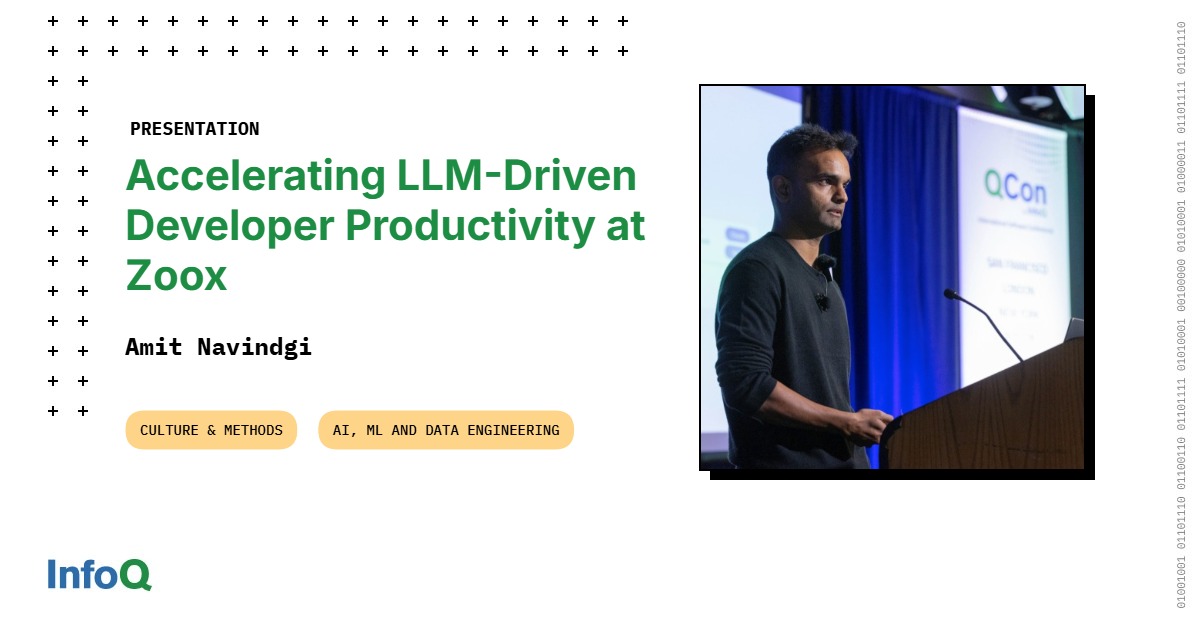
According to InfoQ, Amit Navindgi explains how Zoox built Cortex, an internal AI platform that streamlines the developer lifecycle. InfoQ's summary says Cortex is intended to move beyond hype by delivering secure, agentic workflows and real-world impact. The piece by Amit Navindgi was published on May 14, 2026 on InfoQ. For practitioners, internal LLM platforms that integrate developer tooling, security, and agent orchestration can reduce friction in building and shipping model-driven features, while raising governance and operational demands.
What happened
According to InfoQ, Amit Navindgi published a writeup on May 14, 2026 describing how Zoox built Cortex, an internal AI platform designed to streamline the developer lifecycle. InfoQ's summary states that Cortex aims to move beyond hype by delivering secure, agentic workflows and real-world impact.
Editorial analysis - technical context
Industry-pattern observations: Teams building internal LLM platforms typically integrate model orchestration, developer-facing SDKs, and runtime agents to reduce end-to-end development time. Such platforms commonly require layered safeguards, including access controls, input/output sanitization, and monitoring to manage agentic actions against production systems.
Context and significance
The framing of a platform that combines developer lifecycle tooling with agentic workflows reflects a broader shift where organizations centralize LLM capabilities to standardize interfaces, enforce governance, and accelerate feature iteration. For engineering teams, this often trades point-solution flexibility for centralized operational responsibilities such as model evaluation, cost management, and data lineage.
What to watch
Observers will look for concrete details on how platforms like Cortex handle:
- •observability and logging for agent actions,
- •security and least-privilege access for tooling that touches production systems,
- •mechanisms for model evaluation, rollback, and cost control.
Editorial analysis
Practitioners evaluating similar work should weigh developer productivity gains against the added maintenance and governance load that centralized, agent-enabled LLM platforms introduce.
Key Points
- 1Internal LLM platforms that unify developer tooling and agent orchestration can speed prototyping but increase operational and governance complexity.
- 2Embedding security and least-privilege controls into platform layers is essential when agentic workflows can act on production systems.
- 3Adopting internal LLM platforms shifts attention to observability, model evaluation, and cost controls as primary engineering concerns.
Scoring Rationale
An internal platform for LLM-driven developer productivity is practically relevant to engineering teams. The single-source InfoQ summary limits technical detail, so the story is useful but not transformational for the wider AI/ML community.
Sources
Public references used for this report.
Practice interview problems based on real data
1,625 SQL & Python problems across 15 industry datasets — the exact type of data you work with.
Try 250 free problems