
x402 Reveals Approval Gap in Agentic Micropayments
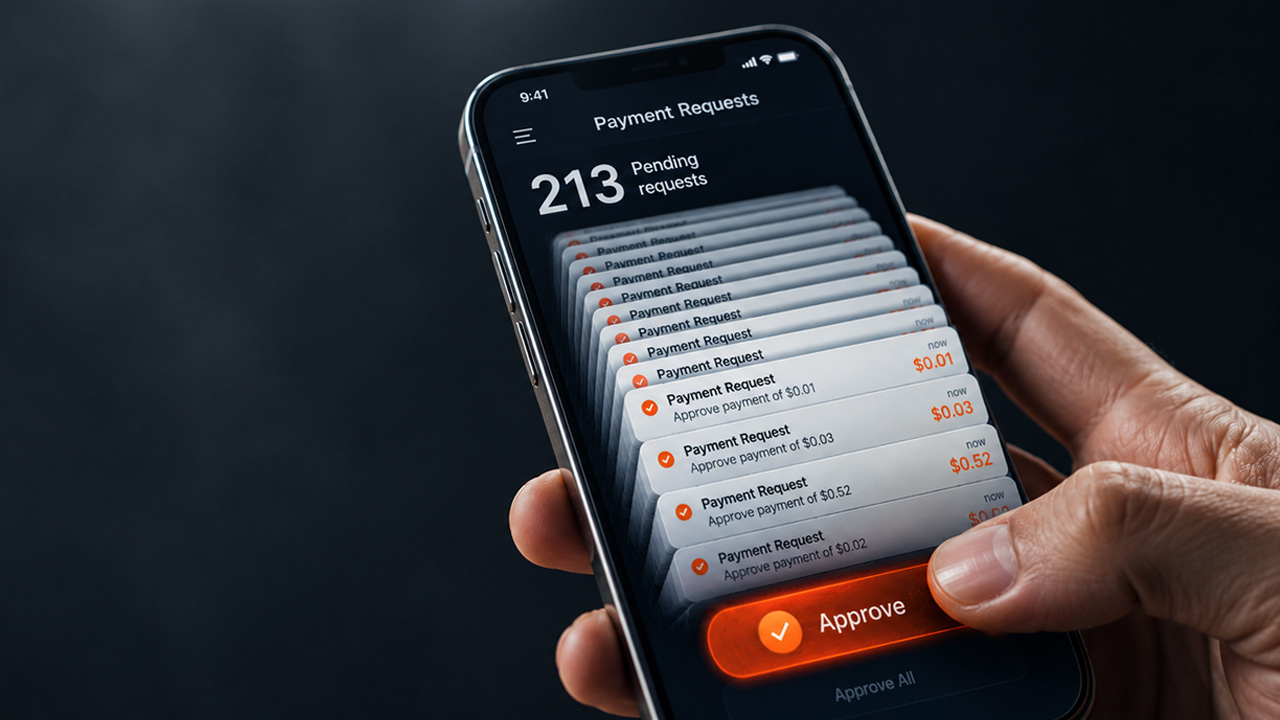
Artemis data, reported by CryptoSlate, shows the agentic payment protocol x402 saw adjusted volume fall about 77% from a November 2025 peak of $5.15 million to $1.19 million by May 2026, while monthly transaction counts rebounded to 2.89 million with an average size of $0.52. CryptoSlate and CoinDesk report that many of those transactions are tiny, high-frequency payments for APIs, data, and compute, where manual wallet confirmations create approval friction. CryptoSlate quantifies the approval cost: a conservative 5-to-15-second confirmation cadence can generate 4,000 to 12,000 user-hours of approval work per month, translating to $0.03 to $0.10 in human time value per confirmation at $25/hour, which can exceed the value of sub-cent calls. Reporting also notes development of delegation and authorization frameworks: CryptoSlate says AP2 was donated to the FIDO Alliance and uses cryptographically signed "mandates." Per an OKX Ventures research report, x402 was jointly launched by Coinbase and Cloudflare and had processed over 100 million transactions with an annualized payment volume of $600 million by the end of 2025. Industry coverage frames the central unresolved problem as delegation: agents can propose payments, but wallet approval gates block fully autonomous micropayment flows.
What happened
Artemis-derived metrics reported by CryptoSlate show the agentic payment protocol x402 experienced a collapse in adjusted volume, down roughly 77% from a $5.15 million November 2025 peak to $1.19 million by May 2026, while transaction counts fell less sharply and then rebounded to 2.89 million in May with an average transaction size of $0.52. CryptoSlate reports those transactions reflect high-frequency, low-value payments used by autonomous agents to purchase APIs, data, and compute.
Supporting industry reporting
Per an OKX Ventures research report (published on Binance's research portal), x402 was jointly launched by Coinbase and Cloudflare, and the report states the protocol had processed over 100 million transactions with an annualized payment volume of $600 million by the end of 2025. CoinDesk coverage frames the broader argument from crypto proponents that stablecoins and protocols like x402 make sub-cent, machine-to-machine payments economically viable compared with traditional card rails.
Technical details
CryptoSlate documents the human-friction economics of approvals: a conservative 5-to-15-second wallet confirmation cadence can generate 4,000 to 12,000 user-hours of approval time in a single month, and at $25/hour this equates to roughly $0.03 to $0.10 per confirmation. CryptoSlate further reports that authorization frameworks are emerging as the focal point for enabling delegated, unattended payments; specifically, CryptoSlate says AP2 was donated to the FIDO Alliance and implements cryptographically signed "mandates" that encode ceilings, time windows, and scope of permitted agent actions.
Industry context
Practical implications for practitioners For practitioners building agent workflows, the immediate engineering challenge is not raw throughput but secure, auditable delegation. Industry observers report patterns where authorization schemes rely on cryptographic mandates, constrained policies, and pre-authorized windows to balance autonomy with control. Implementing these schemes in production requires rigorous key management, replay protection, and observability so cost, fraud, and error modes remain tractable.
For practitioners
operational trade-offs and risk surface
What to watch
Editorial analysis
Why this matters for agentic commerce Companies and protocols seeking real-world autonomous agent deployments confront a simple arithmetic problem: when the human approval cost per transaction approaches or exceeds the transaction value, the utility of micropayments collapses. Industry reporting frames delegation and standardized authorization as the missing link that would let agents transact without per-call human gating. Observed efforts such as AP2 and proposals like ERC-8004 in the OKX Ventures report show the ecosystem is converging on three complementary layers:
- •Payment layer: x402 embedding stablecoin micropayments into HTTP,
- •Trust layer: ERC-8004 style registries for identity and reputation,
- •Commercial layer: Virtuals/agent marketplaces and agent-to-agent commerce, per the OKX report.
Systems that allow pre-authorized microroutes must defend against overreach, stale authorizations, and replay attacks. Industry reporting highlights the trade-off between reducing human friction and increasing attack surface; the OKX Ventures report and CryptoSlate coverage both discuss the need for on-chain registries and off-chain attestations to limit exposure while enabling automation.
Observers should track three indicators: adoption of standardized mandate formats (for example AP2 adoption within FIDO workstreams), measurable reductions in per-transaction human confirmations on testnets or production endpoints, and ecosystem tooling for revocation and monitoring of delegated authorities. Reporting from CoinDesk also flags that payments incumbents such as Visa and Mastercard are developing agent-facing tools, which suggests marketplace bifurcation between regulated human commerce on card rails and crypto-native agent rails.
Bottom line
Artemis metrics and multiple industry reports converge on the same operational gap: micropayment economics make autonomous agent commerce feasible in theory, but approval and delegation remain the practical bottleneck. Standardized authorization primitives and robust delegation patterns are the proximate engineering and policy workstreams the ecosystem is actively pursuing.
Key Points
- 1Artemis data shows x402 volume fell 77% while transaction count rebounded to 2.89M, revealing a shift to high-frequency, low-value payments.
- 2Manual wallet confirmations create per-call friction worth $0.03 to $0.10, often exceeding sub-cent transaction values and blocking automation.
- 3Industry reporting highlights authorization frameworks (AP2, ERC-8004) and mandate-style delegation as essential infrastructure to enable unattended agent micropayments.
Scoring Rationale
The story identifies a concrete, operational bottleneck for agentic commerce-approval cost versus micropayment value-which matters for infrastructure and product teams building agent payment rails. It is notable but not paradigm-shifting, as protocols and incumbents are already prototyping solutions.
Sources
Public references used for this report.
Practice with real Payments data
90 SQL & Python problems · 15 industry datasets
250 free problems · No credit card
See all Payments problems
