Whoop Adds Clinician Video Consultations After Fitbit Air Launch
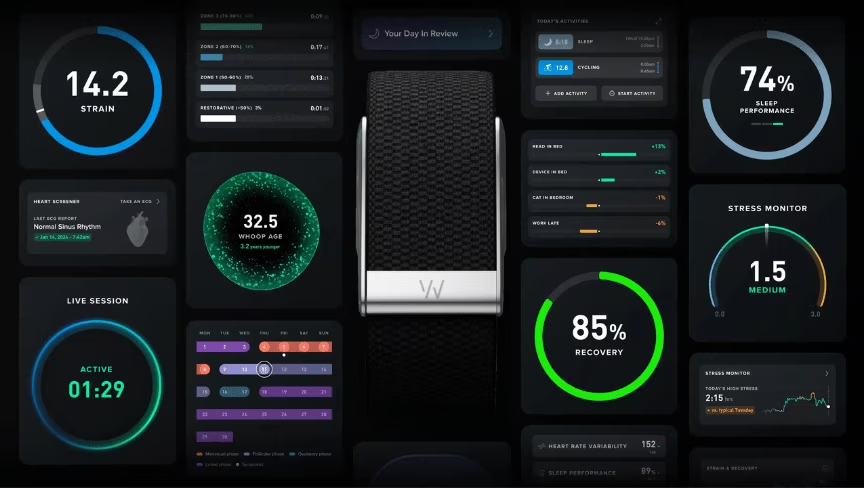
According to The Next Web, Google launched the screenless Fitbit Air for $99 and a Google Health Premium tier priced at $9.99/month (or $99/year) that includes a Gemini-powered AI health coach. The Fitbit Air ships on May 26, per The Next Web, and Google plans to replace the Fitbit app with the Google Health app on May 19, according to reporting. One day after Google's announcements, Whoop announced that US members will be able to request on-demand live video consultations with licensed clinicians through the Whoop app, with clinician access to members' Whoop biometric data and synced medical records via a HealthEx partnership, per CNET and Mashable. Mashable reports Whoop says live consultations will cost extra and will start this summer, with pricing and full availability to be confirmed. The pair of launches highlights a broader industry split between AI-first coaching and clinician-integrated services.
What happened
According to The Next Web, Google announced the screenless Fitbit Air priced at $99, a device that collects continuous heart rate, heart rate variability, SpO2, sleep stages, and activity and has an estimated battery life of about one week. The Next Web reports the Fitbit Air ships on May 26 and that Google will replace the Fitbit app with a new Google Health app on May 19. The Next Web also reports Google is offering a Google Health Premium tier at $9.99/month (or $99/year) that includes a Gemini-powered AI health coach that generates personalized workout plans, interprets sleep trends, and summarizes health records.
One day after Google's announcements, Whoop announced in a company statement and accompanying press materials, as reported by CNET and Mashable, that US Whoop members will be able to request on-demand live video consultations with licensed clinicians via the Whoop app. CNET and Mashable state clinicians will be able to access a member's Whoop biometric data and, when available, bloodwork and medical history synced through a partnership with HealthEx. Mashable and CNET report Whoop says the live sessions will require an additional cost and that full pricing and availability details will be provided later this summer. Mashable quotes Whoop Chief Product Officer Ed Baker saying, "WHOOP is a membership, and we take that seriously. We're always asking how we can deliver more value to our members..."
Editorial analysis - technical context
Industry-pattern observations: Public reporting frames these two announcements as exemplifying a recurring split in digital health product strategy: low-cost, AI-driven guidance layered on top of sensor data versus clinician-mediated interpretation of continuous biometric streams. Companies that combine continuous wearable signals with EHR syncing and live clinician access typically confront integration work across data formats, patient consent flows, and secure record transfer; these are common engineering and privacy challenges across the space.
Industry-pattern observations: AI-first health coaches such as the Gemini-powered assistant described by The Next Web rely on model-driven summarization and recommendation pipelines, which foreground questions about model confidence, provenance of recommendations, and guardrails for medical advice. Clinician-integrated services, as described in Whoop's announcement per CNET, shift complexity toward workflow and UI design that presents longitudinal sensor data in an actionable way for a human clinician.
Context and significance
What to watch
- •Pricing and scope: Per Mashable and CNET, Whoop has not yet published the additional fee for live clinician sessions; practitioners should watch for the pricing model and whether consultations include follow-ups or prescriptions.
- •Clinical scope and credentials: Track how broadly Whoop makes clinician capabilities available (specialties, prescription authority), and whether this is disclosed in provider directories or in-app triage flows, as reported by CNET and Digital Trends.
- •Data interoperability: Monitor the HealthEx integration described by CNET and Mashable for specifics on how EHRs are synced, what data formats are used, and what controls users have to edit or revoke access.
- •Model behavior and safety: For teams building health-facing AI coaches like the Gemini integration reported by The Next Web, watch for published model guardrails, error rates on clinical questions, and the vendor's approach to citing evidence.
Editorial analysis
For product teams and ML engineers, the juxtaposition matters because it foregrounds two different reliability and compliance trade-offs. AI coach approaches prioritize scale and personalization through model inference, requiring investments in model evaluation, hallucination mitigation, and long-context data handling. Clinician-access approaches prioritize clinical workflow integration, secure EHR interoperability, and medico-legal controls, which often increases per-user service cost but can reduce single-point failure risk from model errors.
For privacy and regulatory monitoring, the timing is notable. The Next Web cites the US Food and Drug Administration's recent relaxation of oversight for some consumer wearables and AI tools; observers will therefore be watching how companies document clinical claims, handle prescription authority, and manage data-sharing consent when EHRs are bridged into consumer apps.
Overall, these back-to-back announcements crystallize a practical question for practitioners and product teams: whether scale is best achieved by automating interpretation with generative models or by building hybrid systems that surface wearable data to licensed clinicians. Each path creates distinct technical, regulatory, and operational priorities that engineering and compliance teams must address.
Key Points
- 1Google launched the screenless Fitbit Air for $99 plus a $9.99/month Gemini-powered Google Health Premium tier, shifting emphasis to AI-driven coaching (The Next Web).
- 2Whoop announced US on-demand live video consultations with licensed clinicians and EHR syncing via HealthEx, with sessions priced separately and due this summer (CNET, Mashable).
- 3Editorial analysis: The pair of announcements highlights an industry split between AI-first coaching and clinician-integrated services, each with different engineering, privacy, and regulatory trade-offs.
Scoring Rationale
Notable product moves in consumer health: Google's low-cost, AI-driven Fitbit Air expands scale for model-based coaching, while Whoop's clinician integration raises interoperability and regulatory concerns. Relevant to engineers and product teams but not a frontier-model release.
Sources
Public references used for this report.
View 4 more sources
- Whoop Will Soon Let You Talk to a Doctor Without Leaving Its Apptech.yahoo.com
- Whoop wearable adds on-demand doctors, new AI tools, and ... - MSNmsn.com
- WHOOP Expands Health Platform with On-Demand Clinician ...finance.yahoo.com
- Whoop trackers will provide users with on-demand video access to ...sea.mashable.com
Practice with real Health & Insurance data
90 SQL & Python problems · 15 industry datasets
250 free problems · No credit card
See all Health & Insurance problems