Waystar Launches Agents for Autonomous Claim Resubmission
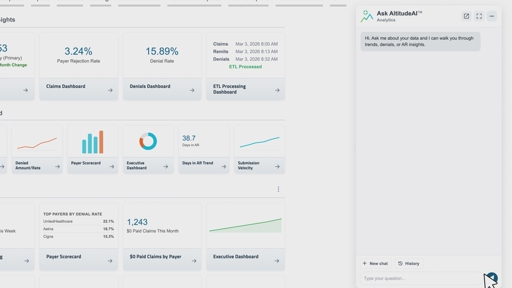
Waystar launched AltitudeAI-powered agentic capabilities on August 26, including agents that interpret payer responses and automatically resubmit eligible denied or rejected claims. According to Waystar, its platform data spans more than 7.5 billion transactions and approximately 60% of U.S. patients; the company reports that about 70% of initially denied claims are ultimately paid after provider rework.
Waystar launched new AltitudeAI-powered agentic capabilities on August 26, adding autonomous claim resolution, conversational performance intelligence, and agentic clinical documentation to its healthcare revenue-cycle software. The company's announcement describes agents that interpret payer responses, apply payer-specific intelligence, select a next action, and automatically resubmit eligible rejected or denied claims with minimal human intervention.
According to Waystar, its underlying platform has payer connectivity and proprietary data spanning more than 7.5 billion transactions and approximately 60% of U.S. patients. The company also reports that roughly 70% of initially denied claims are ultimately paid, but often only after providers invest time and money in rework.
Claim resubmission moves from recommendation to execution
The new capability targets a workflow where an analytics system may identify a denial, but staff still need to interpret the payer response, determine the appropriate correction or appeal path, and submit the transaction. Waystar's announcement frames the new feature as an autonomous resubmission capability for claims that meet its eligibility criteria.
TechTarget reports that the release also covers conversational access to operational and financial performance data. Users can query the system about trends, root causes, and financial impact, rather than manually navigating analytics workflows. Waystar told TechTarget that early adopters reduced time spent on performance analysis by 75%; the company did not provide independent validation of that figure in the announcement.
For clinical documentation, TechTarget reports that Waystar's agents can analyze about 30,000 data points in a medical record and synthesize recommendations. The company anticipates reduced documentation-review time, but the available reporting does not establish a measured deployment-wide result.
Accuracy and process variability remain material
The value of automated resubmission depends on more than natural-language interpretation of a remittance or denial message. A system acting on a claim needs current payer-specific rules, reliable mapping from denial reasons to permissible actions, and controls over when to send a corrected claim versus route it to a human reviewer. Errors can affect reimbursement timing, create rework, or complicate subsequent appeals and recoupment processes.
The Next Web reports that Waystar identifies variation in AI claims-matching accuracy across payers and changes to payer appeals and recoupment processes as risks. Those limitations are consequential in revenue-cycle automation because payer policies and operational processes can vary by plan, claim type, and jurisdiction. Companies deploying comparable systems typically need monitoring for action accuracy, exception rates, denial recurrence, and the financial outcomes of automated versus human-handled submissions.
Waystar CEO Matt Hawkins said in the company's release, "By combining AI with the breadth of our data, payer intelligence, and connected workflows, Waystar increasingly identifies what needs attention and deploys specialized agents to pursue resolution." The release characterizes the work as part of Waystar's stated vision for an autonomous revenue cycle.
Different administrative constraints in Germany
The Next Web contrasted the U.S. denial-management use case with German hospital billing audits. It reports that Germany limits the share of a hospital's invoices that sickness funds can submit for medical audit each quarter to 5%, 10%, or 15%, based on prior review outcomes. The publication also reports that, since December 2024, hospitals pay a flat 400 euro surcharge when an audit reduces an invoice.
That comparison illustrates how automation opportunities in healthcare administration are shaped by reimbursement rules as well as model capability. In U.S. revenue-cycle workflows, automated claim follow-up may be valuable where denials generate significant manual work. In systems where audit volumes are legally capped or dispute economics differ, the same agentic workflow may address a narrower operational problem.
Key Points
- 1Waystar's agents automate eligible claim resubmissions, extending revenue-cycle AI from denial analysis into payer-facing workflow execution.
- 2Waystar reports 7.5 billion transactions of platform data, but payer-specific accuracy and policy changes remain deployment constraints.
- 3Comparable healthcare automation deployments require monitoring of exception rates, action accuracy, reimbursement outcomes, and human escalation paths.
Scoring Rationale
The launch is a notable production use of agentic AI in healthcare revenue-cycle operations, where denial rework directly affects provider cash flow and administrative cost. Its practitioner relevance is tempered by vendor-reported performance figures and the need to validate payer-specific accuracy, eligibility controls, and operational outcomes.
Sources
Primary source and supporting public references used for this report.
Practice with real Health & Insurance data
90 SQL & Python problems · 15 industry datasets
250 free problems · No credit card
See all Health & Insurance problems