Valarian Raises $50 Million for Sovereign AI Infrastructure
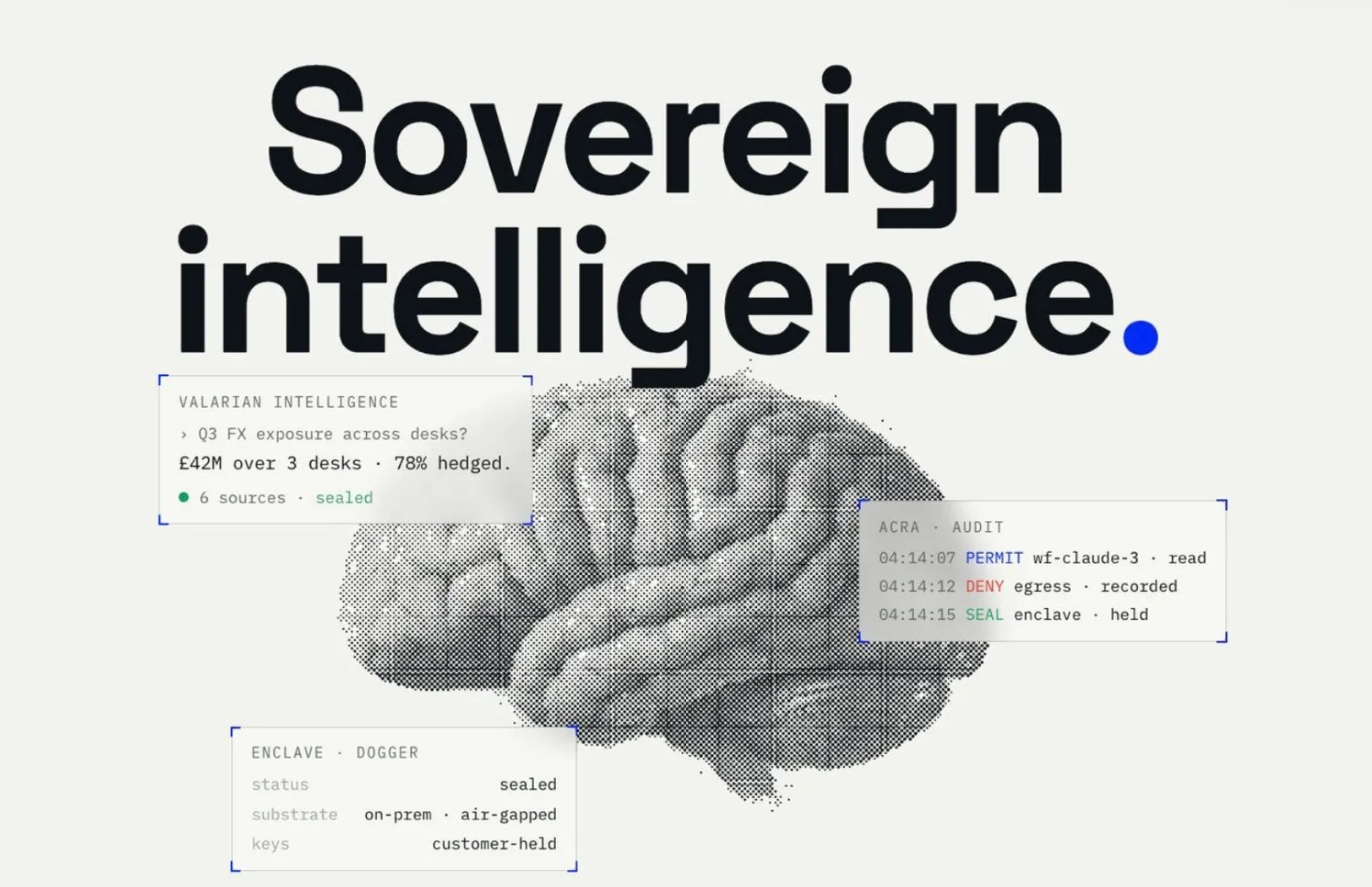
Valarian has raised a $50 million Series A led by New Enterprise Associates to expand software intended to give governments and regulated enterprises more control over AI workloads, data access, operational policies, and shutdown authority. Fortune and SiliconANGLE report that the London company positions its product beneath models and applications, rather than as another cloud or foundation model. The financing is real; the stronger claims about sovereignty, security, and reduced supplier dependence are product claims that still require customer-level evidence. LDS evaluates the platform as a control plane: buyers should test model portability, offline operation, policy enforcement, audit completeness, key ownership, failure recovery, and whether administrators can replace a supplier without rebuilding the application stack.
What happened
Valarian has raised a $50 million Series A led by New Enterprise Associates to expand software for governments and regulated enterprises running sensitive AI systems. Fortune and SiliconANGLE describe the London company as building a control layer beneath models and applications, with the goal of governing data access, deployment boundaries, operational policy, and shutdown authority.
The round is a verified financing event. Claims that the platform creates sovereignty, improves security, or reduces dependence on foreign cloud providers remain company positioning until deployments expose architecture, controls, and measurable outcomes. Funding validates investor interest; it does not validate every technical guarantee.
Technical context
Sovereign AI is not achieved by hosting a model inside national borders. A useful control plane must determine which identity can call a model, which data it can retrieve, where inference runs, which logs leave the environment, how keys are held, and what happens if a cloud or model supplier becomes unavailable.
| Control question | Evidence a buyer should request | Failure mode |
|---|---|---|
| Workload location | Deployment and network-boundary proof | Data crosses an unapproved region |
| Model portability | Reproducible supplier-swap test | Application remains locked to one model |
| Policy enforcement | Denied-action and escalation logs | Rules exist only in documentation |
| Administrative control | Customer-held keys and shutdown test | Vendor retains privileged access |
| Recovery | Offline and degraded-mode exercise | Critical workflow stops with one dependency |
For practitioners
Procurement teams should convert the word sovereignty into acceptance tests. Run the same workflow against two model providers, disconnect external services, rotate customer-owned keys, revoke a compromised identity, export the audit trail, and restore the service from documented artifacts. Record what continues working, what silently degrades, and which actions still require vendor intervention.
Security evaluation should also separate orchestration from isolation. A policy engine can route requests correctly while the underlying model endpoint, telemetry service, or administrator path remains outside the customer's control. Threat models should cover privileged insiders, compromised connectors, model-supplier outages, poisoned updates, incomplete logs, and jurisdictional access requests.
Editorial analysis
LDS sees the financing as evidence that infrastructure governance is becoming a distinct AI product category. Valarian's opportunity is credible because sensitive adopters need controls above heterogeneous clouds and models. Its proof burden is equally high: the platform should demonstrate enforceable boundaries and supplier replacement under realistic failure conditions, not merely present a dashboard that describes them.
What to watch
Watch for named deployments, independently tested isolation, published integration boundaries, customer-held key support, reproducible model replacement, third-party security assessments, and evidence that critical operations survive supplier or network failure.
Key Points
- 1Valarian raised a $50 million Series A to expand a control layer for sensitive AI infrastructure and high-consequence workloads.
- 2The financing is verified, while sovereignty and security benefits still require deployment evidence and independent technical testing.
- 3LDS recommends portability, offline-operation, key-ownership, policy-enforcement, audit-export, shutdown, and recovery tests before buyers accept sovereignty claims.
Scoring Rationale
An impact score of 6.5 reflects a substantial early-stage investment in a relevant infrastructure-control category, tempered by limited public deployment and independent performance evidence.
Sources
Primary source and supporting public references used for this report.
Practice interview problems based on real data
1,625 SQL & Python problems across 15 industry datasets — the exact type of data you work with.
Try 250 free problems