
Trump and Xi Meet to Discuss Iran, Trade and AI
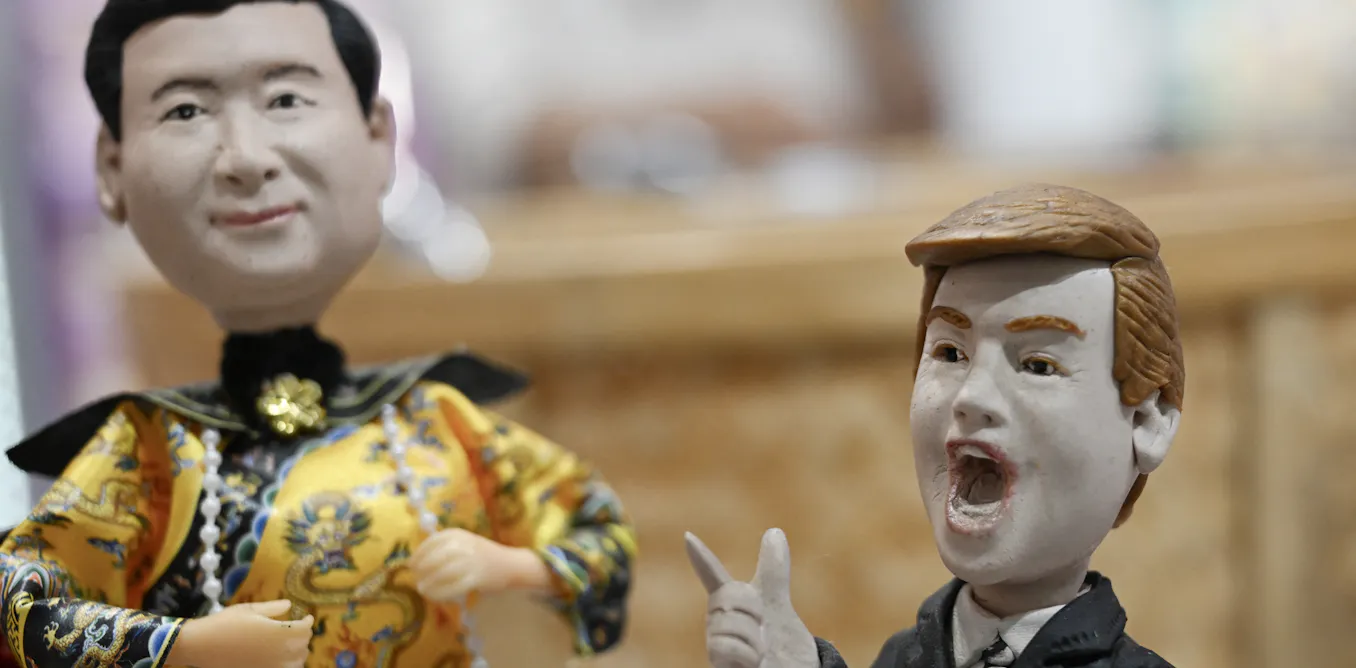
U.S. President Donald Trump and Chinese President Xi Jinping are meeting in Beijing for a two-day summit that brings Iran, Taiwan, trade and artificial intelligence onto the agenda. Reporting from Reuters and The New York Times says the talks will cover extensions of a critical-minerals (rare-earths) arrangement, agricultural and aircraft purchases and the creation of trade and investment boards. Expectations among commentators and analysts are modest: The Conversation's Rana Mitter characterises the summit as unlikely to produce a transformational "Nixon in China" moment, while outlets including the Financial Times, WSJ and The Economist highlight constrained goals and short-term stability as the probable outcome.
What happened
Per reporting by Reuters and The New York Times, Donald Trump and Xi Jinping are holding a two-day meeting in Beijing to discuss a range of bilateral and global issues, including Iran, Taiwan, trade and artificial intelligence. Reuters reports that U.S. and Chinese officials are weighing an extension of a critical-minerals (rare-earths) arrangement, and that trade conversations include possible Chinese purchases of Boeing planes, U.S. beef and soybeans, and the creation of trade and investment boards, a set of proposals described by senior U.S. officials and summarised by The New York Times as the "Five B's." The New York Times also notes that this will be Mr. Trump's first trip to China since 2017.
Technical details / reported agenda items
According to Reuters, the summit agenda explicitly lists Iran, nuclear issues, Taiwan, AI and trade, and Reuters quotes U.S. officials saying talks could cover agriculture purchases, airline sales and investment forums. The Financial Times reports that the U.S. side intends to press Beijing about the war in Iran, while the WSJ opinion coverage frames trade and rare-earths as central bargaining chips.
Context and significance
For practitioners
Observed patterns in similar diplomatic settings: prior summits between Washington and Beijing have produced hortatory purchase commitments and short-term truce arrangements rather than durable structural change, as several outlets including the WSJ and The Economist note. That pattern implies that practitioners should view any headline announcements coming out of Beijing as tentative until concrete, verifiable follow-through appears in trade filings, export-control adjustments, or new multilateral regulatory text.
What to watch
Observers will track:
- •the text and technical scope of any rare-earths or critical-minerals extension reported by Reuters
- •concrete purchase commitments and implementation timetables for aircraft and agricultural goods cited by The New York Times
- •whether the summit yields any joint statements or working groups on AI governance that specify timelines, scope, or mechanisms for information exchange (agenda items noted by Reuters)
- •subsequent regulatory or export-control notices from the U.S. Commerce Department or Chinese ministries that would convert summit rhetoric into operational rules
Bottom line
Editorial analysis
Industry observers frame this meeting as one oriented toward stabilization rather than sweeping agreements. The Conversation's Rana Mitter argues the summit is unlikely to replicate the symbolic breakthrough of historical moments like Nixon's 1972 visit, a view echoed in analytical coverage that stresses modest, tactical outcomes over deep strategic rapprochement.
For technology and AI communities, the meeting matters for three practical reasons. First, any agreement to limit or extend cooperation on critical minerals affects chip and materials supply chains used in high-performance computing and AI accelerators; Reuters highlights U.S. and Chinese attention to that issue. Second, media coverage shows Washington is seeking mechanisms-trade and investment boards-to carve out managed economic interactions, which could influence cross-border data flows and sourcing for AI hardware and services (reported by The New York Times). Third, the stated inclusion of artificial intelligence on the agenda marks regulatory and standards conversations as an explicit bilateral topic (reported by Reuters), which could shape multilateral approaches to AI guardrails and export controls.
Coverage across the major outlets frames the summit as important for keeping lines of communication open, with limited expectations for sweeping breakthroughs. For AI and infrastructure stakeholders, the immediate implications will hinge on whether negotiators convert verbal commitments into enforceable supply-chain or regulatory actions in the weeks after the meeting.
Key Points
- 1Trump and Xi meet in Beijing to discuss Iran, Taiwan, trade and AI, with coverage by Reuters and The New York Times.
- 2Reporting highlights possible rare-earths/critical-minerals extensions and trade purchase pledges, which affect AI hardware supply chains.
- 3Editorial commentary frames outcomes as likely modest, so practitioners should await concrete regulatory or export-control follow-through.
Scoring Rationale
The summit directly involves AI regulation, critical-minerals supply and trade arrangements that matter to ML infrastructure and governance. Coverage suggests modest, tactical outcomes rather than paradigm shifts, so importance is high but not historic.
Sources
Public references used for this report.
View 11 more sources
- Donald Trump to press China’s Xi Jinping about Iran war at summitft.com
- The Trump-Xi summit will expose a dysfunctional duoeconomist.com
- Trump-Xi summit has high stakes for Taiwan - AP Newsapnews.com
- From Singapore to Brussels, world leaders eye Trump-Xi summit from afarcnbc.com
- Trump-Xi Summit Explained: Iran, Taiwan, AI and the Battle Over Rare Earthsoutlookbusiness.com
- The best-case scenario for Taiwan from the Trump-Xi summit - PBSpbs.org
- On Trump's Beijing agenda: Strait of Hormuz, Taiwan and AI - NPRnpr.org
- Trump and Xi's Beijing summit must confront the AI cold warabc.net.au
- At the Trump-Xi Summit, China Will Have the Upper Handcfr.org
- Can the US and China cooperate on AI? - Brookings Institutionbrookings.edu
- The Trump–Xi summit: can progress be made on Iran?chathamhouse.org
Practice interview problems based on real data
1,625 SQL & Python problems across 15 industry datasets — the exact type of data you work with.
Try 250 free problems

