Trad.Fi Uses AI to Tokenize $650M Equipment Loans
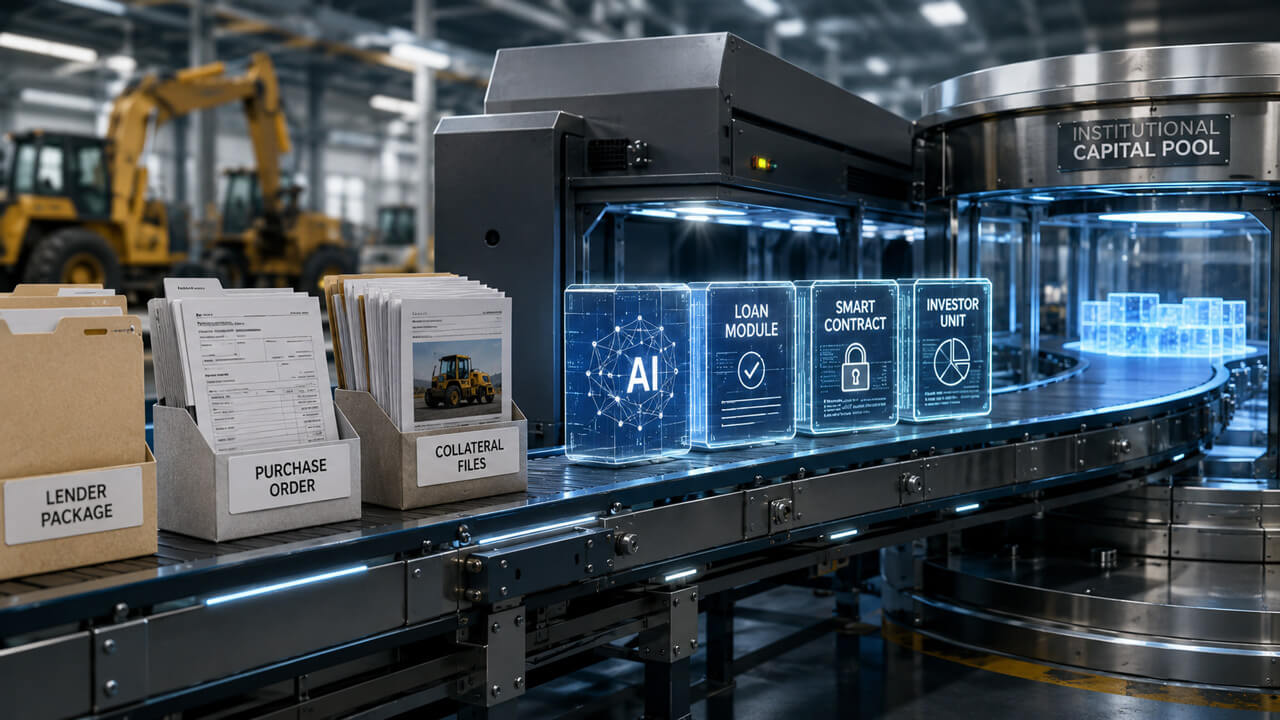
According to reporting from CoinDesk, CryptoSlate, CryptoBriefing and CryptoNews, Trad.Fi and AI-agent platform W3 intend to move a targeted $650 million equipment-finance origination pipeline onto public blockchain rails over the next four years. The program targets U.S. equipment financing for manufacturing, industrial electrical infrastructure, residential solar and related sectors, and will use W3's automation to compress underwriting, due diligence and pricing from months to as little as a single business day, per CoinDesk and CryptoBriefing. CryptoNews reported that the tokenized pool will run across Avalanche, Base and Arc blockchains, that legal documents and UCC filings will remain offchain, and that Trad.Fi has roughly $85 million in signed term sheets with about $40 million expected to close imminently. The experiment tests whether AI-driven automation plus tokenized liquidity can speed origination without degrading credit outcomes.
What happened
According to CoinDesk, CryptoSlate, CryptoBriefing and CryptoNews, Trad.Fi and AI-agent developer W3 plan to move a targeted $650 million private-credit equipment-finance pipeline onto blockchain rails over the next four years. The initiative targets U.S. equipment financing in sectors including manufacturing, industrial electrical contracting and residential solar, and aims to use AI to assess risk, conduct due diligence and price loans fast enough to reduce approval timelines from months to a single business day, per CoinDesk and CryptoBriefing. CryptoNews reported that the program will mint a tokenized investment pool and operate across Avalanche, Base and Arc blockchains, while legal agreements and UCC-1 filings will remain offchain. CryptoNews also reported Trad.Fi has about $85 million in signed term sheets and about $40 million expected to close imminently.
Technical details
Public reporting describes W3 as supplying programmable treasury and workflow infrastructure that automates information extraction, agent-powered reviews and fund orchestration. CryptoBriefing and Blockster note that W3 will produce onchain records called a Programmable Credit Record (PCR) for each loan to provide real-time visibility into collateral and payment status. Reporting also indicates the initiative will ingest offchain data sources such as Plaid and traditional credit bureau feeds for underwriting inputs, per CryptoBriefing. Legal and enforcement components, including lien filings and documentation, will remain offchain according to CryptoNews, so the system combines onchain recordkeeping with offchain legal plumbing.
Context and significance
Tokenized real-world assets (RWAs) have grown across multiple sectors, but most public activity has focused on Treasuries and institutional funds. CoinDesk and CryptoSlate frame this Trad.Fi-W3 effort as an attempt to give RWAs a clearer real-economy lending use case by pairing AI-driven underwriting with tokenized investor liquidity. CryptoBriefing and CryptoSlate underline that faster approvals only matter if loan performance and recoveries match traditional standards, since collateral valuation, servicing quality and investor liquidity remain key determinants of credit outcomes.
Risks and limitations
Multiple outlets warn the hard tests are loan performance and recoveries. CryptoSlate and CryptoBriefing explicitly note that collateral enforcement, servicing arrangements and investor exit options will still rely on offchain legal and operational processes. CryptoNews documented that U.S. investors will not be eligible during the initial phase and that a third-party operator - not yet named - will manage the onchain investment pool.
What to watch
Observers should track measurable loan performance against comparable traditional vintages over a credit cycle; how PCRs and onchain signals map to recoveries and collateral valuations; the third-party pool operator's identity and the legal wrappers for investor protections; and the extent to which onchain liquidity actually shortens funding times without creating mismatched investor and lender horizons. Teams building AI-assisted credit systems should also monitor how Plaid and bureau data are integrated into automated decisioning and which credit attributes remain subject to human review.
Key Points
- 1Trad.Fi and W3 target a $650 million tokenized equipment-finance pipeline over four years, testing AI-driven underwriting at scale.
- 2Tokenization plus programmable records (PCRs) aims to speed funding, but reported constraints include offchain legal filings, servicing and investor eligibility.
- 3Industry pattern: similar AI-plus-RWA pilots hinge not on origination speed alone but on whether automated scores predict recovery and loss performance over a credit cycle.
Scoring Rationale
A niche equipment-finance lender pairing AI-driven underwriting with tokenized private credit is an interesting live test of AI automation in a real lending workflow, but the 4-year $650M pipeline target is speculative and the AI component (W3 workflow automation) is a supporting tool rather than the primary story. Multiple outlets flag performance risk and investor eligibility restrictions. Solid tier for practitioners building AI-assisted credit or RWA infrastructure.
Sources
Public references used for this report.
Practice with real Banking data
90 SQL & Python problems · 15 industry datasets
250 free problems · No credit card
See all Banking problems