Tutoriallatent diffusionclipunetlaion aesthetics
Stable Diffusion Explains Latent Diffusion Image Generation
8.1
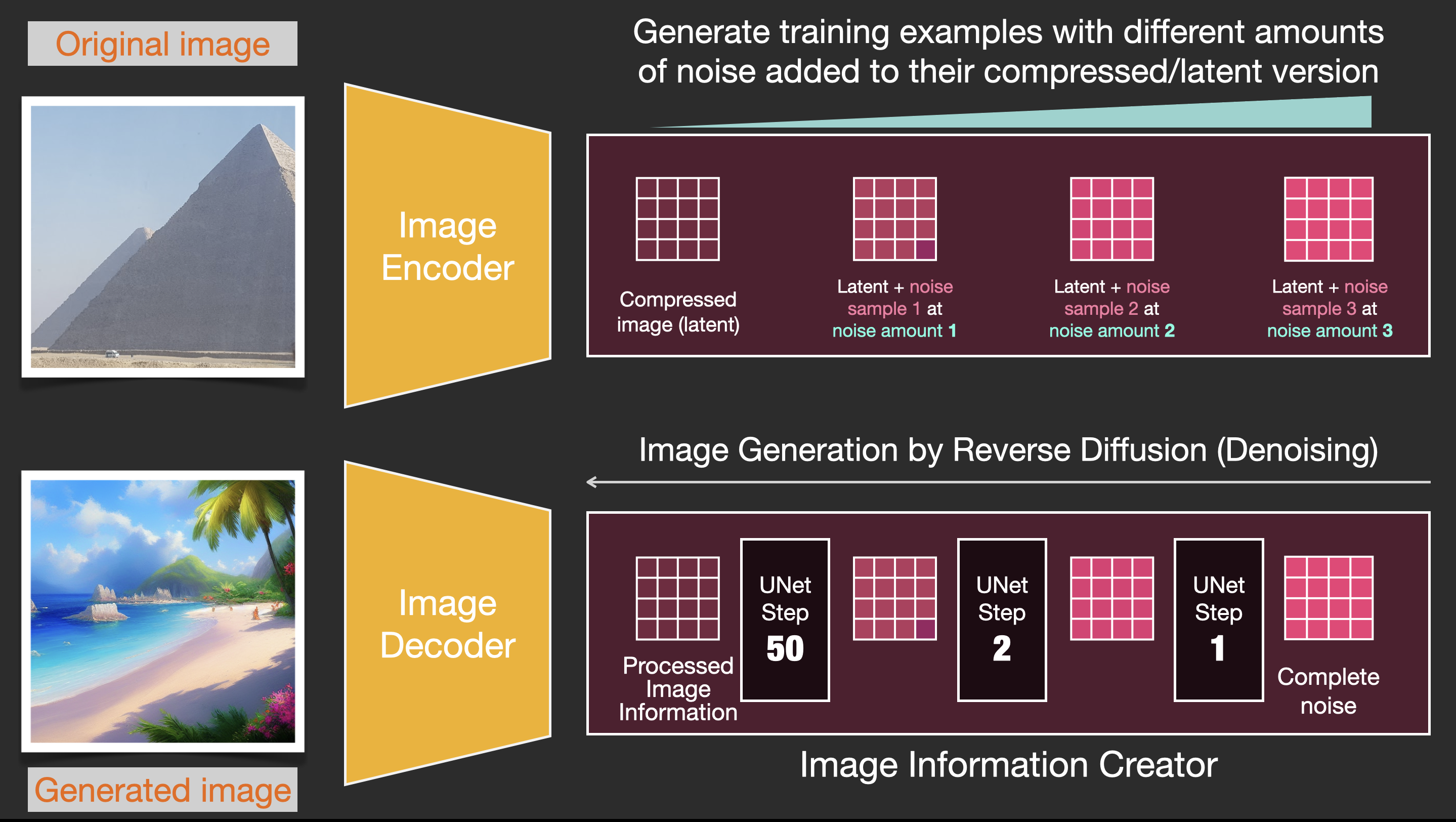
This Nov 2022 updated explainer breaks down how Stable Diffusion generates images from text, describing its CLIP text encoder, UNet-based latent diffusion process, and autoencoder decoder. It notes operational details—77×768 token embeddings, diffusion steps commonly set to 50–100, latent shape (4,64,64) decoded to (3,512,512)—and explains training with noisy-image denoising on datasets such as LAION Aesthetics, highlighting latent-space speed gains.
Key Points
- 1Describes system components: CLIP text encoder, UNet latent denoiser, and autoencoder image decoder.
- 2Explains latent-space diffusion yields faster, higher-quality generation than pixel-space diffusion.
- 3Implies practitioners can tune steps, guidance, and latents for quality, speed, and prompt control.
Scoring Rationale
Comprehensive, practical breakdown of Stable Diffusion components and parameters + limited original research or novel claims.
Practice interview problems based on real data
1,625 SQL & Python problems across 15 industry datasets — the exact type of data you work with.
Try 250 free problems