Spatial Computing Integrates With MCP in Virtual Worlds
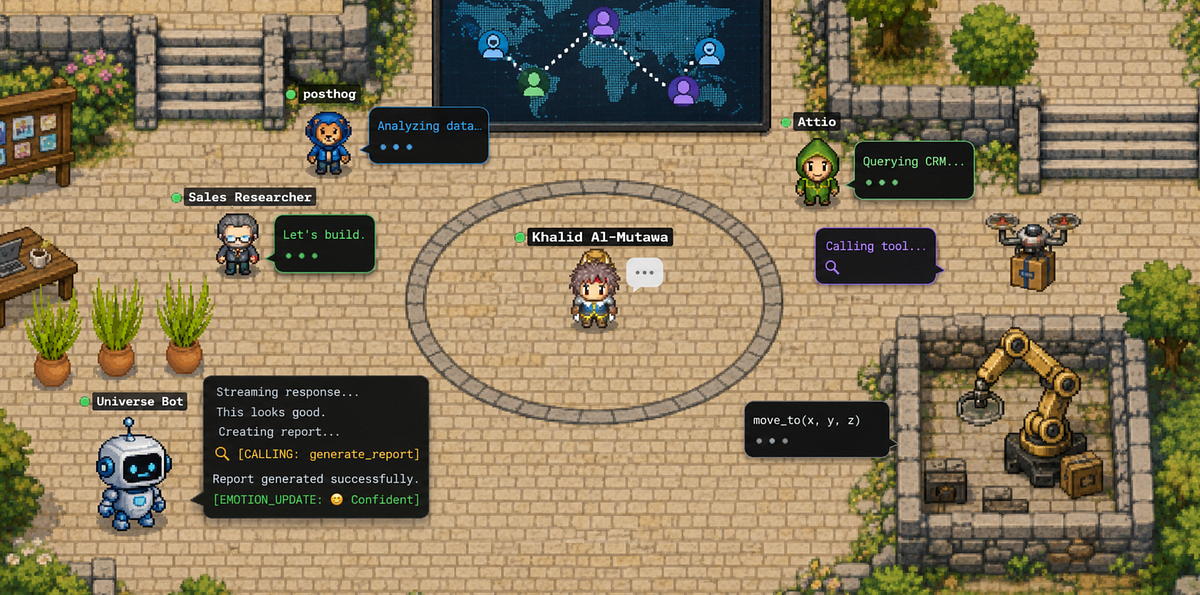
The BAWES Universe essay published on July 7, 2026 argues that spatial computing and the Model Context Protocol can be combined so AI agents operate inside persistent virtual worlds instead of only through chat or API calls. The post describes Universe as an open virtual-world platform built on WorkAdventure with AI agent support, MCP tool integration, streaming conversations, behavioral AI, and a spatial runtime. For practitioners, this is best treated as an early project thesis: persistent spatial state could make agent memory, permissions, replay, and object-level safety controls more important, but the post does not provide adoption metrics, benchmarks, or a standards roadmap. The MCP documentation supports the protocol context; the Universe claims remain single-source.
The practitioner value in this essay is the engineering shape of the problem: once agents operate in persistent spaces, teams need to manage state, permissions, replay, and tool access as runtime infrastructure rather than as a chat prompt convention. The evidence is still early and single-source, so the safest treatment is as a project thesis, not as market validation.
What happened
A BAWES Universe post published July 7, 2026 argues that spatial computing and the Model Context Protocol belong together. The post describes Universe as an open virtual-world platform built on WorkAdventure, extended with AI agent support, MCP tool integration, streaming conversations, behavioral AI, and a spatial runtime for autonomous agents.
Technical context
The Model Context Protocol is designed to standardize how models connect to tools and external systems. In a spatial runtime, that interface could map agents to files, APIs, databases, objects, rooms, and actions inside a persistent world. That makes access control, audit logs, object-level permissions, and deterministic replay more important than they are in a simple stateless chatbot.
For practitioners
Teams exploring agentic systems should separate the architectural idea from the adoption claim. The article gives a concrete example of MCP-style tool access in a virtual-world setting, but it does not publish benchmarks, third-party usage, protocol-governance details, or formal interoperability tests.
What to watch
Useful follow-up would include public repositories, reproducible demos, integration tests with MCP clients and servers, and safety controls for multi-agent actions inside shared environments. Until then, the idea is interesting for builders but not yet proof of a broader spatial-agent platform category.
Key Points
- 1The BAWES post frames spatial worlds as persistent runtimes where agents need tool access, memory, and permissions.
- 2MCP provides relevant protocol context, but the Universe implementation details and adoption claims remain single-source.
- 3Practitioners should watch for reproducible demos, access-control patterns, replay tooling, and third-party integrations.
Scoring Rationale
The essay is relevant to agent and spatial-computing builders, but it is a single-project thesis without adoption metrics, benchmarks, or standards evidence. The impact is therefore minor-to-solid rather than notable for the broader AI industry.
Sources
Public references used for this report.
Practice interview problems based on real data
1,625 SQL & Python problems across 15 industry datasets — the exact type of data you work with.
Try 250 free problems