SN9 Deploys IOTA for Distributed Large-Scale Model Training
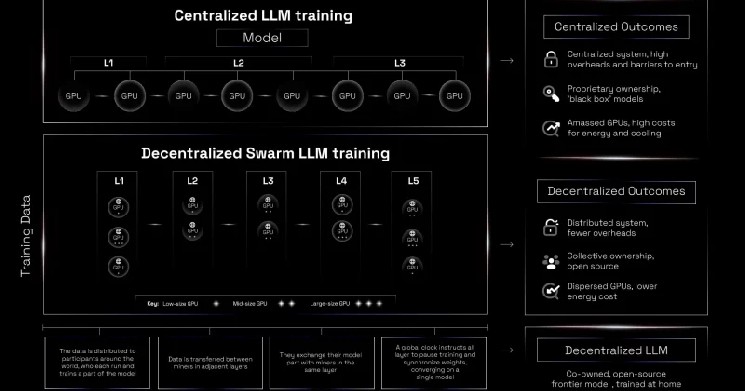
Bittensor's Subnet 9 (SN9) has published the Incentivised Orchestrated Training Architecture (IOTA), a decentralized data- and pipeline-parallel system that splits model layers across heterogeneous nodes, enabling permissionless pretraining at scale, according to the arXiv paper submitted July 16, 2025 and the project documentation. The arXiv paper reports that SN9 pretrained models up to 14 billion parameters in August 2024 and lists core techniques including activation compression (up to 128x), a Butterfly All-Reduce averaging scheme, and a contribution-attribution mechanism called CLASP. The project's GitHub and docs show a live 1.5B-parameter run and roadmap items to scale to 15B, 50B, and 100B. CryptoBriefing reports a consumer-facing Train at Home application launched in February 2026 to let participants contribute GPU capacity to the pipeline.
What happened
Bittensor's Subnet 9 (SN9) introduced the Incentivised Orchestrated Training Architecture, or IOTA, a permissionless, token-incentivized framework for pretraining large language models across heterogeneous nodes, per the arXiv technical paper submitted July 16, 2025 and the subnet documentation. The arXiv paper reports that SN9 previously pretrained LLMs up to 14 billion parameters in August 2024 and describes IOTA's core components as a data- and pipeline-parallel SWARM orchestrator, granular contribution accounting, activation compression, a Butterfly All-Reduce scheme, and a contribution-assessment algorithm named CLASP (all listed in the paper). The project's GitHub and docs show an ongoing 1.5B-parameter run and roadmap items to scale to 15B, 50B, and 100B models. CryptoBriefing reports a consumer-facing Train at Home application launched in February 2026 that lets external GPUs join the training pipeline.
Technical details
Per the arXiv primer and the project's documentation, IOTA combines multiple distributed-training techniques and crypto-economic mechanisms:
- •An orchestrator that assigns model layers to miners and streams activations between them, enabling model size to scale with participant count. (arXiv; docs)
- •Activation compression, reported in the paper to reduce communication bandwidths by up to 128x via model-bottleneck techniques. (arXiv)
- •A Butterfly All-Reduce variant for parameter averaging that the paper describes as offering O(1) bandwidth per miner, redundancy, and collusion-detection properties. (arXiv)
- •CLASP, a sampled-pathway contribution attribution scheme claimed to assign credit proportional to marginal utility and to detect exploits in interdependent pipelines. (arXiv)
The GitHub repository provides runnable miner and validator code, notes current runs in bfloat16, and lists compute guidance (recommendations for GPUs with >= 16GB VRAM) and dashboard tooling for monitoring runs. (GitHub; docs)
Industry context
What to watch
Bottom line
Editorial analysis
Projects that market decentralized compute have historically emphasized inference rather than pretraining, and coverage of such projects frequently highlights a gap between economic incentives and cluster-equivalent training performance; CryptoBriefing explicitly notes that many decentralized compute projects target inference workloads. IOTA's design attempts to bridge incentive alignment and training performance by combining pipeline parallelism with tokenized, continuous rewards. For practitioners, this matters because network-level compression and attribution schemes are the primary technical levers for making geo-distributed pretraining cost-effective compared with colocated clusters.
Observers should track:
- •whether public runs reproduce the paper's claimed 128x activation compression in real network conditions
- •scaling of live training from 1.5B toward 15B+ models and the associated wall-clock efficiency
- •validator effectiveness and CLASP behavior under adversarial or noisy nodes
- •how Train at Home and similar consumer clients affect bandwidth, latency, and data hygiene. These indicators will determine whether distributed, incentivized pretraining can approach the throughput and reliability of conventional data-center training without centralized coordination
IOTA is a concrete, well-documented attempt to combine established distributed-training primitives with crypto-economic incentives. For engineers and researchers, the technical proofs in the arXiv paper and reproducible artifacts on GitHub make SN9 one of the more testable decentralization experiments in large-scale ML to date, while the real-world behavior of compression, attribution, and orchestration in heterogeneous networks remains the pivotal question.
Key Points
- 1IOTA's split-model pipeline reduces per-node VRAM requirements, lowering hardware barriers and widening potential contributor pools for pretraining.
- 2Heavy activation compression and a Butterfly All-Reduce aim to solve communication bottlenecks that typically limit geo-distributed training scalability.
- 3Tokenized, granular attribution (CLASP) seeks to align rewards with marginal contribution; verification and collusion detection will determine reliability in practice.
Scoring Rationale
This is a notable infrastructure development: IOTA combines distributed-training techniques with incentive mechanisms and runnable artifacts. The story matters to practitioners because it tests whether pretraining can be decentralized without prohibitive communication or verification costs.
Sources
Public references used for this report.
Practice with real Hotels & Lodging data
90 SQL & Python problems · 15 industry datasets
250 free problems · No credit card
See all Hotels & Lodging problems