Simple Higher Ed Launches Simple TA for Scalable Instructional Support
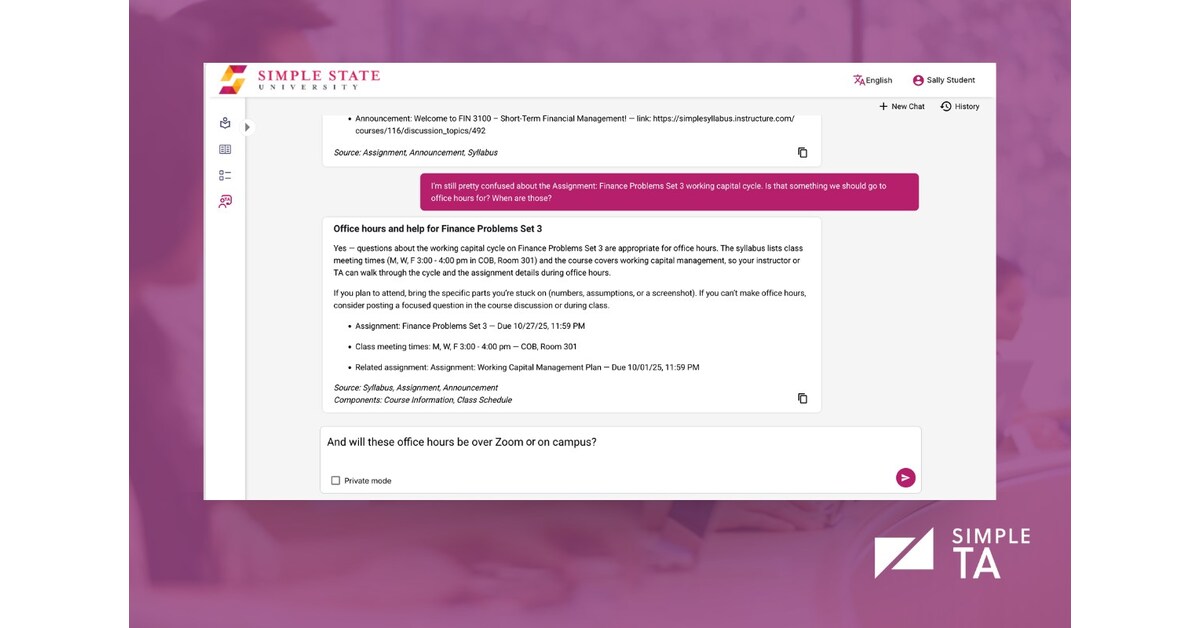
Simple Higher Ed launched Simple TA, an AI teaching assistant integrated into the LMS via LTI to deliver course-aligned, real-time student support. The product creates a per-course, syllabus-grounded assistant that uses instructor-provided materials to keep responses relevant and focused on academic integrity. The platform uses a flexible BYOK approach so institutions can route inference to OpenAI, Google, or Anthropic while keeping course data in their ecosystem. Simple TA also includes reporting to surface common student questions and curricular confusion, enabling instructional designers and academic leaders to iterate on course content.
What happened
Simple Higher Ed announced the launch of Simple TA, an AI teaching assistant purpose-built for higher education and already offered to a customer base of nearly 600 colleges and universities. The assistant integrates directly into institutional LMSs via LTI and provisions a per-course, syllabus-grounded agent that uses instructor-provided content to keep student-facing guidance aligned with course expectations and academic integrity goals.
Technical details
Simple TA constructs course-aware responses by indexing the syllabus, LMS content, and instructor materials so answers are scoped to what is actually taught. The platform supports a BYOK model that lets institutions select the inference provider, OpenAI, Google, or Anthropic, enabling policy alignment and data-local control. Simple TA emphasizes guidance over unconstrained generation to reduce hallucination and integrity risks, and exposes reporting for instructional designers and academic leaders to track patterns in student questions.
- •Integration: LTI-based deployment embedded in the LMS per course, minimizing friction for students and instructors.
- •Provider flexibility: BYOK support for OpenAI, Google, or Anthropic, aligning vendor choice with institutional policy.
- •Pedagogical alignment: responses are grounded in syllabus and instructor content rather than open-ended web scraping.
- •Analytics: reporting surfaces recurring confusions and engagement patterns for course improvement.
- •Academic integrity: design choices favor course-aware guidance over free-form content generation to reduce misuse.
Context and significance
This launch reflects a maturing segment of verticalized AI tooling that prioritizes governance, data locality, and pedagogical alignment rather than raw model novelty. For higher education IT and instructional design teams, Simple TA packages common integration and compliance requirements, LTI deployment, vendor flexibility, and syllabus grounding, into a turnkey product. That matters because institutions face regulatory, privacy, and FERPA-related constraints that generic chatbots do not address.
What to watch
Adoption velocity at the existing customer base, how BYOK is implemented end-to-end (key management, telemetry, and logging), and whether Simple TA supports vector stores or on-prem inference will determine its fit for privacy-sensitive campuses. Track whether analytics deliver actionable curricular changes and measurably reduce instructor workload.
Key Points
- 1Course-grounded AI reduces hallucination risk by constraining answers to syllabus and instructor content, improving academic integrity outcomes.
- 2BYOK with OpenAI, Google, and Anthropic gives institutions vendor choice and aligns AI usage with internal data governance policies.
- 3Built-in reporting surfaces student confusion patterns, enabling instructional designers to iterate courses and target support where it matters most.
Scoring Rationale
Product launch is notable for higher-education practitioners because it packages LMS integration, data governance, and vendor choice into a single offering and leverages an existing customer base. It does not introduce new model research, so impact is operational rather than frontier-breaking.
Practice interview problems based on real data
1,625 SQL & Python problems across 15 industry datasets — the exact type of data you work with.
Try 250 free problems