Shopify Engineer Describes Building Multi-Agent Systems
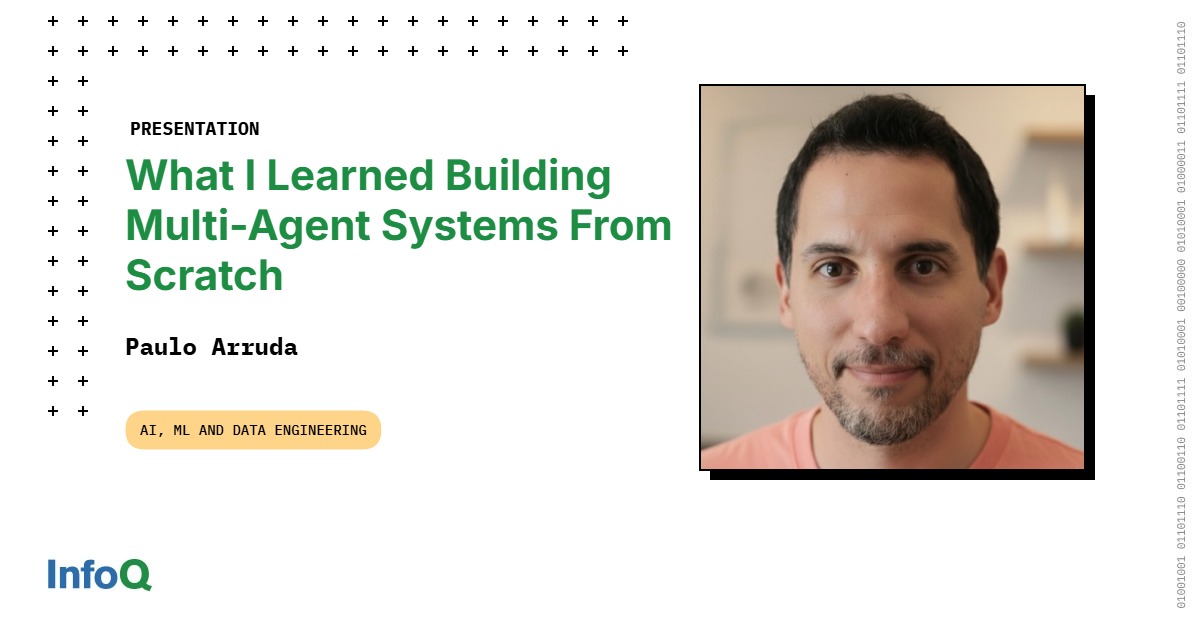
Per an InfoQ presentation, Paulo Arruda, a Staff Engineer at Shopify, described the companys evolution from simple chat tools to a multi-agent architecture (InfoQ). Arruda reported moving away from large "all-in-one" prompts toward narrow, specialized agent microservices, and said this approach reduced task times from hours to minutes (InfoQ). He also discussed a future-facing hypothesis of using filesystem-based adapters to address context bloat (InfoQ). Arruda is credited as the creator of Claude Swarm and SwarmSDK, with Claude Swarm noted as having 1.4k+ GitHub stars on the project page (InfoQ). The talk was presented at QCon AI and published on InfoQ on May 13, 2026.
What happened
Per an InfoQ presentation, Paulo Arruda, a Staff Engineer at Shopify, outlined Shopifys internal journey in AI adoption from early chat tools to a purpose-built multi-agent system (InfoQ). Arruda described moving away from large, monolithic prompts to a network of narrow, specialized agent microservices, and reported this change cut end-to-end task times from hours to minutes (InfoQ). He also presented a hypothesis for using filesystem-based adapters to mitigate context bloat in agent interactions (InfoQ). The presentation page lists Arruda as the creator of Claude Swarm and SwarmSDK, and notes Claude Swarm has 1.4k+ GitHub stars (InfoQ).
Technical details
Per the presentation transcript on InfoQ, Arruda contrasted "all-in-one" prompt pipelines with a microservices-style agent architecture that assigns narrow responsibilities to individual agents. He framed this approach as reducing per-task context and enabling parallelization of discrete subtasks, and he identified filesystem-backed adapters as a proposed mechanism for keeping working context bounded (InfoQ).
Editorial analysis - technical context
Companies and teams experimenting with agent orchestration commonly split capabilities into smaller, single-responsibility components to control prompt size, improve observability, and enable incremental scaling. Filesystem or local-state adapters are a recurring pattern in research and open-source projects aiming to manage long-context state without inflating model context windows.
Context and significance
Practitioner talks like Arrudas matter because they document operational tradeoffs when moving from exploratory chat UIs to production orchestration. The reported latency reductions described on stage illustrate a measurable practitioner benefit from decomposing tasks, a lesson relevant to engineering teams building automated workflows and data pipelines.
What to watch
For practitioners
follow evidence of adoption patterns-open-source agent toolkits, adoption of filesystem or vector-store adapters to bound context, and benchmarks showing latency or cost improvements from microservice-style agents. Also watch SwarmSDK and repositories for Claude Swarm for reproducible examples and reference implementations (InfoQ).
Key Points
- 1Industry pattern: Decomposing work into narrow agent microservices often reduces end-to-end latency and improves parallel throughput.
- 2Industry pattern: Filesystem-backed or local adapters are a common approach to limit context bloat in long-running agent workflows.
- 3Industry pattern: Open-source agent toolkits and reference SDKs accelerate practitioner adoption by packaging orchestration and debugging primitives.
Scoring Rationale
This is a practitioner-focused presentation that documents operational lessons rather than a major model or product launch. The talk provides useful engineering patterns for teams building agent orchestration, but does not introduce a paradigm-shifting capability.
Sources
Public references used for this report.
Practice with real Retail & eCommerce data
90 SQL & Python problems · 15 industry datasets
250 free problems · No credit card
See all Retail & eCommerce problems