Scorsese Joins Black Forest Labs to Storyboard Films
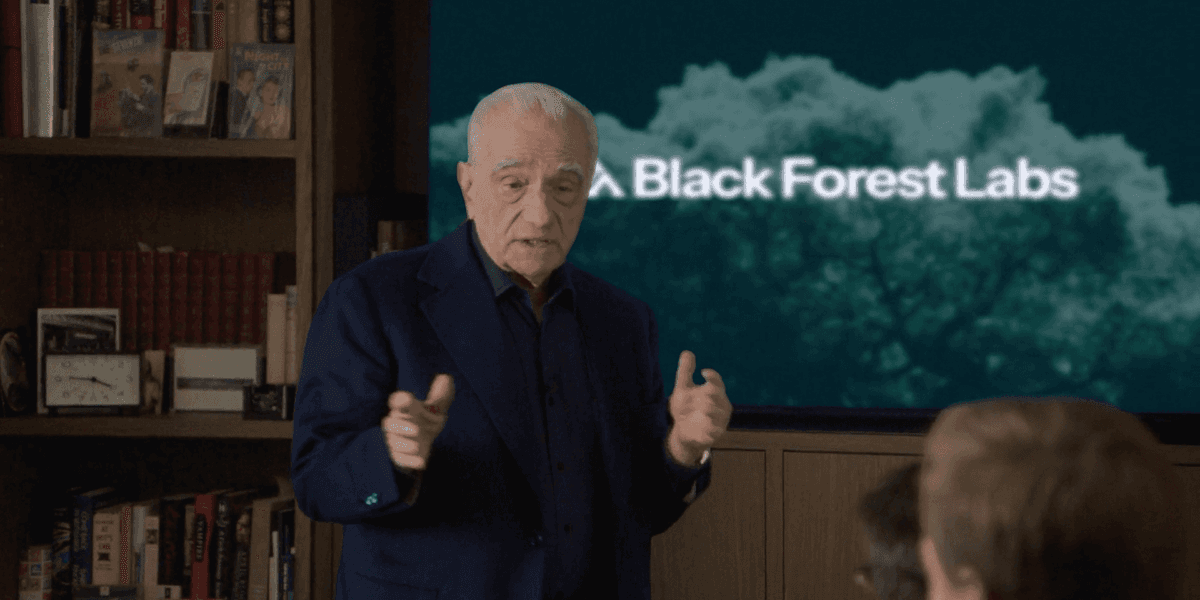
Martin Scorsese has joined Black Forest Labs, the image and video generative-AI startup behind the FLUX model, as an adviser and partner, according to The New York Times and the company's announcement. In a video filmed at his New York office, Scorsese uses FLUX to storyboard a scene; the company quotes him saying, "Cinema is a young medium, only around 125 years old, so we have to be open to how it can evolve." Variety and The Hollywood Reporter report Scorsese tested the tool while storyboarding his next film, What Happens at Night, starring Leonardo DiCaprio and Jennifer Lawrence, and described it as "creatively freeing." The partnership was introduced through investor and management connections including BroadLight Capital and Scorsese's manager Rick Yorn; Variety reports it is unclear whether Scorsese personally invested. Co-founder and CEO Robin Rombach told the Times the involvement is "a great proof point that this works."
What happened
Martin Scorsese has signed on as an adviser and partner to Black Forest Labs, per reporting by The New York Times and the company's own announcement. Black Forest Labs published a short video, filmed at Scorsese's New York City office, showing the director using the company's model, FLUX, to generate a storyboard for a scene. Variety and The Hollywood Reporter report Scorsese tested the tool while storyboarding his next film, What Happens at Night, starring Leonardo DiCaprio and Jennifer Lawrence, and called the experience "creatively freeing." The company quotes him saying, "Cinema is a young medium, only around 125 years old, so we have to be open to how it can evolve." Co-founder and CEO Robin Rombach told the Times the partnership is "a great proof point that this works." Variety reports the introduction came through investor and management connections including BroadLight Capital and Scorsese's manager Rick Yorn, and that it is unclear whether Scorsese personally invested.
Editorial analysis - technical context
Black Forest Labs markets FLUX as a generative image and video model and frames its mission as building "visual intelligence," per the company's website. Industry-pattern observation: generative image and video models are increasingly positioned as pre-production tools that produce rapid visualizations of framing, staging, and lighting, which can shorten iteration cycles in storyboarding and concept design. The practical benefits shown in the footage are familiar: faster iteration and clearer communication with production designers and cinematographers.
Industry context
The New York Times frames the move as part of a broader softening in Hollywood's stance on generative AI, contrasting it with earlier resistance from creative guilds when generative tools emerged. High-profile endorsements tend to accelerate tool exploration across peer networks, but adoption often collides with legal, rights, and labor questions. Black Forest Labs' public messaging emphasizes keeping "human taste, values, and judgment at the center," per the company's website.
Practical considerations and risks
Industry-pattern observation: teams integrating generative visual models into film production typically face three recurring challenges: maintaining temporal and stylistic consistency across sequences; managing likeness, copyright, and guild-rights questions when generating or modifying actor images; and integrating outputs into existing VFX and shot-planning pipelines.
What to watch
Monitor whether studios, agencies, or guilds issue formal guidance or contract language addressing pre-production AI tools; watch Black Forest Labs product updates on temporal coherence, camera-metadata export, and pipeline compatibility; and observe whether other established directors publish documented experiments that mirror Scorsese's public session.
Bottom line
This is a reported example of a high-profile creator publicly using a generative visual model for storyboarding and taking an adviser role with the vendor. Treat it as an indicator of growing experimentation by established filmmakers rather than proof of widespread production-level adoption; legal, labor, and technical-integration questions remain central to how quickly such tools move into standard pipelines.
Key Points
- 1Martin Scorsese joined Black Forest Labs as an adviser and used its FLUX model to storyboard his next film, a high-profile endorsement of generative AI in pre-production.
- 2Generative visual models speed pre-production iteration, but temporal consistency, likeness and rights questions, and VFX-pipeline integration remain common challenges.
- 3The New York Times frames the move as part of Hollywood's softening stance on AI; guild, legal, and labor negotiations will shape how such tools deploy in practice.
Scoring Rationale
A major cultural figure publicly adopting a generative visual model is notable for practitioners, signaling growing experimentation and potential normalization of generative AI in creative pre-production. The story is industry-relevant but announces no technical breakthrough or regulatory change.
Sources
Public references used for this report.
Practice interview problems based on real data
1,625 SQL & Python problems across 15 industry datasets — the exact type of data you work with.
Try 250 free problems