Researchers Use AI to Compare Water Structural Descriptors
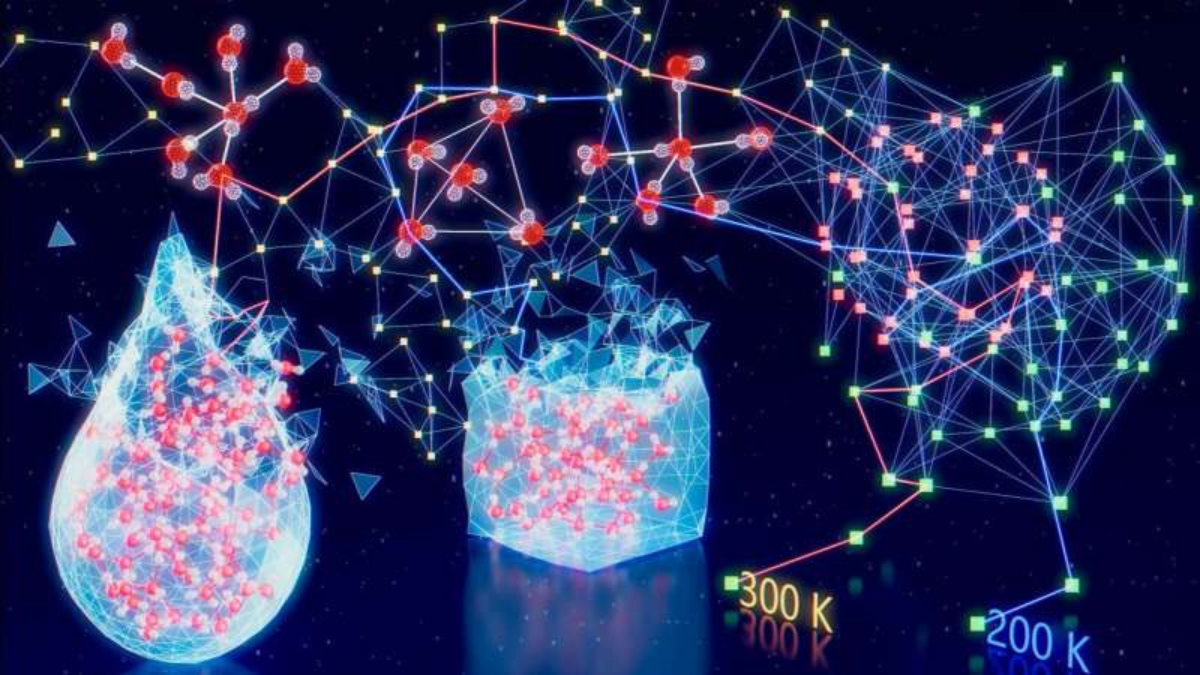
University of Osaka researchers published a July 6, 2026 Communications Chemistry paper using machine learning to evaluate 16 structural descriptors for supercooled water. The study trains neural-network temperature classifiers on molecular-dynamics snapshots, then uses explainable AI to test which descriptors capture temperature-dependent structural change. For AI and computational-chemistry practitioners, the value is a benchmark-style framework: instead of choosing hand-built descriptors by tradition, teams can compare whether descriptors separate high-density and low-density liquid-like states and whether the learned signal matches physical interpretation. The result is niche, but useful for simulation-driven ML workflows where feature choice, interpretability, and reproducibility decide whether a model teaches chemistry or merely fits artifacts.
This is a methods-and-interpretability story for computational chemistry. The LDS angle is that machine learning is being used as an audit tool for scientific descriptors: it tests whether features used in molecular simulation actually carry the structural signal researchers think they carry. That is directly relevant to ML practitioners who build models on top of domain-specific hand-crafted features.
What happened
A University of Osaka team published a Communications Chemistry article on July 6, 2026 titled "Machine learning evaluation of structural descriptors for supercooled water." The paper evaluates 16 previously proposed structural descriptors for supercooled water using neural-network-based temperature classification. Asia Research News and ARY News summarized the work as an AI-assisted framework for comparing structural descriptors in a unified way.
Technical context
The paper focuses on supercooled water, where local structure is often discussed through high-density and low-density liquid-like arrangements, tetrahedral order, local density, and hydrogen-bond network metrics. The authors use molecular-dynamics snapshots and train a fully connected neural network to distinguish temperatures from descriptor values. They then apply LIME-style explainable AI to examine whether the model's decisions align with physically meaningful structural changes.
For practitioners
The useful pattern is descriptor benchmarking. When a scientific ML pipeline depends on hand-built features, teams can treat prediction performance and local explanations as checks on whether the feature captures a real domain signal. That does not remove the need for physical validation, but it can make feature selection more systematic and less dependent on isolated prior practice.
What to watch
Look for code, simulation inputs, and supplementary material that make the descriptor ranking reproducible. The next step would be testing whether the same framework transfers across force fields, pressure regimes, and other liquids where descriptor choice shapes downstream ML conclusions.
Key Points
- 1The paper uses neural-network temperature classification to compare 16 structural descriptors for supercooled water simulations.
- 2Explainable AI is used as a check on whether learned descriptor signals match physically meaningful structural changes.
- 3Practitioners can reuse this pattern to audit feature selection in simulation-driven scientific machine-learning pipelines before downstream modeling.
Scoring Rationale
This is a specialized research-methods result with clear ML interpretability relevance for computational chemistry. The score rises modestly because the original paper and preprint are now attached, but the impact remains niche rather than broadly industry-moving.
Sources
Public references used for this report.
Practice with real Ad Tech data
90 SQL & Python problems · 15 industry datasets
250 free problems · No credit card
See all Ad Tech problems