Researchers build FEDE brain twin recreating toddler brain activity
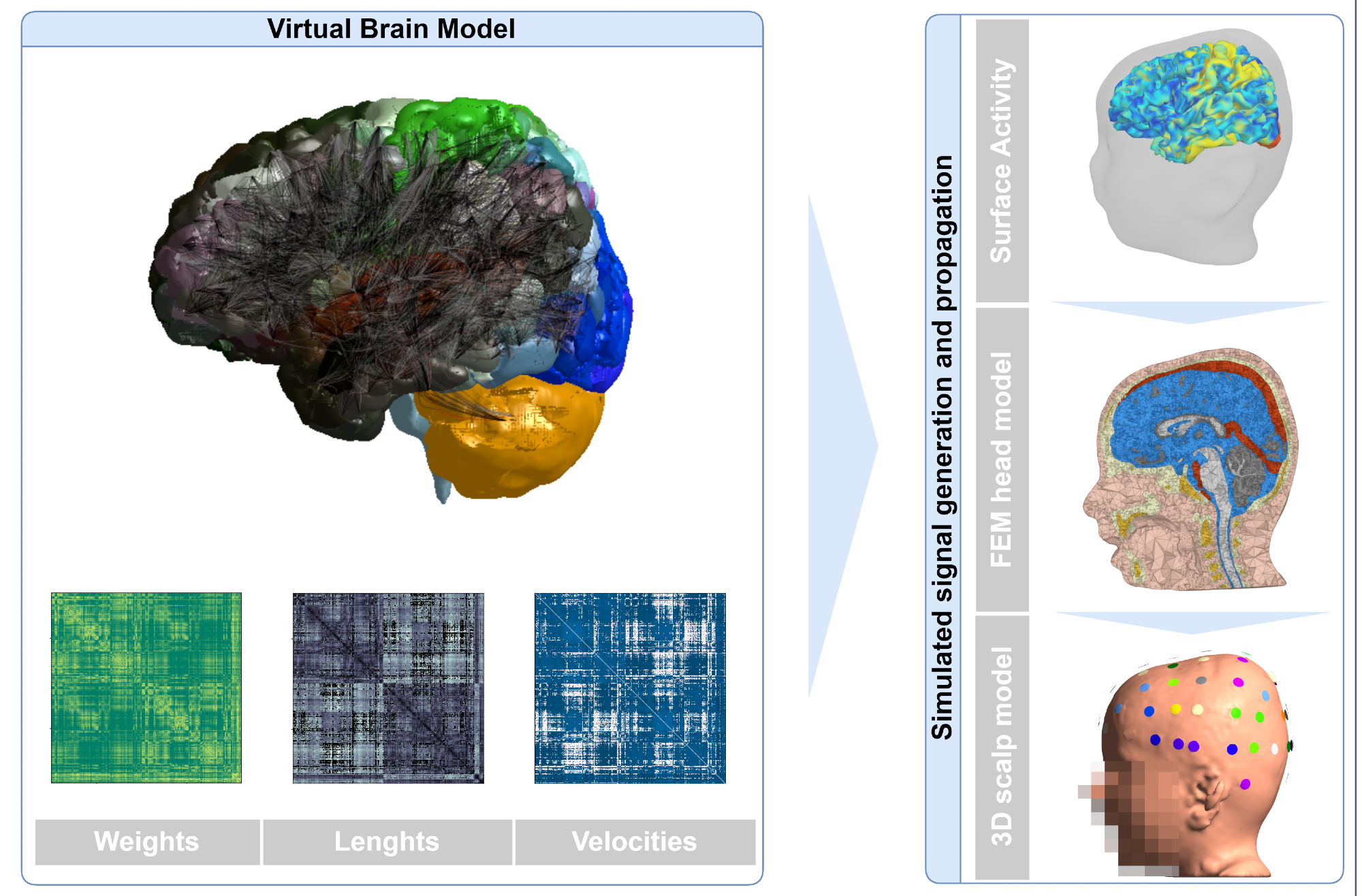
Researchers developed FEDE (high FidElity Digital brain modEl), a computational pipeline that combines three MRI modalities with finite-element biophysical simulation to build patient-specific virtual brain models. Published in PLOS Digital Health, the study demonstrated the approach by constructing what the authors describe as the first brain digital twin of a toddler (age 2.4) with autism spectrum disorder (ASD). The model closely replicated EEG recordings of the child's brain activity and estimated patient-specific alterations in excitatory-to-inhibitory (E/I) signaling - approximately three times the level seen in a healthy brain - consistent with known ASD pathophysiology. Because the study involved a single patient with no control group, the ASD-related findings are proof-of-concept hypotheses. If validated in larger studies, FEDE could support individualized modeling of brain disorders and inform precision medicine approaches to developmental conditions.
What FEDE Does
The FEDE (high FidElity Digital brain modEl) pipeline generates anatomically precise brain digital twins from imaging data. It integrates three MRI modalities - T1-weighted, T2-weighted, and diffusion-weighted imaging (DWI) - with the finite-element method (FEM) to reconstruct brain structure and simulate whole-brain neural activity in a single individualized framework. The pipeline maps cortical connectivity, nerve fiber myelination, tissue conductance, and signal transmission delays at high spatial resolution (20,484 cortical mesh vertices), using the HCPMMP1 brain atlas for region parcellation.
Application to Autism
In the study (Fabbrizzi et al., PLOS Digital Health 2026), researchers applied FEDE to build a brain digital twin of a 2.4-year-old child with ASD. They compared simulated EEG output against the child's actual resting-state EEG recordings and used parameter optimization to fit the model. The pipeline replicated both the time-frequency distribution and the spatial pattern of recorded brain activity.
Key Findings
Two patient-specific parameters required notable adjustment relative to standard models. Neural background noise had to be set approximately 100 times higher than the standard value, suggesting greater fluctuations in neural activity consistent with ASD. The excitatory-to-inhibitory (E/I) ratio was approximately three times higher than expected in a healthy brain - an imbalance associated with ASD pathophysiology. The model also predicted shorter signal transmission delays than conventional approaches, because FEDE explicitly accounts for myelination - the insulating sheath around nerve fibers that conventional models omit.
Scope and Limits
The study involved a single patient with no control group. The authors caution that the E/I imbalance and elevated noise estimates are model-derived hypotheses, not confirmed biomarkers. Toddlers present additional imaging challenges including motion artifacts and rapidly changing brain anatomy. The ASD-specific findings are explicitly described as feasibility demonstrations rather than generalizable disease markers, requiring larger and more diverse validation studies.
Relevance
If validated across larger populations, FEDE could enable individualized brain models for a range of neurological and developmental conditions, potentially supporting virtual evaluation of therapeutic strategies without invasive procedures in pediatric patients.
Key Points
- 1WHAT: FEDE is a computational pipeline combining multi-modal MRI and finite-element biophysical simulation to create individualized brain digital twins.
- 2WHY: Applied to a 2.4-year-old with ASD, the model replicated the child's EEG activity and flagged possible elevated excitatory-to-inhibitory imbalance.
- 3SO WHAT: If validated at scale, FEDE could enable personalized brain models for developmental disorders and virtual evaluation of therapeutic strategies.
Scoring Rationale
FEDE is a methodologically notable proof-of-concept - first individualized brain digital twin of a toddler with ASD - published in a peer-reviewed journal (PLOS Digital Health). However, the study is limited to a single patient with no control group and all ASD-specific findings are model-derived hypotheses requiring larger validation; solid for computational neuroscience and digital health audiences but narrow in immediate clinical or core AI/ML practitioner impact.
Sources
Public references used for this report.
Practice interview problems based on real data
1,625 SQL & Python problems across 15 industry datasets — the exact type of data you work with.
Try 250 free problems