RAG Frameworks Expand Capabilities for Production Generative AI
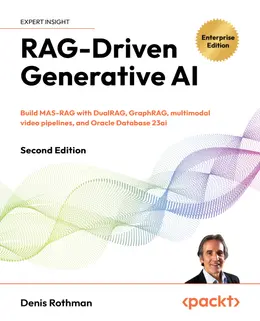
A new second edition eBook, RAG-Driven Generative AI, 2nd Edition, publishes a 430-page practical playbook for production retrieval-augmented generation. The book focuses on building MAS-RAG (multi-agent systems for RAG) and introduces patterns and architectures such as DualRAG, GraphRAG, multimodal video pipelines, and enterprise integrations with Oracle Database 23ai. It consolidates hybrid retrieval strategies, scalable vector search, and agent orchestration for real-world data reasoning, targeting engineers deploying RAG in production. The edition emphasizes engineering tradeoffs: latency versus recall, chunking and re-ranking strategies, and system-level components required for robust, multimodal retrieval and generation pipelines.
What happened
The second edition of the eBook RAG-Driven Generative AI released as a 430-page practical manual on April 17, 2026. It codifies production patterns for retrieval-augmented generation and introduces MAS-RAG as a core design, plus named architectures DualRAG and GraphRAG, multimodal video pipelines, and integration patterns with Oracle Database 23ai.
Technical details
The book centers on hybrid retrieval models that combine sparse and dense methods to balance precision and latency. MAS-RAG frames RAG as a multi-agent orchestration problem where specialized retrieval agents handle domain, modality, and temporal retrieval. DualRAG appears to be a dual-retriever pattern that separates a high-recall candidate retriever from a precision-focused re-ranker. GraphRAG integrates knowledge graph traversal with vector search to enable structured reasoning and provenance. The multimedia sections describe pipelines for video: chunking frames and audio, producing temporal embeddings, caption-first indexing, and late fusion during generation. The Oracle integration covers using Oracle Database 23ai as an enterprise vector store and hybrid index, plus patterns for transactional metadata, ACL enforcement, and secure retrieval.
- •MAS-RAG for agentized retrieval and reasoning
- •DualRAG pattern: recall retriever plus precision re-ranker
- •GraphRAG for graph-augmented retrieval and provenance
- •Multimodal video pipeline steps: chunk, embed, index, re-rank, fuse
- •Enterprise integration patterns with Oracle Database 23ai
Context and significance
This edition consolidates several converging trends: the operationalization of RAG for real-world SLAs, the rise of agent architectures to decompose retrieval and reasoning, and the need for multimodal indexing as video and audio data become first-class sources. It maps tactical engineering tradeoffs practitioners face: embedding dimensionality, index choice (FAISS/Milvus/managed DB), sharding and caching strategies, and orchestrating agent workflows for latency-sensitive applications.
What to watch
Practitioners should evaluate reproducibility of the named patterns and benchmark DualRAG and GraphRAG claims on their own data. Watch for vendor implementations adopting the same patterns, and for early case studies showing measurable improvements in recall, latency, and provenance when combining graph and vector methods.
Key Points
- 1MAS-RAG reframes RAG as multi-agent orchestration, improving modularity and control over retrieval and reasoning stages.
- 2DualRAG splits candidate retrieval and precision re-ranking, enabling higher recall while containing generation latency and cost.
- 3GraphRAG fuses knowledge graphs with vector search to add provenance and structured reasoning, useful for regulated enterprise deployments.
Scoring Rationale
Practical consolidation of RAG engineering patterns is useful for practitioners but not a research breakthrough. The book packages operational architectures and enterprise integrations that help teams deploy robust RAG pipelines.
Practice with real FinTech & Trading data
90 SQL & Python problems · 15 industry datasets
250 free problems · No credit card
See all FinTech & Trading problems