Qutwo Raises €25M to Fuel Quantum-AI Orchestration
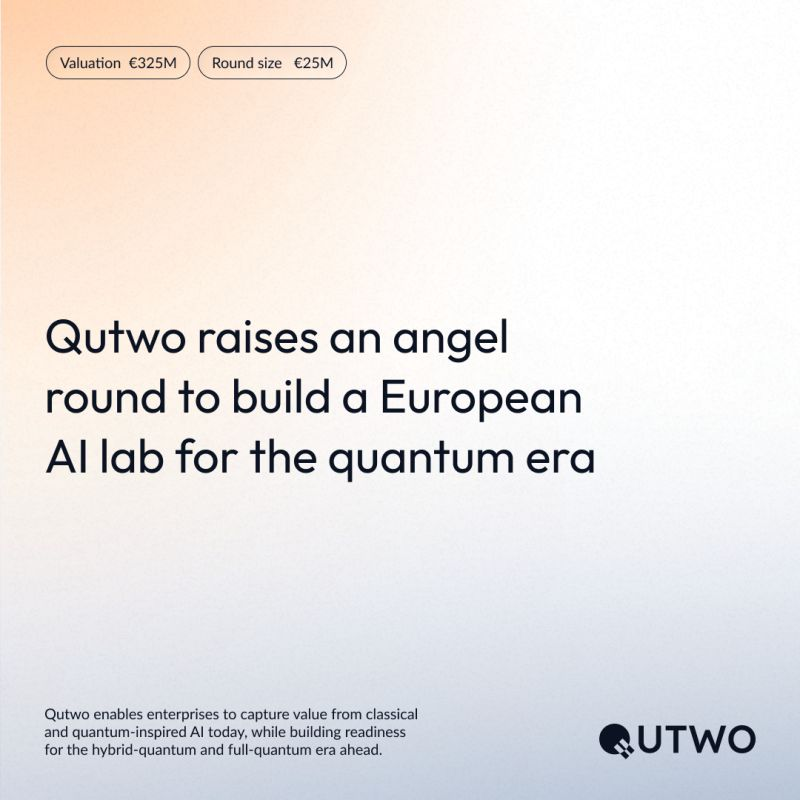
Qutwo, a Helsinki-based AI and quantum software startup founded by Peter Sarlin, raised €25 million in an angel round at a €325 million post-money valuation, according to Quantum Computing Report and N24. The company launched in February 2026, and reporting describes Qutwo OS as an orchestration layer that routes workloads across classical, quantum-inspired, and future quantum hardware, per TechCrunch and Quantum Computing Report. Reporting by Quantum Computing Report and N24 states Qutwo secured over €20 million in contracted design partnerships within two months, including work with fashion retailer Zalando and financial firm OP Pohjola. N24 and Quantum Computing Report also report the board and team include former Silo AI and IQM leaders such as Kaj-Mikael Bjork, Kuan Yen Tan, and Pekka Lundmark.
What happened
Qutwo, a Helsinki-based startup founded by Peter Sarlin, raised €25 million in an angel funding round at an approximate €325 million post-money valuation, as reported by Quantum Computing Report and N24. The company publicly launched in February 2026, and reporting by TechCrunch and Quantum Computing Report describes its flagship product as Qutwo OS, an orchestration layer designed to manage AI workloads across classical, quantum-inspired, and emerging quantum hardware. Quantum Computing Report and N24 state Qutwo secured more than €20 million in contracted design partnerships within two months of launch, with reported customers and pilots including Zalando and OP Pohjola.
Technical details
Context and significance
Multiple outlets, including TNW and TechCrunch, highlight that the valuation and pace of deals are notable because Qutwo has limited or no shipping quantum hardware, and reporting notes early enterprise traction. Reported investor interest and a founder with a prior exit (Silo AI sold to AMD in 2024, per TNW) are framed in coverage as drivers of investor confidence. Sources also report the company is developing Miles, an open-source tool for large-scale reinforcement learning, and that N24 says the new capital will be used to expand Qutwo OS features and managed inference services.
What to watch
For practitioners
Observers should track:
- •whether reported contracted revenue converts into recurring, production-grade deployments
- •demonstrations of quantum-inspired or hybrid workflows delivering measurable cost, time, or quality improvements versus tuned classical baselines
- •adoption and community uptake of the reported open-source project Miles
- •partnerships or integrations with cloud and hardware vendors that would make hybrid routing operational at enterprise scale. Coverage to date from Quantum Computing Report, TechCrunch, TNW, and N24 provides the current public evidence for these signals
Editorial analysis - technical context
Public coverage frames Qutwo OS as a middleware layer that classifies, routes, and optimises workloads between conventional GPUs/CPUs and quantum or quantum-inspired solvers. Sources note the company emphasizes "quantum-inspired" approaches that run on classical high-performance hardware such as Nvidia and AMD today, while maintaining an architecture intended to support future quantum processors, per Quantum Computing Report and TechCrunch. This approach aligns with broader industry patterns where hybrid orchestration and simulator tooling are used to make near-term progress without waiting for utility-scale quantum hardware.
The reported architecture and emphasis on quantum-inspired methods make commercial sense as a transitional product strategy: enterprises can obtain performance or modeling gains on available hardware while maintaining options for future quantum accelerators. The orchestration layer model reduces lock-in to a single hardware paradigm and creates a product focus on routing, compatibility, and developer ergonomics rather than on proprietary qubit-level IP.
Industry context
Qutwo joins a field of quantum software vendors and orchestration projects aiming to bridge current ML infrastructure with anticipated quantum accelerators. For infrastructure teams, the signal to monitor is not just headline valuation but whether engineering resources and open-source engagement convert early pilots into repeatable, observable production outcomes.
What's next
Follow-on reporting should clarify: how contracted design partnerships translate into recurring revenue; benchmarks or case studies that compare quantum-inspired workflows to tuned classical baselines; the release cadence and community uptake for Miles; and any announced integrations with cloud providers or hardware vendors that would make hybrid routing operational.
Bottom line
Qutwo has attracted significant angel funding and reported commercial pilots, and public coverage positions the company as building an orchestration layer to help enterprises prepare for hybrid classical/quantum workflows.
Why it matters
Enterprises planning long-term infrastructure need patterns and tools to manage heterogeneous compute. Qutwo's reported approach reflects an industry tack of using quantum-inspired software to capture near-term benefits while leaving the path open for future quantum hardware.
Key Points
- 1Founder-track record matters: startups led by repeat founders attract outsized angel valuations, speeding early commercial traction for infrastructure plays.
- 2Hybrid orchestration is pragmatic: enterprises and vendors adopt quantum-inspired software to capture near-term gains while remaining hardware-agnostic.
- 3Open-source tooling and early design partnerships are common levers for commercialising complex infrastructure products before hardware maturity.
Scoring Rationale
This story matters to practitioners because it highlights an enterprise-focused orchestration approach that bridges current GPU/CPU infrastructure and future quantum hardware, backed by notable capital and commercial pilots. The development is notable for infrastructure planning but not a model or hardware breakthrough.
Sources
Public references used for this report.
View 5 more sources
- Silo AI Founder Secures €25M for Quantum-AI Integration - N24n24.com.tr
- Peter Sarlin's QuTwo reaches $380M valuation in angel roundtechbuzz.ai
- Finland AI Startups, Investors & Funding (2026)startuphub.ai
- QuTwo Valuation Hits $380M in Angel Round: Peter Sarlin's ...mexc.com
- Founder Angel Rounds for Quantum AI: €25M Qutwo Deal | 2026angelinvestorsnetwork.com
Practice interview problems based on real data
1,625 SQL & Python problems across 15 industry datasets — the exact type of data you work with.
Try 250 free problems