Python blueprint automates daily project summaries
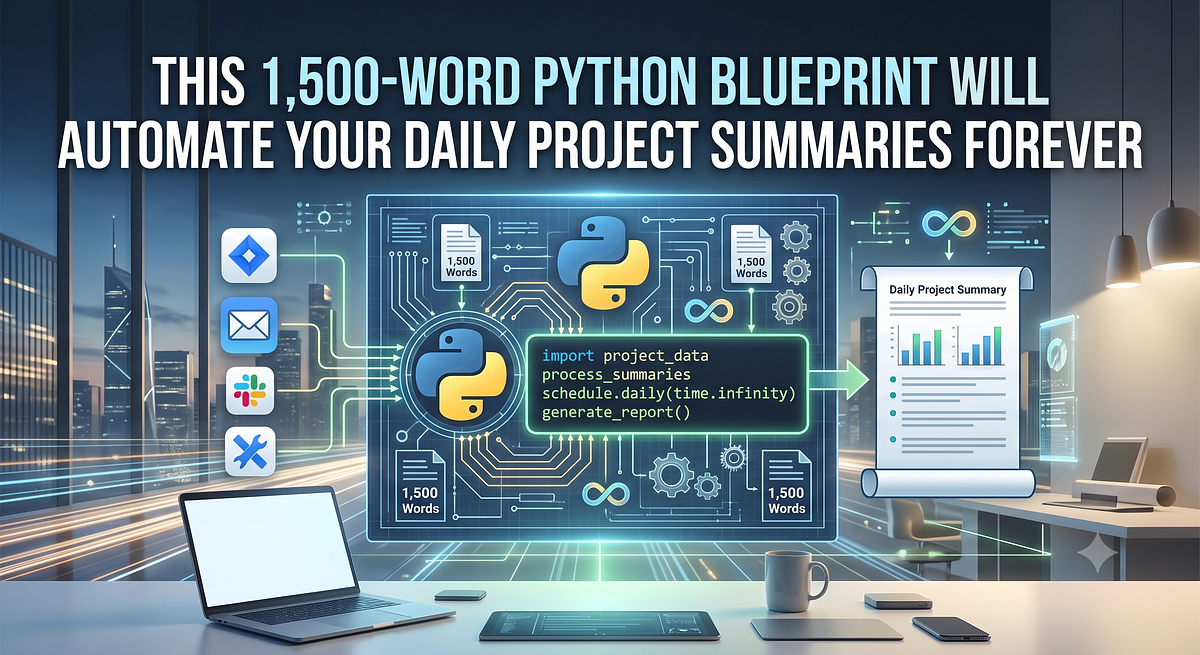
How To Profit AI published a July 10, 2026 Python guide for building an asynchronous agent that turns Slack, Jira, and email updates into daily project summaries. The guide says the pipeline pulls updates from multiple work systems, normalizes noisy context, and produces a concise briefing instead of forcing engineers or managers to inspect each tool separately. For practitioners, the useful pattern is less the blog's marketing promise than the architecture: separate connectors, async collection, deduplication, and a final summarization step that can be audited before it reaches a team channel. Because the article is a tutorial rather than a product launch, teams should treat it as a build blueprint and still add authentication, rate limits, source citations, and review controls before using it on real project data.
Daily status automation is most useful when it reduces tool-switching without turning private project systems into an unverifiable summary box. The LDS takeaway is that this pattern should be treated as a controlled ingestion workflow: collect narrow context, preserve links back to source records, and make the final generated summary reviewable before it reaches a team.
What happened
How To Profit AI published a July 10, 2026 tutorial that describes a Python context-aggregation agent for daily project summaries. The guide says the workflow pulls updates from Slack, Jira, and email, then uses asynchronous collection and summarization to turn scattered status signals into a single briefing.
Technical context
The useful engineering idea is not the headline promise but the pipeline shape. A production version would separate connectors for each system, use asyncio or equivalent scheduling to avoid slow serial polling, normalize duplicate or low-value updates, and keep source references so a generated summary can be checked against the underlying tickets or messages.
For practitioners
Treat the blueprint as a starting pattern, not a drop-in internal reporting system. Real deployments need scoped credentials, rate-limit handling, data-retention rules, prompt injection checks for user-generated messages, and a review path before summaries are sent to a broader team channel.
What to watch
The build-versus-buy question matters because adjacent tools already offer Jira or Slack summary workflows. A custom Python agent is most defensible when teams need cross-system context, traceable citations, or local control that packaged Jira and Slack assistants do not provide.
A safe implementation should treat Slack messages, ticket descriptions, and email as untrusted input. Those records can contain misleading instructions, sensitive data, or text that tries to redirect an agent. Connectors should retrieve only the fields needed for the briefing, and the summarizer should not inherit broad write permissions from collection credentials. Output should include links or identifiers that let a reviewer trace each status claim back to its source.
Operationally, teams should define what happens when one connector fails or returns stale data. A briefing that silently omits Jira or repeats yesterday's email can look complete while being wrong. Freshness timestamps, partial-data warnings, deduplication rules, and a final human review are more important than making the prose sound polished. Packaged tools may cover a single system well; a custom agent earns its complexity only when cross-system context and local control are genuinely required.
Key Points
- 1The guide describes a Python agent that collects Slack, Jira, and email updates before generating a daily project briefing.
- 2Its useful pattern is asynchronous context aggregation, with separate connectors and cleanup before the final summarization step.
- 3Teams should add permissions, source links, and human review before applying the blueprint to real project data.
Scoring Rationale
Useful practitioner tutorial for automating project-status aggregation across common work systems, but it is a single-source how-to rather than a platform release, research result, or market-moving deployment. The impact remains solid for engineers experimenting with agentic workflow automation, with high-stakes claims intentionally kept modest.
Sources
Public references used for this report.
Practice interview problems based on real data
1,625 SQL & Python problems across 15 industry datasets — the exact type of data you work with.
Try 250 free problems