Pompeii Archaeologists Use AI to Reconstruct Victim
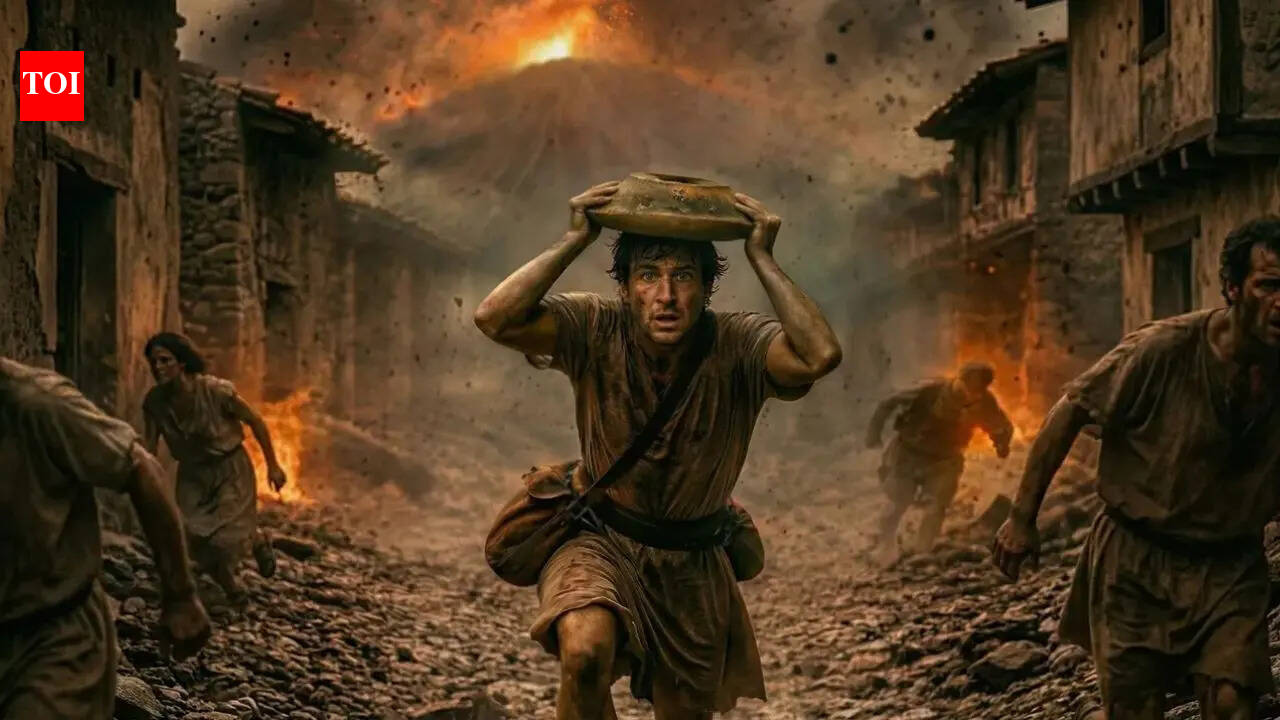
Italian archaeologists used artificial intelligence to generate a digital image of a man who died in the AD 79 eruption of Mount Vesuvius, the Pompeii Archaeological Park released on April 27, 2026, Reuters reports. The reconstruction is based on newly discovered remains of an adult male found just outside one of Pompeii's southern gates, lying next to a fractured terracotta mortar he appears to have used as a shield, according to Reuters and AP. The park reported the man was carrying an oil lamp and 10 bronze coins; archaeologists interpret the pose as an attempt to escape while protecting his head from falling lapilli (small volcanic stones) (AP, Reuters). Pompeii park director Gabriel Zuchtriegel is quoted calling AI a potential catalyst for renewing classical studies (Reuters).
What happened
Italian archaeologists used artificial intelligence to generate a lifelike image of a Pompeii victim, the Pompeii Archaeological Park released on April 27, 2026 (Reuters, AP). The AI-generated image depicts a man ducking while holding a large bowl or terracotta mortar above his head with Mount Vesuvius aflame in the background; Reuters and JPost report the image was produced by the park in collaboration with the University of Padua. The reconstruction is grounded in the recent discovery of skeletal remains of an adult male found just outside one of Pompeii's southern gates; the remains were found next to a fractured terracotta mortar, an oil lamp and 10 bronze coins, the park said, as reported by Reuters and AP. Archaeologists quoted in coverage interpret the finds as consistent with death from a heavy fall of lapilli during the second day of the eruption (Euronews, ABC News, Reuters).
Technical details
Reporting describes the portrait as the product of archaeological survey data combined with digital imaging techniques and artificial intelligence to translate skeletal and contextual data into a realistic human likeness (ABC News, Reuters, AP). None of the sources specify which AI model, framework, or prompt chain was used. The Pompeii Archaeological Park and the University of Padua are identified as project collaborators in multiple reports (AP, Euronews).
Editorial analysis - technical context
Industry-pattern observations: Cultural-heritage teams increasingly combine photogrammetry, 3D scanning, and generative image tools to create public-facing reconstructions. Projects that blend measured archaeological data with generative techniques typically face trade-offs between visual realism and evidentiary transparency; practitioners normally document source inputs, processing steps, and uncertainty bounds so viewers can distinguish direct archaeological evidence from artistic inference. This Pompeii case follows that pattern of coupling detailed excavation data with AI-enabled image synthesis to communicate context to non-specialist audiences.
Context and significance
Industry context: The use of AI at a high-profile site like Pompeii matters for two audiences. For cultural-heritage professionals, the approach signals growing acceptance of generative tools as outreach and interpretive aids, subject to debates about accuracy and ethics of representation. For ML practitioners, the project is another demonstration of applied multimodal pipelines where structured archaeological metadata and imagery are converted into consumer-facing visuals. Coverage also emphasizes public engagement: Pompeii is a UNESCO World Heritage site and recorded 4.3 million visitors in 2024, a statistic cited in Reuters and JPost that contextualizes why visual reconstructions attract attention.
What to watch
For observers, key indicators include publication of a technical appendix detailing data inputs, processing pipeline, and model provenance; current reporting does not disclose model names or parameter settings (AP, Reuters). Industry observers will also look for documentation practices that delineate which facial features are supported by osteological evidence versus those that are artistically inferred. Finally, responses from peer archaeologists and heritage bodies will indicate evolving professional norms for AI-assisted reconstructions.
Reported quote
Reuters and AP both cite Pompeii park director Gabriel Zuchtriegel: "If used well, artificial intelligence can contribute to a renewal of classical studies, illustrating the classical world in a more immersive way," (Reuters, AP).
Key Points
- 1Pompeii Archaeological Park used AI to produce a portrait from recently excavated remains, showing increased adoption of generative tools in heritage reporting.
- 2Media reports emphasize archaeological context, fractured terracotta mortar, oil lamp, and 10 bronze coins, as the empirical basis for the reconstruction.
- 3Industry observers will watch for published provenance and documentation to separate measured osteological evidence from AI-driven artistic inference.
Scoring Rationale
This is a notable application of generative AI in cultural heritage with clear relevance for digital-archaeology workflows and public engagement. It does not introduce a new model or technical advance, but it illustrates practical integration of AI and excavation data for practitioners.
Sources
Public references used for this report.
View 9 more sources
- Archaeologists at Pompeii use AI to reveal the face of a victim trying to flee the Mount Vesuvius eruptioncbsnews.com
- Pompeii escape: AI reconstructs the last gesture of an eruption victimeuronews.com
- Artificial intelligence reveals face of Pompeii eruption victimindy100.com
- Pompeii archaeologists use AI to reconstruct face of man who died during volcano eruptionnews.sky.com
- Archaeologists at Pompeii use AI to reconstruct the face of a man killed in the volcano's eruptionyahoo.com
- Pompeii, artificial intelligence reconstructs for the first time the escape of an eruption victimfinestresullarte.info
- Pompeii researchers use AI to create stunning digital portrait of ...nypost.com
- Archaeologists use AI to reconstruct Pompeii victim's attempted ...independent.co.uk
- AI recreates face of Pompeii eruption victim for first time - MSNmsn.com
Practice interview problems based on real data
1,625 SQL & Python problems across 15 industry datasets — the exact type of data you work with.
Try 250 free problems